 Hire Compass HQ
What It's Really Like to Work as a Paramedic
A shift-by-shift look at a 24-hour ambulance tour, from rig checks and cardiac calls to decontamination, paperwork in the cab and broken sleep.
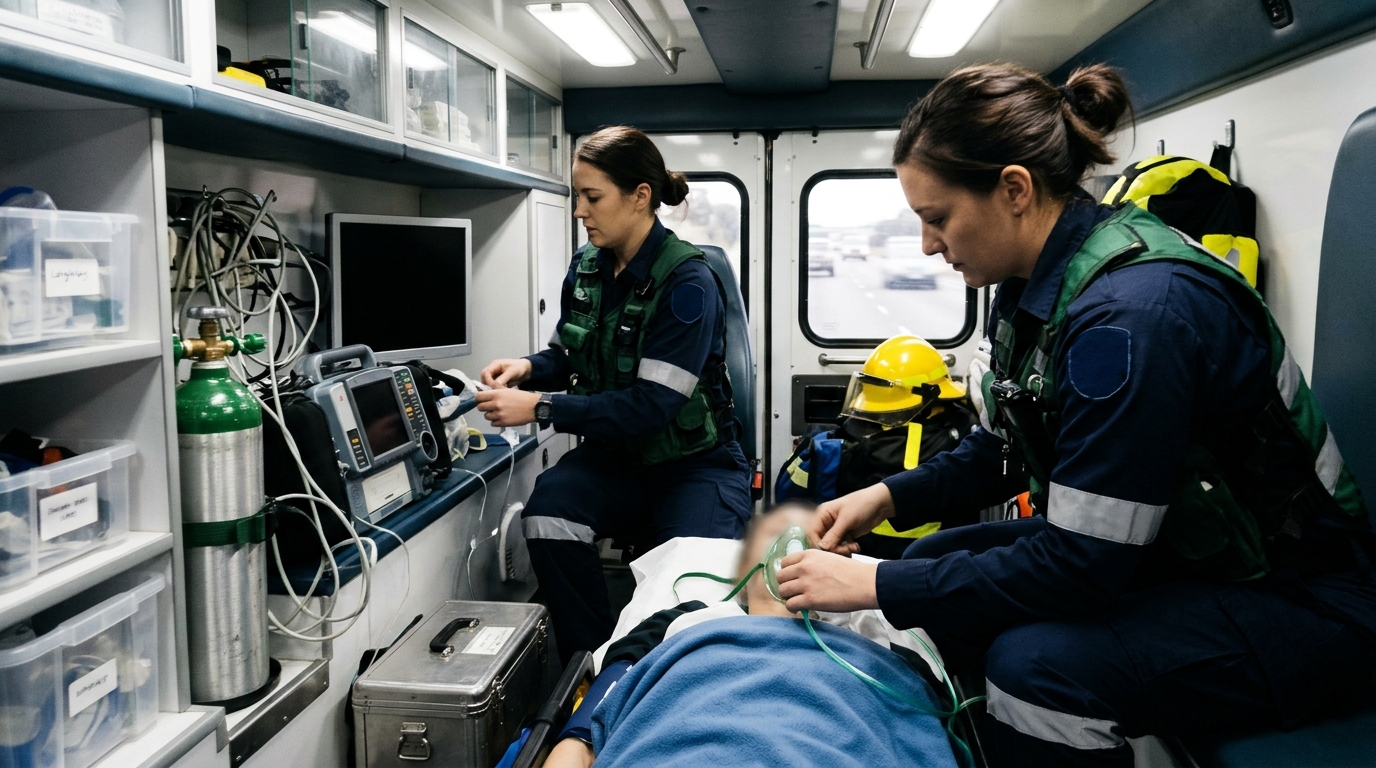
Working as a paramedic means responding to calls, assessing patients, providing treatment from first aid through advanced life support, moving and transporting patients, documenting and reporting what you found, and cleaning and restocking equipment afterwards (U.S. Bureau of Labor Statistics, 2026-08-27). Between calls you wait, in a station or parked at a street corner post, which is why the job feels like long stretches of nothing broken by twenty minutes where a mistake matters badly.
Most paramedics work full time, and schedules routinely include nights, weekends and holidays; some shifts run 12, 18 or 24 hours (U.S. Bureau of Labor Statistics, 2026-08-27). The tour below is a 24-hour shift at a busy urban service — one common pattern, not the only one.
Hour-by-Hour Schedule
Call volume, posting policy and station chores vary by employer and by whether the service is fire-based, hospital-based or private.
- 6:45 AM - Handover. Take report from the off-going crew: what broke overnight, which drug box was opened, whether the stretcher battery held charge.
- 7:05 AM - Rig check. Daily checklist: seals on the controlled-drug pouch, two narcotic counts with your partner, monitor-defibrillator self-test, oxygen pressure, suction, two airway bags, fuel.
- 7:50 AM - Chest pain call. Twelve-lead EKG within minutes of patient contact, IV access, history, medication list photographed, tracing transmitted ahead to the receiving hospital.
- 8:35 AM - Hospital handoff. Verbal report to the triage nurse, stretcher stripped and remade, supplies replaced from the hospital's EMS room.
- 9:10 AM - Documentation in the cab. Finish the patient care report before the next call: times, vitals, interventions, the patient's own words about the pain (U.S. Bureau of Labor Statistics, 2026-08-27).
- 10:30 AM - Posting. Park at an assigned corner and wait. Eat standing up, work through a continuing-education module for recertification.
- 12:15 PM - Lift assist at a care home. A resident down between a bed and a wall: twenty minutes of kneeling and bending before anyone touches a monitor.
- 2:00 PM - Decontamination. A suspected contagious respiratory infection means wiping every interior surface, bagging linens and sitting out of service until it dries.
- 5:20 PM - Dinner interrupted. Highway collision, spinal motion restriction, extrication alongside the fire crew, two patients and one transport.
- 8:00 PM - Behavioral health call. Forty minutes of talking, no equipment used, a transport decision made with a family that disagrees with itself.
- 1:40 AM - Cardiac arrest. Compressions on a bedroom floor, airway, rhythm checks every two minutes, then a conversation with the family.
- 4:15 AM - Sleep attempt. Back in quarters, boots on, radio where you can find it in the dark, waiting for the tone.
The Good and the Challenging Parts
The satisfaction is usually small and concrete. A patient in a severe asthma attack who could not finish a sentence at the door is speaking normally by the time you reach triage, and you can name the drug and the dose that changed it. A cardiac arrest at 1:40 AM gets a pulse back on the third rhythm check, and three weeks later that person walks into your station. Those calls are rare enough that paramedics remember the dates.
The second is autonomy. At 3 AM in a hallway nobody senior is standing beside you: you read the EKG, pick the drug, choose the hospital. Seventy-one percent of paramedics surveyed by ONET rated the consequence of error in their job as "Extremely serious" (ONET OnLine, U.S. Department of Labor, 2026). Some people find that weight intolerable; others find it is the reason they stayed.
The frustrations are equally specific. The first is your body. Much of the shift is spent standing or moving, with considerable kneeling, bending and lifting while caring for and moving patients (U.S. Bureau of Labor Statistics, 2026-08-27). EMTs and paramedics have one of the highest rates of injuries and illnesses of all occupations (U.S. Bureau of Labor Statistics, 2026-08-27), and the injury is rarely dramatic — it is a stair chair on a narrow staircase, or a heavy patient in a bathroom with no room for a second rescuer.
The second is the shape of the week. Schedules include nights, weekends and holidays, and some paramedics work more than 40 hours a week (U.S. Bureau of Labor Statistics, 2026-08-27); 97% of those surveyed by ONET reported typical weeks longer than 40 hours (ONET OnLine, U.S. Department of Labor, 2026). Dinner gets abandoned mid-plate, sleep on a 24 is broken, and the day off is largely spent recovering it.
Third is exposure and the cleaning that follows it. Eighty-seven percent of paramedics surveyed by ONET reported exposure to disease or infections every day (ONET OnLine, U.S. Department of Labor, 2026), and after a contagious patient you decontaminate the ambulance interior and may have to report the case to the proper authorities (U.S. Bureau of Labor Statistics, 2026-08-27) — often at the end of a long night.
Tools, Equipment, and Work Environment
- Cardiac monitor-defibrillator. Used for 12-lead EKG acquisition and interpretation, a subject taught formally in paramedic programs alongside anatomy and physiology and airway management (U.S. Bureau of Labor Statistics, 2026-08-27).
- Airway kit. Laryngoscope or video laryngoscope, supraglottic airways, bag-valve mask, portable suction and end-tidal CO2 monitoring, checked at the start of every shift.
- Stretcher, stair chair and scoop. Powered cots reduce but do not remove manual lifting on staircases, in bathrooms and inside cars.
- Gloves and protective equipment every shift. Ninety percent of paramedics surveyed by ONET said they wear common protective or safety equipment such as gloves every day (ONET OnLine, U.S. Department of Labor, 2026).
- The ambulance as a workplace. Ninety percent of surveyed paramedics reported being in an enclosed vehicle or operating enclosed equipment every day (O*NET OnLine, U.S. Department of Labor, 2026) — treating patients braced against a bench seat while moving.
- Reporting and clinical software. ONET lists Microsoft Outlook for electronic mail, information retrieval software such as Epocrates, and medical and EHR software such as eClinicalWorks and MEDITECH (ONET OnLine, U.S. Department of Labor, 2026).
- Drug box and controlled substance log. Sealed, counted with a partner at handover, reconciled after any call in which it is opened.
- Station and post. Shared bunk rooms, a kitchen, a vehicle bay to mop — and on many systems, hours parked at a street corner instead of a building.
Frequently asked questions
How long is a paramedic shift?
Most EMTs and paramedics work full time, and some shifts run 12, 18 or 24 hours (U.S. Bureau of Labor Statistics, 2026-08-27). Schedules commonly include nights, weekends and holidays, and 97% of paramedics surveyed by O*NET said their typical work week is longer than 40 hours (O*NET OnLine, U.S. Department of Labor, 2026). The rotation depends on the employer: fire-based, hospital-based and private ambulance services all build schedules differently.
How hard is this on your body over time?
Much of the shift is spent standing or moving, with considerable kneeling, bending and lifting while caring for and moving patients (U.S. Bureau of Labor Statistics, 2026-08-27). EMTs and paramedics have one of the highest rates of injuries and illnesses of all occupations, and may be exposed to serious diseases and viruses such as HIV (U.S. Bureau of Labor Statistics, 2026-08-27). Lifting technique, partner coordination and powered cots tend to matter more to career length than general fitness.
Can any part of this job be done remotely?
Patient care cannot be: 90% of paramedics surveyed by O*NET reported being in an enclosed vehicle or operating enclosed equipment every day (O*NET OnLine, U.S. Department of Labor, 2026). Paramedics held about 102,200 jobs in 2025, mostly in local government excluding education and hospitals, and in ambulance services (U.S. Bureau of Labor Statistics, 2026-08-27). Dispatch, quality assurance and clinical education involve more desk time, but they are separate postings.
What do I need before working a shift like this, and where do I check pay?
Paramedic postsecondary programs typically require EMT-Intermediate certification to apply and lead to a nondegree award or associate's degree, covering anatomy and physiology, EKG interpretation and airway management plus supervised field experience (U.S. Bureau of Labor Statistics, 2026-08-27). All states require licensure in the state where you work, and requirements vary by state (U.S. Bureau of Labor Statistics, 2026-08-27); the National Registry of Emergency Medical Technicians' state-licensed pathway requires at least an EMT license, a CAAHEP-accredited paramedic program, a current state paramedic license and a pass on the National Registry Paramedic exam. Employers typically require a driver's license and may prefer ambulance driver certification; for pay, check the BLS Occupational Outlook Handbook and OEWS tables, which report a median annual wage for paramedics for May 2025.
Sources
- U.S. Bureau of Labor Statistics — EMTs and Paramedics : Occupational Outlook Handbook (2026-08-27)
- O*NET OnLine (U.S. Department of Labor) — 29-2043.00 - Paramedics (2026)

Written by
Desmond writes about the mechanics of job hunting — resumes, interviews, the strange rituals of being evaluated by strangers. He's drawn to the gap between how hiring is supposed to work and how it actually happens.