 Hire Compass HQ
How to Become a Veterinary Technician: Step-by-Step Guide
Find out whether animal restraint, anesthesia monitoring and in-house lab work suit you, and what the accredited-program-plus-VTNE route really asks of you.
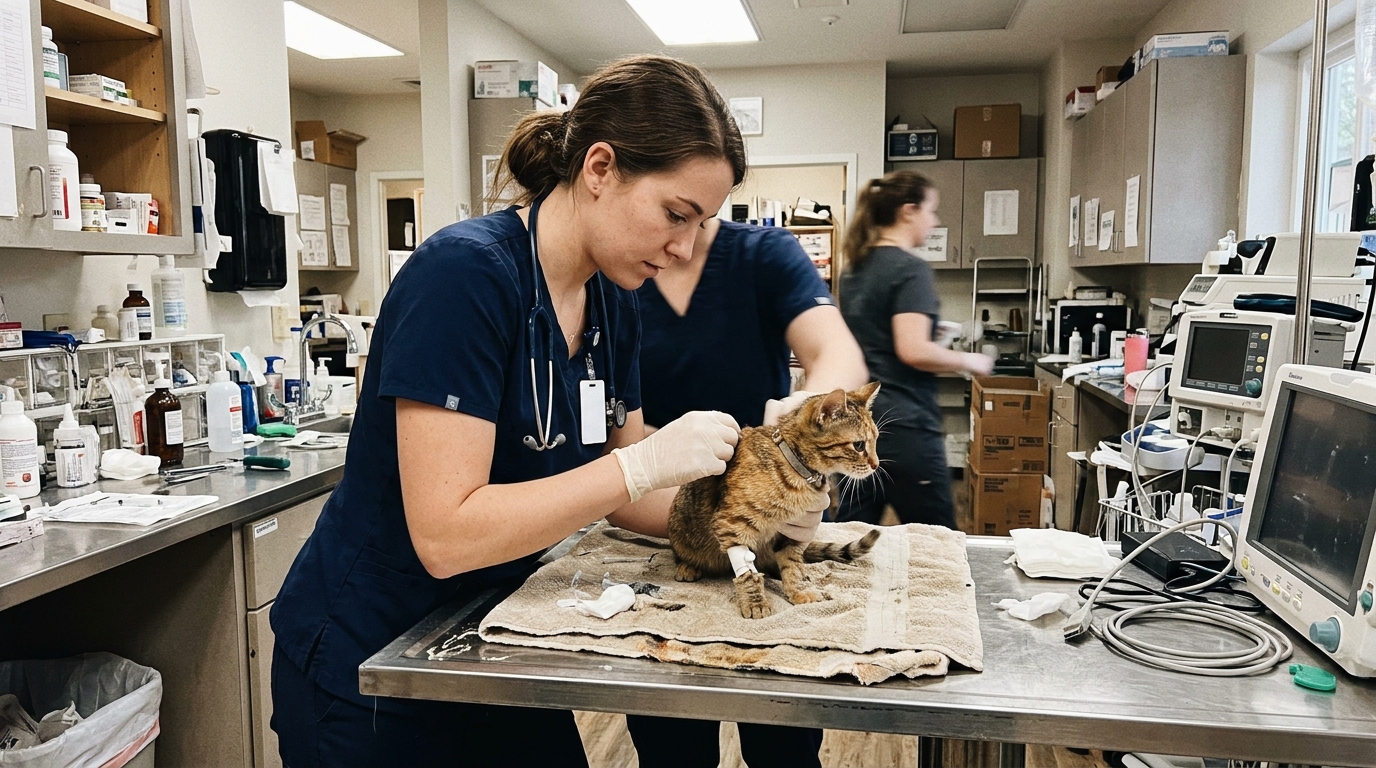
Becoming a veterinary technician means graduating from a veterinary technology program accredited by the AVMA Committee on Veterinary Technician Education and Activities (CVTEA) — most often a two-year associate's degree — then passing the Veterinary Technician National Examination (VTNE) and applying to your state for credentialing. The U.S. Bureau of Labor Statistics lists an associate's degree as the typical entry-level education for the occupation (2025), and most states require an exam before you can be registered, licensed or certified (U.S. Bureau of Labor Statistics, 2025).
The work is hands-on: restraining animals during exams, monitoring anesthesia, taking x-rays and recording case histories (U.S. Bureau of Labor Statistics, 2025). What you may call yourself, and what you must do to earn it, depends heavily on your state.
Step-by-Step Path to This Career
The credentialing route is standardised: an accredited program, then the VTNE, then your state (NAVTA).
- Spend 20-40 hours in a working clinic before you apply. Volunteer or work as a kennel or veterinary assistant. You are testing whether you can hold a frightened 70-lb dog still for a blood draw and be in the room for euthanasia and the disposal of remains, which CareerOneStop lists among the occupation's duties. Allow one to three months alongside other work.
- Clear program admission requirements. Most accredited programs expect high school biology and chemistry, a math placement, immunisation records and a background check. Retaking a science course takes about one semester (16 weeks).
- Enrol in a CVTEA-accredited program. The AVMA CVTEA maintains the list of accredited Associate in Science programs, many at community colleges, and a separate list of Bachelor of Science programs (AVMA). Associate's: 2 years full-time. Bachelor's: 4 years, and graduates are designated veterinary technologists (NAVTA). New programs are added periodically — one community college program was accredited effective September 2025 (AVMA) — so check the current list.
- Complete the clinical skills log and preceptorship. This is where you log venipuncture, IV catheter placement, dental scaling, radiographic positioning and anesthesia monitoring on live patients, usually over 8-16 weeks at the end of the program.
- Apply to take the VTNE through the AAVSB. The AAVSB owns and administers the exam: review your eligibility pathway, apply (Step 1), then schedule and sit it (Step 2) (AAVSB). Allow 4-8 weeks between applying and your test date.
- Apply to your state board for credentialing. Many states and provinces require a passing VTNE score before a technician can be credentialed (AAVSB). Depending on the state you become an RVT, LVT or CVT. Allow 2-8 weeks for processing.
- Take an entry-level post in general small-animal practice, then consider specialty certification in years three to five: a specialist spends about 75% of their time on a specific task and passes an exam from one of eleven Specialist Academies (NAVTA).
Education and Training Options Compared
Only graduation from a CVTEA-accredited program reliably makes you eligible for the VTNE, so the real choice is which accredited format fits your life.
| Path | Time | Typical Cost | Outcome |
|---|---|---|---|
| CVTEA-accredited Associate in Science at a community college | 2 years full-time | In-district per-credit tuition published by that college, across roughly 60-75 credits, plus scrubs, stethoscope and instrument kit | VTNE eligibility and the associate's degree the U.S. Bureau of Labor Statistics lists as typical entry-level education (2025) |
| CVTEA-accredited Bachelor of Science in veterinary technology | 4 years full-time | Four years of the university's published in-state or out-of-state tuition, plus housing | VTNE eligibility plus the title "Veterinary Technologist," designated for bachelor's graduates (NAVTA); the usual route into laboratory and research roles (U.S. Bureau of Labor Statistics, 2025) |
| CVTEA-accredited distance program with in-clinic preceptorship | 2-4 years part-time | Per-credit distance tuition set by the host institution, plus travel to the preceptorship site | Same VTNE eligibility while you keep an income as a veterinary assistant |
| On-the-job assistant training, no accredited program | 0 formal study | Cost of scrubs only | Paid clinic experience, but no VTNE eligibility in states requiring an accredited program, and no protected title |
The fourth row matters. Most states lack restrictions on the title "veterinary technician," and inconsistent state rules and enforcement lead to widespread misuse, according to a NAVTA report; Utah established credentialing criteria in 2020, and another 10 states limit who may use titles including "certified" veterinary technician (AVMA).
What You'll Actually Be Doing Once You Start
Your first 6-12 months are mostly patient handling, diagnostics and records. Typical duties for the occupation include observing animal behaviour and condition, nursing care and emergency first aid, restraining animals during exams, administering anesthesia and monitoring responses, taking x-rays, performing lab tests such as urinalyses and blood counts, preparing animals and instruments for surgery, giving medications and vaccines prescribed by a veterinarian, and recording case histories (U.S. Bureau of Labor Statistics, 2025).
A new technician's shift: restrain for exams and nail trims, place peripheral IV catheters, run blood chemistry and complete blood counts on the in-house analyser, read urine sediment on a microscope, position patients for digital radiographs in a lead gown, autoclave the surgical pack, scale teeth with an ultrasonic dental scaler, and type every treatment into the practice management software. You will also assist with euthanasia and the disposal of remains (CareerOneStop).
The demands are concrete: lifting dogs onto a table with a second person, standing for most of an 8-12 hour shift, risk of bites and scratches, and payment conversations that occasionally turn into verbal confrontation.
Senior staff differ: they induce and monitor anesthesia on high-risk patients, manage ICU cases overnight, train new hires and run the surgery schedule. Specialists narrow further, spending about 75% of their time on one area such as emergency and critical care, certified by one of eleven Specialist Academies (NAVTA). Separately, veterinary technologists usually work in more advanced, research-related jobs under a scientist or veterinarian, primarily in a laboratory — preparing tissue samples, for instance — while technicians generally work in private clinical practice under a licensed veterinarian (U.S. Bureau of Labor Statistics, 2025).
Costs and Time Investment
Costs attach to specific steps, and the amounts are set by different bodies — your college, the AAVSB and your state board. Get each current figure from the source named below before you commit.
| Cost item | Step | Who sets it / where to check | Time it adds |
|---|---|---|---|
| Program tuition and fees | Step 3 | The institution's published tuition schedule; find the program on the AVMA CVTEA accredited list first | 2 years (associate's) or 4 years (bachelor's) |
| Textbooks, instrument kit, scrubs, stethoscope | Step 3 | The program's required-materials list, issued at orientation | First 2 weeks of each term |
| Immunisations, background check, drug screen | Step 2 | Your program's clinical compliance office | 2-6 weeks before placement |
| Travel and unpaid hours during preceptorship | Step 4 | Your own commuting costs; sites are assigned by the program | 8-16 weeks |
| VTNE application fee | Step 5 | The AAVSB, which owns and administers the VTNE and reports scores to your state or province | 4-8 weeks to apply and schedule |
| State credentialing fee | Step 6 | Your state veterinary board; certification information by state is at CareerOneStop (U.S. Bureau of Labor Statistics, 2025) | 2-8 weeks of processing |
| Continuing education for renewal | After Step 6 | Your state board's renewal rules | Each renewal cycle |
| Specialist Academy exam fee | Step 7 | One of the eleven Specialist Academies (NAVTA) | Years 3-5 of practice |
Common Entry Mistakes to Avoid
- Enrolling in a program that is not CVTEA-accredited (Step 3). Fix: before paying a deposit, find the exact program name on the AVMA CVTEA Associate in Science or Bachelor of Science list and confirm accreditation is current — programs are added over time, including one effective September 2025 (AVMA).
- Applying for the VTNE before checking your eligibility pathway (Step 5). Fix: the AAVSB process starts with reviewing your eligibility pathway, then applying (Step 1), then scheduling and sitting the exam (Step 2). Work through those in order rather than paying first.
- Assuming your credential moves with you to another state (Step 6). Fix: each state regulates the occupation differently (U.S. Bureau of Labor Statistics, 2025), so ask the receiving state's board what it accepts before you sign a lease — and note that most states do not restrict the plain title "veterinary technician" at all (AVMA).
- Treating assistant experience as equivalent to the degree (Step 1 vs Step 3). Fix: use assistant work to confirm you can handle restraint and euthanasia appointments, then still complete the accredited program the BLS lists as typical entry-level education (2025).
- Coasting through the preceptorship skills log (Step 4). Fix: record every venipuncture, catheter placement, radiograph and anesthetic case as you go; hiring managers ask what you have done unsupervised, and the log doubles as your VTNE revision map.
Frequently asked questions
How long does it take from starting school to working as a credentialed technician?
About two and a half years on the associate's route: 2 years full-time in an AVMA CVTEA-accredited program, 4-8 weeks to apply for and schedule the VTNE through the AAVSB, and 2-8 weeks for your state board to process the credential. The bachelor's route takes 4 years and leads to the title veterinary technologist (NAVTA). Part-time and distance students should plan on 3-4 years.
Does the VTNE transfer if I move to another state?
The AAVSB owns the VTNE and provides your score to the state or province where you plan to practice (AAVSB), so the exam is portable, but the credential is not automatic. Each state regulates the occupation differently (U.S. Bureau of Labor Statistics, 2025), and title protection is uneven — Utah established credentialing criteria in 2020 and another 10 states limit who can use titles including "certified" veterinary technician (AVMA). Contact the new state's board before you move; CareerOneStop lists certification information by state.
Can I do this job without a degree?
You can work as a veterinary assistant, but not as a credentialed technician in states that require graduation from an accredited program plus an exam. The BLS lists an associate's degree as the typical entry-level education for veterinary technologists and technicians (2025), and 26% of O*NET survey respondents for the occupation said a two-year degree is required. Technologists usually need the 4-year bachelor's degree (U.S. Bureau of Labor Statistics, 2025).
What do the job numbers look like?
The median annual wage for veterinary technologists and technicians was $47,380 in May 2025, equivalent to $22.78 per hour (U.S. Bureau of Labor Statistics, 2025). Employment is projected to grow much faster than the average for all occupations from 2025 to 2035, with a projected employment change of 12,300 and about 13,400 openings each year (U.S. Bureau of Labor Statistics, 2025). Pay varies by employer and region, so check current local postings alongside the national figure.
Sources
- U.S. Bureau of Labor Statistics — Veterinary Technologists and Technicians : Occupational Outlook Handbook (2025)
- American Association of Veterinary State Boards (AAVSB) — AAVSB - American Association of Veterinary State Boards

Written by
Desmond writes about the mechanics of job hunting — resumes, interviews, the strange rituals of being evaluated by strangers. He's drawn to the gap between how hiring is supposed to work and how it actually happens.