 Hire Compass HQ
How to Become a Paralegal: Step-by-Step Guide
Paralegals draft pleadings, track discovery deadlines and run document reviews — here is the training, credential and first-job route into the work.
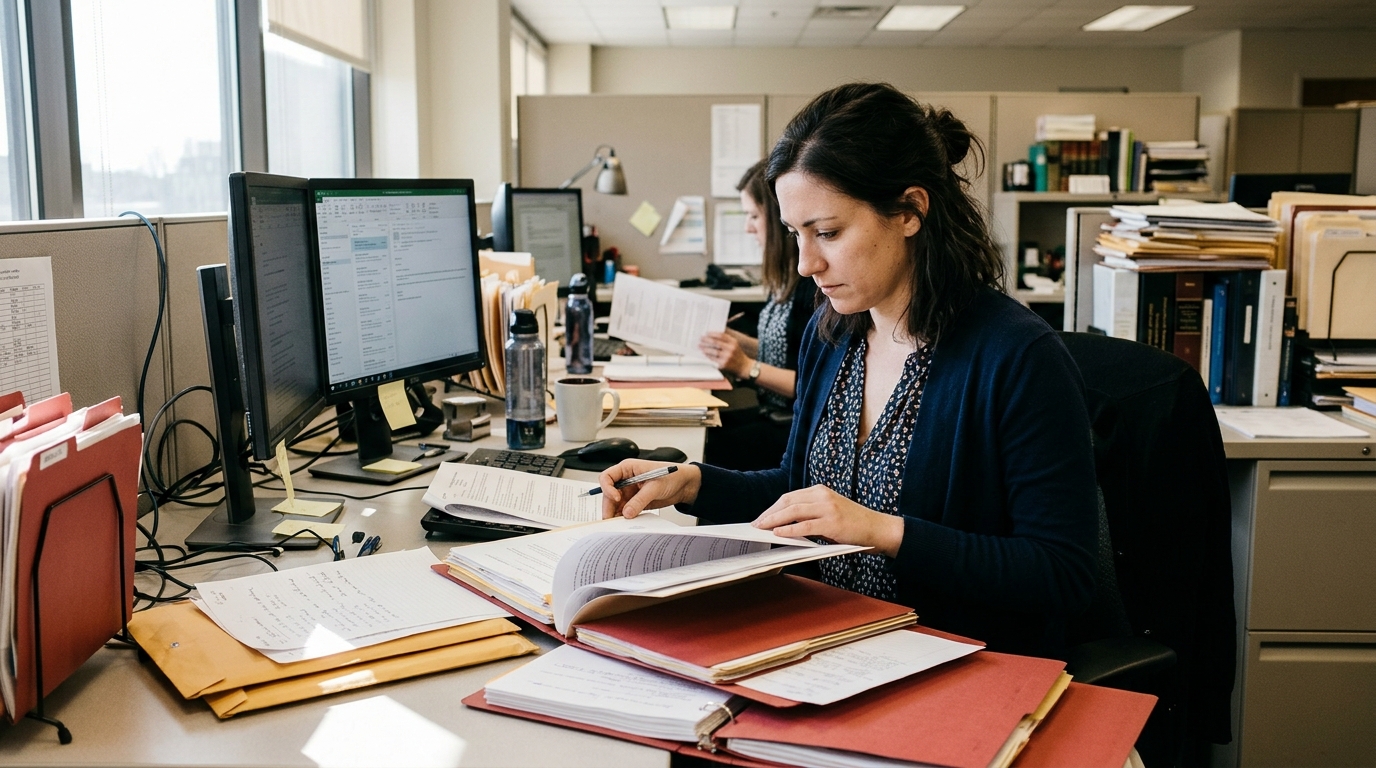
Most people enter this occupation through an associate's degree in paralegal studies or a post-degree paralegal certificate, which the U.S. Bureau of Labor Statistics (2025) lists as the typical entry-level education, then learn the employer's filing systems, court rules and case software on the job. No state currently licenses paralegals, although many are considering it (National Federation of Paralegal Associations, undated), so the gate into the job is coursework, supervised experience and an employer's hiring standards rather than a government exam.
Plan on about two years from a standing start on the community college route, or four to twelve months of certificate study if you already hold a bachelor's degree. Voluntary credentials such as the NALA Certified Paralegal (CP) come after, or alongside, your first legal job.
Steps to Becoming a Paralegal
The order below assumes you are starting with a high school diploma or GED. If you already hold a degree, skip to step three.
- Check what your target employers accept (2-4 weeks). Read 20-30 current postings in the city and practice area you want. The Bureau of Labor Statistics (2025) notes paralegals typically need an associate's degree or a certificate in paralegal studies, that some employers prefer a bachelor's degree, and that others accept a high school diploma plus experience. Requirements vary by employer and by state.
- Complete an associate's degree in paralegal studies (about 2 years full-time, 3-4 years part-time). A program approved by the American Bar Association satisfies NALA's Category 1 exam eligibility outright. ONET places paralegals in Job Zone Three — medium preparation such as vocational school training, related on-the-job experience, or an associate's degree (National Center for ONET Development, undated).
- Or take a post-degree paralegal certificate instead (4-12 months full-time, 18-24 months part-time). The usual career-changer route. NALA's Category 2 accepts a bachelor's degree in any field plus one year of paralegal experience, or 15 semester hours of substantive paralegal courses in place of that experience (NALA, undated).
- Do a supervised externship, internship or legal aid clinic placement (one academic term, typically 12-16 weeks). Most programs place students one or two days a week with a firm, a prosecutor's office, a corporate legal department or a legal aid nonprofit. This matters more than your GPA: the Bureau of Labor Statistics (2025) lists work experience in a related occupation as required to enter the occupation. If your program has no placement, volunteer at a courthouse self-help desk and log your hours and tasks.
- Take a feeder job if you do not land a paralegal title first (6-18 months). Legal receptionist, records clerk, court clerk's office assistant, litigation support technician or document review contractor. These put you inside the deadline calendar and the e-filing system.
- Get hired and complete on-the-job training (first 3-6 months). On-the-job training is typically needed after being hired (U.S. Bureau of Labor Statistics, 2025). Expect to be taught the firm's document management system, billing conventions and local filing quirks before you file unsupervised.
- Sit a voluntary certification exam (3-6 months of study). Certification is not required, but some employers prefer or require it, which means passing an exam, meeting education or work-experience eligibility, and continuing education to maintain it (U.S. Bureau of Labor Statistics, 2025). The main options are the NALA CP and NFPA's Paralegal CORE Competency Exam, conferring the CRP designation; NFPA's Paralegal Advanced Competency Exam (PACE), conferring RP, assumes comprehensive education plus years of practical experience (NFPA, undated). NALA publishes a processing window for approving a complete application before you may test — check it before booking study leave.
Education and Certification Options
Costs are described rather than quoted, because tuition varies by state, residency and institution, and exam fees are reset by the certifying bodies. Check the college's per-credit tuition page and NALA's or NFPA's current fee schedule before committing.
| Path | Time | Approximate Cost | Where Required |
|---|---|---|---|
| Associate's degree in paralegal studies (community college) | About 2 years full-time; 3-4 years part-time | Lowest published tuition in most states at in-district per-credit rates, plus books and fees | Typical entry-level education for the occupation (U.S. Bureau of Labor Statistics, 2025); meets NALA Category 1 |
| Bachelor's degree (paralegal studies or any major) | 4 years full-time | Higher than community college; varies sharply between in-state public and private institutions | Preferred by some employers (U.S. Bureau of Labor Statistics, 2025); supports NALA Category 2 with one year of paralegal experience |
| Post-degree paralegal certificate, ideally ABA-approved | 4-12 months full-time; 18-24 months part-time | Single flat program fee set by the provider, usually well below a second degree | Career-changer route; a program of 60 semester hours including 15 substantive legal hours meets NALA Category 1 |
| High school diploma plus paralegal work experience | 5+ years of paid experience | No tuition; you earn while you learn | Accepted by some employers (U.S. Bureau of Labor Statistics, 2025); NALA Category 3 also requires 20 hours of substantive continuing legal education within the prior two years |
| Military legal specialist service | One enlistment term, typically 3-6 years | No tuition | Service experience may count as paralegal experience toward NALA eligibility; confirm with NALA before applying |
| NALA Certified Paralegal (CP) exam | 3-6 months of study, plus NALA's stated application approval window | First-time application fee covering one attempt each at the Knowledge and Skills Exams, plus PSI testing center fees charged on NALA's behalf; a discounted first-time fee exists for students in their final term | Voluntary; preferred or required by some employers (U.S. Bureau of Labor Statistics, 2025) |
Keep one distinction straight: no state currently has paralegal licensure, though many are considering it, and passing an exam such as PCCE or PACE confers a credential — not a license, and not the same as a school's education certificate (NFPA, undated). If a program advertises that it will make you "licensed," look elsewhere.
Skills You'll Need on Day One
Split these into what a hiring attorney expects you to have already and what you will be taught in your first quarter.
Bring these to the interview:
- Bluebook citation formatting and cite-checking. Take a draft brief and correct case, statute and record citations without being walked through it.
- Boolean and natural-language searching in Westlaw and LexisNexis. Most programs give student access; name the databases on your résumé and describe a search you built.
- Microsoft Word for legal documents. Styles, automatic paragraph numbering, cross-references, track changes, and generating a table of authorities. This is tested informally in most interviews.
- Adobe Acrobat Pro production work. Bates numbering, redaction that removes text rather than drawing a black box, OCR on scanned exhibits, and splitting or combining exhibit sets.
- Deadline calculation from court rules. Counting days under the Federal Rules of Civil Procedure or your state's equivalent, and knowing which deadlines run from service versus filing. Litigation paralegals calendar each new deadline the day the document arrives, not at week's end.
Expect to learn these after hire (on-the-job training is typically needed in this occupation — U.S. Bureau of Labor Statistics, 2025):
- Electronic filing systems. PACER and CM/ECF for federal courts, plus your state portal — these vary by state and county, and rejection rules are learned the hard way.
- Case and review platforms. Relativity or Everlaw for e-discovery; Clio, iManage or NetDocuments for matters and files. The employer picks these and trains you on its configuration.
- Billing and practice-area routines. Most firms record time in tenths of an hour, logged daily, and hand you a filing checklist for immigration petitions, probate inventories or trial exhibit binders in week one.
Frequently asked questions
How long does it take to become a paralegal from scratch?
About two years of full-time study for an associate's degree in paralegal studies, which the U.S. Bureau of Labor Statistics (2025) lists as the typical entry-level education, plus the 12-16 week externship most programs build into the final term. With a bachelor's degree in any subject, a post-degree certificate takes 4-12 months full-time or 18-24 months part-time. Add 6-18 months if you need a feeder role first.
What does paralegal certification cost, and can I retake the exam?
NALA charges a first-time application fee for the Certified Paralegal exam covering one attempt each at the Knowledge and Skills Exams, with a discounted first-time fee for students in their last semester or quarter who do not yet meet Categories 1-3; PSI also charges testing center fees on NALA's behalf (NALA, undated). Candidates who fail an attempt must wait a set period before retaking and are capped at a maximum number of attempts within the eligibility period. Pull the current fee schedule from NALA before budgeting.
Do I need a license to work as a paralegal?
No state currently has paralegal licensure, though many states are considering it (National Federation of Paralegal Associations, undated). What exists are voluntary credentials — NALA's CP, and NFPA's PCCE conferring CRP or PACE conferring RP. Certification is not required to be hired, but some employers prefer or require it, and keeping it active means continuing education (U.S. Bureau of Labor Statistics, 2025).
Will a criminal record or background check stop me?
Law firms, courts, corporate legal departments and government offices commonly run background checks, and roles needing courthouse or detention-facility access may apply stricter standards. Whether a particular conviction is disqualifying depends on the employer, the agency and the state — there is no single national rule, so ask the employer or state body directly. Convictions involving dishonesty draw the most scrutiny in roles handling client funds or confidential files.
Sources
- U.S. Bureau of Labor Statistics — Paralegals and Legal Assistants : Occupational Outlook Handbook (2025)
- O*NET OnLine (National Center for O*NET Development) — 23-2011.00 - Paralegals and Legal Assistants

Written by
Yuki covers the broader shifts in how people work: shrinking industries, growing ones, the policies that quietly decide who gets steady income. She tends to start stories with a worker's own account before zooming out.