 Hire Compass HQ
How to Become a Vet Tech: Step-by-Step Guide
From a CVTEA-accredited associate degree to the VTNE and a state credential, here is what the training takes and what the work looks like once you start.
Becoming a veterinary technician usually means finishing an associate degree in veterinary technology accredited by the American Veterinary Medical Association's Committee on Veterinary Technician Education and Activities (CVTEA), passing the Veterinary Technician National Examination (VTNE) administered by the American Association of Veterinary State Boards, and then getting credentialed by your state. The U.S. Bureau of Labor Statistics (2025) lists an associate degree as the typical entry-level education, no prior work experience in a related occupation as a requirement, and some on-the-job training after hire.
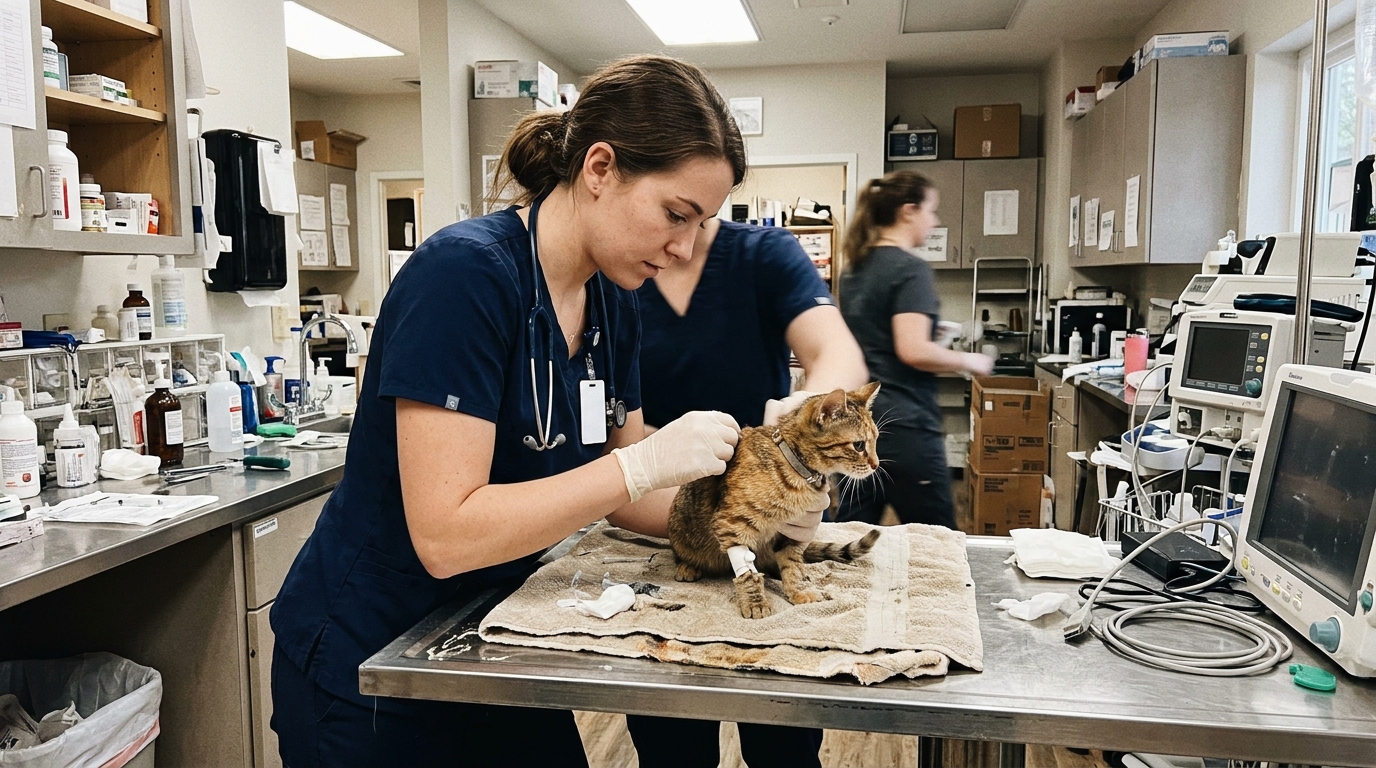
Plan on roughly two to three years from your first class to your first credentialed shift. The work itself is clinical and physical: restraining a fractious cat for a blood draw, monitoring anesthesia every five minutes during a dental, and explaining discharge instructions to an owner before closing.
Steps to Becoming a Vet Tech
- Build the science base in high school (1-2 years). The U.S. Bureau of Labor Statistics (2025) advises taking courses in biology, chemistry, math and anatomy, and getting part-time or volunteer work around animals. If you are already out of school, a single semester of community college biology and algebra covers the same ground and often satisfies program prerequisites.
- Get first-hand experience before you commit (3-6 months, 50-150 hours). Work or volunteer as a veterinary assistant or kennel attendant, or shadow a credentialed technician for a few full shifts. Watch what happens between 7 a.m. and 9 a.m. — pre-surgical bloodwork, catheter placement, treatment-sheet rounds — because that block is the real test of whether the job suits you. The U.S. Bureau of Labor Statistics (2025) does not list prior related work experience as an entry requirement, but admissions committees and hiring practices often weigh it.
- Enroll in a CVTEA-accredited veterinary technology program (2 years for an associate degree, 4 for a bachelor's). The American Veterinary Medical Association (undated) accredits programs through CVTEA, including associate degree programs at institutions such as Cosumnes River College and Carrington College-Sacramento. The U.S. Bureau of Labor Statistics (2025) distinguishes technicians, who typically hold a two-year associate degree, from technologists, who typically hold a four-year bachelor's degree.
- Complete the clinical externship or preceptorship your program requires (8-16 weeks). Accredited programs place students in working practices to log hands-on skills: venipuncture, IV catheter placement, dental prophylaxis, radiographic positioning, anesthesia induction and monitoring. Treat it as a long interview — externship sites are a common source of first jobs.
- Apply for and pass the VTNE (2-4 months of study, scheduled in set testing windows). The American Association of Veterinary State Boards (undated) administers the exam, a multiple-choice test covering the full scope of technician practice. Most candidates study across a defined testing window, so check application deadlines early; missing one can push you back by a full window.
- Get credentialed by your state (4-12 weeks of processing). The U.S. Bureau of Labor Statistics (2025) notes that nearly all states require technicians to pass a credentialing exam after completing a postsecondary program. The title varies: Registered Veterinary Technician (RVT), Licensed Veterinary Technician (LVT) or Certified Veterinary Technician (CVT). California's RVT eligibility requirements are set out by the state and summarized by the California Veterinary Medical Association (undated) — confirm current rules with your own state board, since requirements differ state to state.
- Complete employer on-the-job training (first 3-6 months). The U.S. Bureau of Labor Statistics (2025) lists on-the-job training as typical after hire. Expect to be trained on that practice's specific anesthesia protocols, controlled-drug logging, and its practice management software before you run cases alone.
- Consider a specialty credential later (3-5 years after licensure). Veterinary technician specialties in areas such as emergency and critical care, anesthesia or dentistry require years of documented case logs, continuing education hours and a separate exam.
Education and Certification Options
Costs below are structural, not quoted figures: tuition is charged per credit hour and varies by state, residency status and institution. Check each school's published tuition schedule and net price calculator, and confirm accreditation on the AVMA's CVTEA program list (American Veterinary Medical Association, undated) before paying anything.
| Path | Time | Approximate Cost | Where Required |
|---|---|---|---|
| Associate degree in veterinary technology at a CVTEA-accredited community college | 2 years full time; 3-4 years part time | Lowest option in most states — in-district per-credit public tuition, plus scrubs, liability insurance and VTNE fees | Accepted in all states that credential technicians; the most common route, matching the associate degree the U.S. Bureau of Labor Statistics (2025) lists as typical entry-level education |
| Associate degree at a CVTEA-accredited private or career college | 18-24 months, often year-round | Higher than community college; private per-credit rates with no in-district discount | Same credential value; chosen for year-round scheduling and faster completion |
| Bachelor's degree in veterinary technology (veterinary technologist) | 4 years | Highest of the three degree routes; four years of tuition | Required only if you want technologist-level roles, research or teaching positions; the U.S. Bureau of Labor Statistics (2025) ties the technologist title to a four-year degree |
| Distance or hybrid CVTEA-accredited program with supervised clinical hours at a local practice | 2-3 years | Mid-range tuition, plus travel for required on-site skills testing | Suits people already working as veterinary assistants; you must secure a mentor practice |
| State-specific alternate route to credentialing | Varies; typically several years of documented clinical work plus coursework | Low tuition, high time cost | Only some states offer it — California's RVT eligibility pathways are described by the California Veterinary Medical Association (undated); verify with your state board |
For pay and demand before you enroll, read the occupation page in the Occupational Outlook Handbook (U.S. Bureau of Labor Statistics, 2025), which publishes the median annual wage, the lowest and highest 10 percent wage range, total employment, and projected employment change and annual openings for 2025-35. O*NET's My Next Move (undated) lists the occupation's federal classification code and a detailed task list worth reading alongside it.
Skills You'll Need on Day One
The U.S. Bureau of Labor Statistics (2025) names manual dexterity, communication skills, compassion, detail orientation and physical strength as important qualities for the occupation. Here is what that means in practice, split by what you need walking in versus what a practice will train.
Expected before hire (taught in an accredited program):
- Cephalic and jugular venipuncture on dogs and cats, with enough sample volume for a pre-anesthetic panel on the first stick most of the time.
- Safe restraint positioning — lateral, sternal and ventrodorsal — for radiographs without a second handler fighting you, and knowing when to reach for sedation instead.
- Drug dosage calculation by body weight, including dilutions and constant-rate infusions, done on paper and checked against the patient's chart.
- Anesthesia monitoring: reading heart rate, respiratory rate, blood pressure, pulse oximetry and capnography, and recording them on the anesthetic sheet at five-minute intervals.
- Dental scaling and polishing with an ultrasonic scaler, plus full-mouth dental radiograph positioning.
- Aseptic technique for surgical pack preparation, IV catheter placement and autoclave cycle logging.
Typically learned on the job in the first 3-6 months:
- The practice's software — scheduling, charting, invoicing and lab integration in systems such as Cornerstone, AVImark or ezyVet — and the local habits for how treatment sheets are written.
- In-house lab workflow on the analyzers that clinic owns, such as IDEXX bench units, including daily quality-control runs before the first appointment.
- Controlled substance logging to that practice's protocol, with counts reconciled at the end of each shift under the supervising veterinarian's registration.
- Client conversations under pressure — estimates, euthanasia appointments, and discharge instructions delivered in plain language — which most new technicians shadow before doing solo.
Physical demands are constant: lifting large-breed dogs onto a table with a second person, standing for most of an eight- to twelve-hour shift, and wearing lead for several radiograph series a day.
Frequently asked questions
How long does it take to start working as a credentialed vet tech?
Budget 24-36 months: two years for a CVTEA-accredited associate degree, two to four months of VTNE preparation, and four to twelve weeks for your state board to process the credential. Part-time students commonly take three to four years for the degree portion. The U.S. Bureau of Labor Statistics (2025) lists the associate degree as the typical entry-level education for the occupation.
What is the cheapest way in?
An in-district community college program accredited by CVTEA is normally the lowest-cost route, because public per-credit tuition is below private-college rates and you can often keep a paid veterinary assistant job while enrolled. Add fixed extras most students forget: scrubs, stethoscope, immunizations, liability insurance, VTNE application, and the state credentialing fee. Each school publishes current tuition per credit hour — compare two or three before you apply.
Can I work in a clinic before I am credentialed?
In many states you can work as a veterinary assistant without a credential, but the tasks you may legally perform are limited and the limits differ by state. The U.S. Bureau of Labor Statistics (2025) notes that nearly all states require technicians to pass a credentialing exam after completing a postsecondary program before using a protected title such as RVT, LVT or CVT. Check your state veterinary board's practice act for the exact scope allowed to uncredentialed staff.
Are there age limits or background checks?
State boards typically require applicants to be adults and to disclose criminal history as part of the credentialing application; some convictions trigger review rather than automatic denial. Practices that stock controlled substances may also run their own background check before you handle the log. Because these rules are set state by state, confirm them with your state veterinary board before you enroll, not after you graduate.
Is the job market worth the training?
Check the current figures yourself rather than relying on secondhand claims: the Occupational Outlook Handbook (U.S. Bureau of Labor Statistics, 2025) publishes the median annual wage, the lowest and highest 10 percent wage range, total employment, and projected employment change and annual openings for 2025-35 for veterinary technologists and technicians. Pay is usually hourly in private practice, with shift differentials for overnight emergency work and sometimes on-call pay. Emergency and specialty hospitals and academic referral centers often pay differently from small general practices in the same metro area.
Sources
- U.S. Bureau of Labor Statistics — Veterinary Technologists and Technicians : Occupational Outlook Handbook (2025)
- American Association of Veterinary State Boards (AAVSB) — Veterinary Technician National Exam Candidate Information Handbook

Written by
Felix writes a column on the inner life of work — burnout, ambition, the quiet math people do about whether a job is worth it. He prefers plain language to management jargon and says so often.