 Hire Compass HQ
What Does a Medical Assistant Do? Duties, Skills, and Salary
A look at the clinical and administrative split, the certifications employers ask for, and what the first year on a clinic floor actually looks like.

A medical assistant handles both clinical and administrative work in a doctor's office, clinic or hospital: taking vital signs, recording patient histories, collecting specimens, scheduling appointments and keeping records current (U.S. Bureau of Labor Statistics, 2025). The median annual wage was $45,690 in May 2025, and employment is projected to grow 13 percent from 2025 to 2035 (U.S. Bureau of Labor Statistics, 2025).
Most people enter through a postsecondary certificate or associate program of about one to two years, though some start with a high school diploma and on-the-job training (U.S. Bureau of Labor Statistics, 2025). What you are allowed to do clinically depends on state law and on your employer.
What Does a Medical Assistant Actually Do?
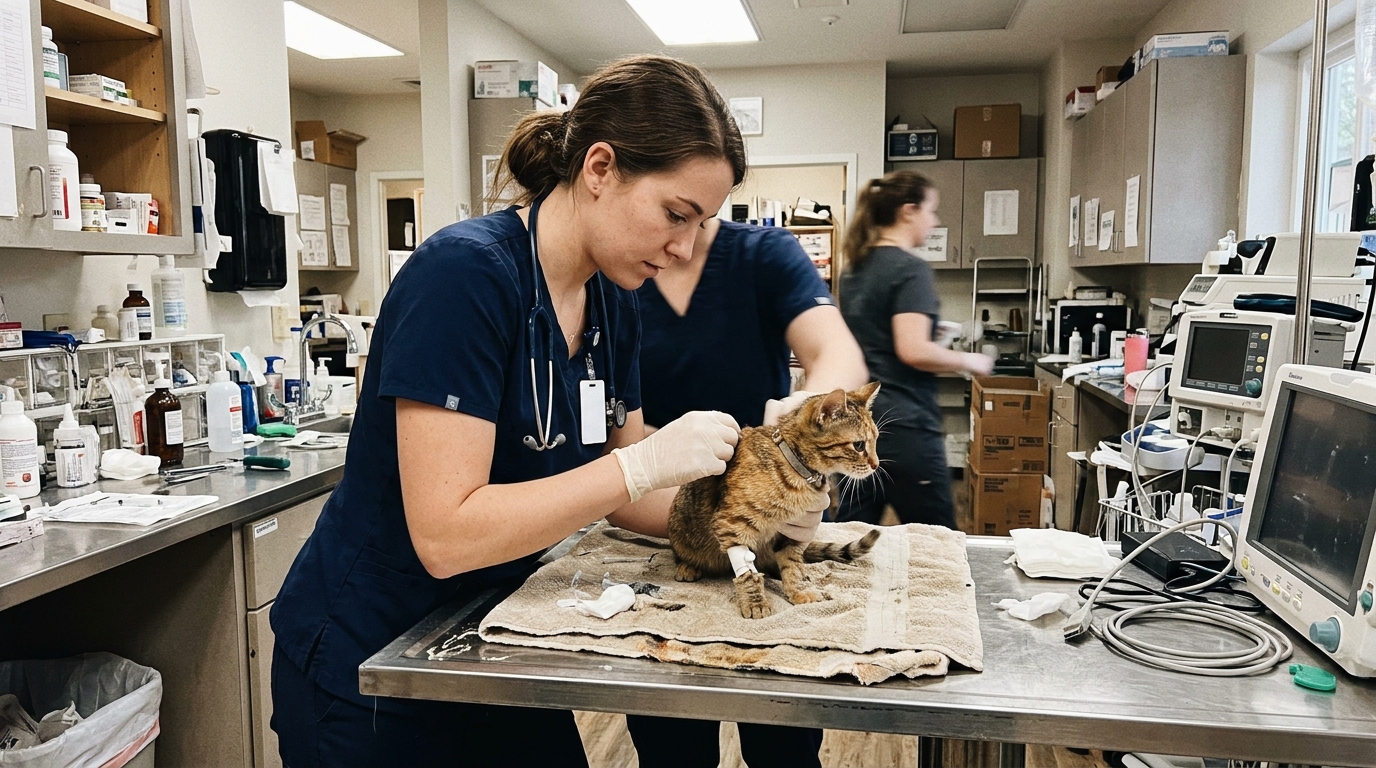
A medical assistant is a trained clinical support worker who prepares patients for examination, performs basic clinical procedures, and handles the office tasks that keep a practice running. The job is a deliberate mix of administrative duties — scheduling appointments, maintaining medical records, billing and coding for insurance — and clinical duties such as taking vital signs, preparing patients for examination, drawing blood, and administering medications as directed by a physician (O*NET OnLine, U.S. Department of Labor).
The outputs are countable: a full schedule of patients roomed, a blood pressure and weight recorded for each one, histories entered into the electronic health record, specimens labeled and sent to the lab, injections given as directed by the physician and as permitted by state law, and charts closed out at the end of the day (U.S. Bureau of Labor Statistics, 2025).
Medical assistants are commonly confused with licensed practical nurses and registered nurses. The difference is licensure and scope: nurses hold a state nursing license and practice under it, while medical assistants work under a physician's direction within what state law and the employer permit (U.S. Bureau of Labor Statistics, 2025). Titles also vary by specialty — reported job titles include Certified Medical Assistant (CMA), Clinical Medical Assistant, Ophthalmic Assistant and Registered Medical Assistant (RMA) (O*NET OnLine, U.S. Department of Labor).
Typical Daily Responsibilities
- Reviews the day's appointment schedule before the first patient arrives, flagging anyone needing labs drawn or forms completed.
- Rooms each patient on the schedule, from the first morning slot to the last afternoon one, measuring vital signs such as blood pressure and weight and recording them in the chart (U.S. Bureau of Labor Statistics, 2025).
- Interviews patients to record medical history, current medications and the reason for the visit, entering it in the electronic health record before the provider goes in (U.S. Bureau of Labor Statistics, 2025).
- Assists the physician during examinations, handing instruments and positioning patients (U.S. Bureau of Labor Statistics, 2025).
- Gives injections or medications as directed by the physician and as permitted by state law, documenting each dose, site and lot number immediately afterward (U.S. Bureau of Labor Statistics, 2025).
- Collects and prepares blood and other specimens for lab tests, labeling tubes at the bedside and batching morning draws for pickup (U.S. Bureau of Labor Statistics, 2025).
- Schedules follow-up appointments and referrals at the close of each visit and works through phone messages and refill requests between rooming blocks (U.S. Bureau of Labor Statistics, 2025).
- Codes and submits information for insurance purposes and updates medical records, usually in a set administrative block (O*NET OnLine, U.S. Department of Labor).
Skills, Tools, and Qualifications
| Requirement/Skill | Why It's Needed | How to Get It |
|---|---|---|
| Postsecondary medical assisting certificate or associate degree | The usual entry route; programs run about one or two years and typically include a practicum (U.S. Bureau of Labor Statistics, 2025) | Community colleges, vocational schools, technical schools and universities (U.S. Bureau of Labor Statistics, 2025) |
| CMA (AAMA) certification | Employers may prefer or require certification even where the state does not (U.S. Bureau of Labor Statistics, 2025) | Eligibility requires student or graduate status from a CAAHEP- or ABHES-accredited program, or the Alternative Pathway (American Association of Medical Assistants) |
| CCMA certification (National Healthcareer Association) | An alternative credential accepted by many employers | Exam has 150 scored questions plus 30 unscored items, a 3-hour limit and a 390 scaled passing score (American Council on Education, ACE National Guide); renew every two years (Vivian Health, citing NHA) |
| State licensure or accredited-program requirements | Some states require graduation from an accredited program, licensure or certification (U.S. Bureau of Labor Statistics, 2025) | Check the rules in the state where you plan to work before enrolling |
| EHR software: eClinicalWorks, Epic Systems, MEDITECH | Patient data is entered, retrieved and billed through these systems every shift (O*NET OnLine, U.S. Department of Labor) | Accredited coursework, practicum hours and employer onboarding |
| Vital signs measurement and phlebotomy technique | Blood pressure, weight and specimen collection are daily outputs (U.S. Bureau of Labor Statistics, 2025) | Lab coursework and supervised practicum hours |
| Medical coding and insurance billing | Administrative duties include coding information for insurance purposes (O*NET OnLine, U.S. Department of Labor) | Program coursework, reinforced on the practice's billing system |
| Communication and interpersonal skills (soft) | You explain instructions to patients and relay clinical detail to the provider (U.S. Bureau of Labor Statistics, 2025) | Practicum and patient-facing work |
| Compassion (soft) | Patients are often anxious during procedures such as blood draws (U.S. Bureau of Labor Statistics, 2025) | Supervised clinical placement and preceptor feedback |
| Detail orientation and analytical skills (soft) | Charting errors and misrecorded vitals carry clinical risk (U.S. Bureau of Labor Statistics, 2025) | Documentation practice and chart audits on the job |
Salary and Job Outlook
| Metric | Figure | Source/Year |
|---|---|---|
| National median annual wage | $45,690 | U.S. Bureau of Labor Statistics, May 2025 |
| National median hourly wage | $21.97 | O*NET OnLine (U.S. Department of Labor), 2025 |
| Low to high (10th to 90th percentile, annual) | Less than $36,050 to more than $59,310 | U.S. Bureau of Labor Statistics, May 2025 |
| Alternative wage range (SOC 31-9092, annual) | $35,020 low, $44,200 median, $57,830 high | CareerOneStop (U.S. Department of Labor), 2024 |
| Alternative wage range (hourly) | $16.84 low, $21.25 median, $27.80 high | CareerOneStop (U.S. Department of Labor), 2024 |
| Projected employment growth | 13 percent, much faster than average for all occupations | U.S. Bureau of Labor Statistics, 2025–2035 |
| Projected annual openings | About 109,700 a year on average, mostly replacement hiring | U.S. Bureau of Labor Statistics, 2025–2035 |
| Preparation level | Job Zone Three: Medium Preparation Needed | O*NET OnLine (U.S. Department of Labor), 2021 |
Pay is normally structured as an hourly wage with overtime, since most medical assistants work full time and shifts can include nights, weekends and holidays (O*NET OnLine, U.S. Department of Labor). These are national figures; rates differ by state, metro area, specialty and employer type, so check the BLS Occupational Employment and Wage Statistics pages and CareerOneStop for your own area before you negotiate.
How to Get Started
- Check your state's rules first (1-2 weeks). Some states require medical assistants to graduate from an accredited program, be licensed or certified, or meet other prerequisites; most do not require certification, but employers may still prefer or require it (U.S. Bureau of Labor Statistics, 2025). This decides which programs are worth paying for.
- Finish high school or an equivalent (varies). Some people enter with a high school diploma and learn through on-the-job training, though postsecondary education is the typical route (U.S. Bureau of Labor Statistics, 2025).
- Enroll in a postsecondary medical assisting program (about 1 to 2 years). These run at community colleges, vocational schools, technical schools and universities and typically include a practicum or internship (U.S. Bureau of Labor Statistics, 2025). If you intend to sit the CMA (AAMA) exam, choose a CAAHEP- or ABHES-accredited program, since eligibility depends on it (American Association of Medical Assistants).
- Complete the practicum and keep a documented skills record (several weeks to a term within the program). Track procedures performed and which EHR you used — eClinicalWorks, Epic Systems and MEDITECH are among those listed for this occupation (O*NET OnLine, U.S. Department of Labor).
- Sit a certification exam (typically 1-3 months of preparation). The CCMA exam from the National Healthcareer Association has 150 scored questions plus 30 unscored items, a 3-hour limit and a 390 scaled passing score (American Council on Education, ACE National Guide), and must be renewed every two years (Vivian Health, citing NHA).
- Apply to doctors' offices, hospitals and clinics (1-3 months of searching is common). About 109,700 openings a year are projected on average over 2025–35, largely replacement hiring (U.S. Bureau of Labor Statistics, 2025). Expect questions about availability for nights, weekends and holidays (O*NET OnLine, U.S. Department of Labor).
Frequently asked questions
How long does it take to become a medical assistant?
Postsecondary programs at community colleges, vocational schools, technical schools and universities take about one or two years and typically include a practicum or internship (U.S. Bureau of Labor Statistics, 2025). Add roughly one to three months if you plan to prepare for and sit a certification exam afterward. Some people enter with a high school diploma and on-the-job training instead, which shortens the path but narrows which employers will consider you.
Do I need to be certified to work as a medical assistant?
Most states do not require certification, but some require graduation from an accredited program, licensure or certification, and employers may prefer or require a credential anyway (U.S. Bureau of Labor Statistics, 2025). The CMA (AAMA) exam requires you to be a student or graduate of a CAAHEP- or ABHES-accredited program, or to meet the Alternative Pathway requirements (American Association of Medical Assistants). Check your own state's rules before choosing a program.
What is the difference between a medical assistant and a nurse?
Medical assistants give injections or medications as directed by a physician and only as permitted by state law, and they also handle scheduling, records, billing and coding (U.S. Bureau of Labor Statistics, 2025; O*NET OnLine, U.S. Department of Labor). Nurses hold a state nursing license with its own defined scope of practice. In practice, a medical assistant's clinical authority flows from the supervising physician and state rules rather than from an independent license.
How much do medical assistants earn?
The median annual wage was $45,690 in May 2025, which O*NET lists as $21.97 an hour (U.S. Bureau of Labor Statistics, 2025; O*NET OnLine, 2025). The lowest 10 percent earned less than $36,050 and the highest 10 percent more than $59,310 (U.S. Bureau of Labor Statistics, May 2025). Those are national figures — look up your state and metro area on the BLS wage pages or CareerOneStop, where 2024 data shows a national range of $35,020 to $57,830.
Sources
- U.S. Bureau of Labor Statistics — Medical Assistants : Occupational Outlook Handbook (2025)
- O*NET OnLine (U.S. Department of Labor) — Medical Assistants at My Next Move

Written by
Desmond writes about the mechanics of job hunting — resumes, interviews, the strange rituals of being evaluated by strangers. He's drawn to the gap between how hiring is supposed to work and how it actually happens.