 Hire Compass HQ
Is a Career in UX Design Right for You?
A look at the research, prototyping and stakeholder work behind user experience roles, and the traits that make the job feel easy or exhausting.
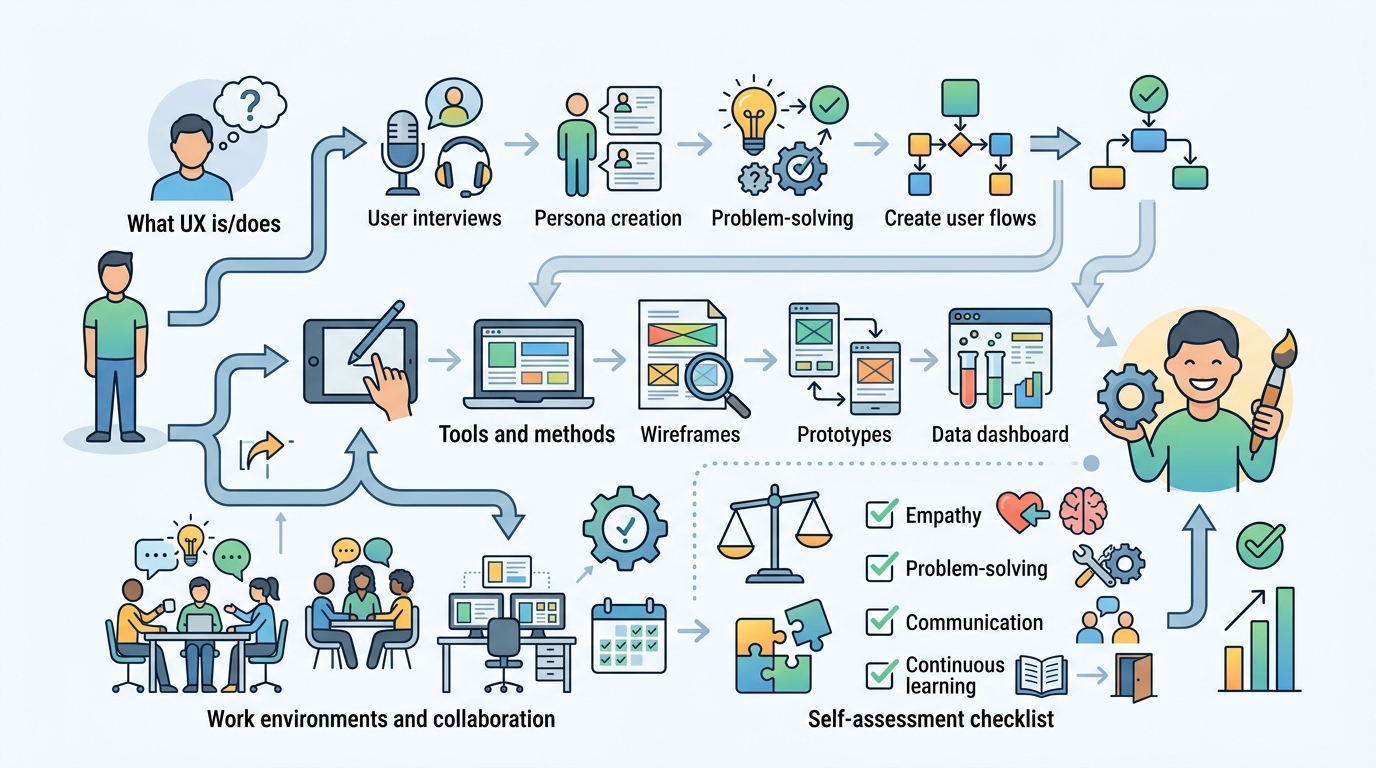
UX design suits people who like solving usability problems with evidence rather than opinion, and who can take critique of their work without taking it personally. The job mixes user research, wireframing in tools like Figma, and meetings with clients, engineers and managers to agree what gets built. Pay sits around a median of $104,000 a year for web and digital interface designers (U.S. Bureau of Labor Statistics, May 2025), and most people in the wider occupation work full time (U.S. Bureau of Labor Statistics, 2025).
It is not a purely artistic job. Much of the week goes on documenting decisions, testing prototypes with real users, and redoing work when the research says you were wrong.
What This Career Involves Day to Day
A typical day starts with a stand-up alongside engineers, where you walk through the screens you handed off yesterday and answer questions about what happens when a form field fails validation.
Mid-morning you run two remote usability sessions over a video call, screen-sharing a clickable Figma prototype and watching where people hesitate on the checkout flow. You take timestamped notes, then write up the pattern you saw — three of five participants missed the secondary button — into a short findings document for the product manager.
After lunch you rebuild that checkout step in Figma, adjusting the component library so the change propagates to every screen using the same button. You check spacing and contrast against the design system documentation, then export specs for the developers.
Late afternoon is usually meetings with clients or management to discuss interface needs (U.S. Bureau of Labor Statistics, 2025) — often a stakeholder asking for an extra field on a form you just simplified, and you making the case with the research you gathered that morning. Depending on the team, you may also write front-end code, work with graphic designers on layout, integrate graphics, audio and video, and monitor site traffic after launch (U.S. Bureau of Labor Statistics, 2025).
Titles vary by employer: the same work shows up as UI Developer, UX Developer, UX Engineer, Web Designer or Webmaster (O*NET OnLine, U.S. Department of Labor). In a small agency you may do all of it; in a large company you may do research only, or interface design only.
Signs This Career Might Suit You
- You have watched someone struggle with an app and immediately started redesigning it in your head, then wondered whether other people hit the same wall.
- You ask people why they did something rather than assuming you know, and you listen through the whole answer before responding.
- You have redone your own work after someone pointed out a flaw, without arguing first.
- You keep files, notes and layers organised well enough that someone else could pick up your project — detail orientation is one of the qualities listed for the occupation (U.S. Bureau of Labor Statistics, 2025).
- You enjoy explaining a decision to someone who disagrees with it, using evidence rather than taste.
- You have taught yourself software from documentation and shipped something with it, even a personal site.
- You find a half-defined problem more interesting than a fully specified one.
Signs This Career Might Not Be for You
- You want your design to ship as drawn. Stakeholders routinely cut or change work after approval, and you will rebuild screens you already finished, sometimes several times in one sprint.
- Sitting through critique bothers you. Usability testing produces direct evidence that your idea confused people, and you have to present that evidence yourself.
- You dislike meetings. A large share of the week goes to discussions with clients or management about interface needs (U.S. Bureau of Labor Statistics, 2025), which means less uninterrupted making time than you may expect.
- You want artistic freedom. Design system components, brand rules and accessibility requirements constrain most choices, and inventing a new button style is usually the wrong answer.
- Screen-heavy days are hard for you. The work is close, sustained screen time at a desk, often full time (U.S. Bureau of Labor Statistics, 2025), with visual adjustments measured in pixels.
Skills and Traits That Matter Most
| Skill/Trait | Why It Matters on the Job |
|---|---|
| Communication | You defend a simplified checkout form to a stakeholder who wants an extra field added, and you brief developers at stand-up on error-state behaviour. |
| Problem-solving | Three of five test participants missed the secondary button, and you have to find a fix that works inside the existing component library. |
| Detail orientation | Spacing, contrast and component states have to match the design system before you export specs, or developers build the wrong thing. |
| Creativity | Turning a vague request for a better signup flow into prototype screens that can actually be tested with users. |
| Customer-service skills | Client meetings go better when you treat a frustrating change request as information about their constraints rather than interference. |
| Research discipline | Running the two usability sessions and analysing the feedback is a listed task: conducting user research to determine design requirements. |
Communication, creativity, customer-service skills, detail orientation and problem-solving are the qualities listed for web developers and digital designers (U.S. Bureau of Labor Statistics, 2025). The research task is listed by O*NET OnLine (U.S. Department of Labor).
Pay, Hours, and Outlook
| What | Figure |
|---|---|
| Median annual wage, web and digital interface designers | $104,000 (May 2025) |
| Median pay, combined web developers and digital designers | $99,520 a year, $47.85 an hour (2025) |
| Lowest 10 percent | Under $53,750 |
| Highest 10 percent | Over $201,550 |
| Typical hours | Most work full time |
| Employment, 2025 | 132,700 |
| Projected growth, 2025-2035 | 5 percent, faster than average |
| Projected job openings, 2025-2035 | 8,300 |
All figures come from the U.S. Bureau of Labor Statistics, with the employment and openings counts and the hourly median also published through O*NET OnLine (U.S. Department of Labor), using 2025 data. Pay is usually a salary for in-house and agency roles, and an hourly or project rate for contract and freelance work. Actual rates vary widely by state, metro area and industry, so check the BLS Occupational Employment and Wage Statistics pages for your state and live postings in your area before you set expectations.
How People Usually Get Started
- Decide on your education route. A bachelor's degree is the typical entry-level education for web developers and digital designers (U.S. Bureau of Labor Statistics, 2025), and the occupation is Job Zone Four, 'Considerable Preparation Needed' (ONET OnLine, U.S. Department of Labor). In an ONET education survey, 52 percent of respondents said a bachelor's degree is required for a new hire, 30 percent a post-baccalaureate certificate, and 16 percent an associate's or other two-year degree.
- If you are not taking a degree, build demonstrable ability instead. Requirements range from a high school diploma to a bachelor's degree, and workers may not need specific credentials if they can show their abilities through prior work or projects (U.S. Bureau of Labor Statistics, 2025). Expect several months of consistent practice before a portfolio holds up.
- Learn Figma to a working standard. It is listed as an in-demand hot technology for this occupation under graphical user interface development software (O*NET OnLine, U.S. Department of Labor). Aim to produce component libraries and clickable prototypes, not static images.
- Run real user research on your own projects. Recruit five people, test a prototype, and write up what changed as a result.
- Apply under every relevant title. Employers post this work as UI Developer, UX Developer, UX Engineer, Web Designer and Webmaster (O*NET OnLine), across agencies, in-house product teams, government and nonprofits. No related work experience and no on-the-job training are listed as required (U.S. Bureau of Labor Statistics, 2025), so junior and associate postings are the realistic target.
- Expect your first year in a junior role to be where you learn handoff, accessibility and design-system discipline from senior colleagues rather than from a course.
Frequently asked questions
Do I need a bachelor's degree to work in UX design?
Not always, but it is the most common route. A bachelor's degree is listed as the typical entry-level education for web developers and digital designers, and 52 percent of O*NET survey respondents said one is required for a new hire. The same sources note requirements range from a high school diploma upward, and workers may not need specific credentials if they can demonstrate ability through prior work or projects.
Do I need to know how to code?
It depends on the employer and the exact title. Writing code is listed among the duties for web developers and digital designers (U.S. Bureau of Labor Statistics, 2025), and roles posted as UX Engineer or UI Developer usually expect it. Pure research or interface design roles at larger companies often do not, though understanding what developers can build makes handoff meetings smoother.
Is the job secure, or is the market shrinking?
Employment of web developers and digital designers is projected to grow 5 percent from 2025 to 2035, faster than the average for all occupations (U.S. Bureau of Labor Statistics, 2025). O*NET lists 2025 employment at 132,700 and projects 8,300 job openings over the decade. That is steady rather than explosive growth, so competition for junior roles can still be heavy.
Can I expect to earn the median straight away?
Unlikely. The median annual wage was $104,000 in May 2025 for web and digital interface designers, but the lowest 10 percent earned less than $53,750 (U.S. Bureau of Labor Statistics, 2025 wage data). Entry-level pay sits well below the median and varies by state and industry, so check BLS state-level wage data and live postings in your metro area.
Is this a good fit if I'm an introvert?
It can be, as long as you can handle structured conversation. Much of the work is solitary — building prototypes, documenting findings, adjusting components — but communication and customer-service skills are listed as important qualities, and you will spend significant time in client and stakeholder meetings. If facilitating a usability session with a stranger sounds unbearable rather than just tiring, that is a genuine warning sign.
Sources
- U.S. Bureau of Labor Statistics — Web Developers and Digital Designers : Occupational Outlook Handbook: : U.S. Bureau of Labor Statistics (2025-05)
- O*NET OnLine (U.S. Department of Labor) — 15-1255.00 - Web and Digital Interface Designers - O*NET OnLine

Written by
Mireille thinks about work the way some people think about weather: always shifting, worth tracking closely. She edits pieces on hiring trends and the small negotiations that shape a career, and has little patience for advice that assumes everyone wants the same thing from a job.