 Hire Compass HQ
What It's Really Like to Work as a Flight Attendant
A look at the safety checks, reserve call-outs, galley carts and FAA certification behind a job most passengers only see for a few minutes.
Working as a flight attendant is a safety job with a service job layered on top. Your legal purpose on board is to inspect emergency equipment, brief passengers, manage the cabin and direct an evacuation if one is ever needed — the beverage service happens in between.
The U.S. Bureau of Labor Statistics (2025) notes that flight attendants must be certified by the Federal Aviation Administration after completing employer-provided training, and that new hires almost always start on call, a status known as reserve. This guide covers a typical duty day, who tends to last in the role, and the usual route in.
What This Career Involves Day to Day
A duty day starts in the crew room, not on the aircraft. You check your assignment in the airline's crew scheduling system — O*NET lists tools such as SBS International Maestro Suite and ValtamTech Flight Crew Log, alongside Microsoft Excel and PowerPoint — then meet the captain and the rest of the crew for a preflight briefing covering flight time, weather, expected turbulence and who works which door.
On board, before passengers come down the jet bridge, you run the preflight equipment check: first aid kits sealed and in date, fire extinguishers and oxygen bottles charged and working, your assigned exit, slide indicator and emergency lighting as they should be (U.S. Bureau of Labor Statistics, 2025; O*NET).
Boarding is crowd control — carry-on bags into bins, aisle clear, passengers seated. You then make the safety announcement over the PA and demonstrate seat belt, oxygen mask and flotation equipment use, live or by monitoring the video.
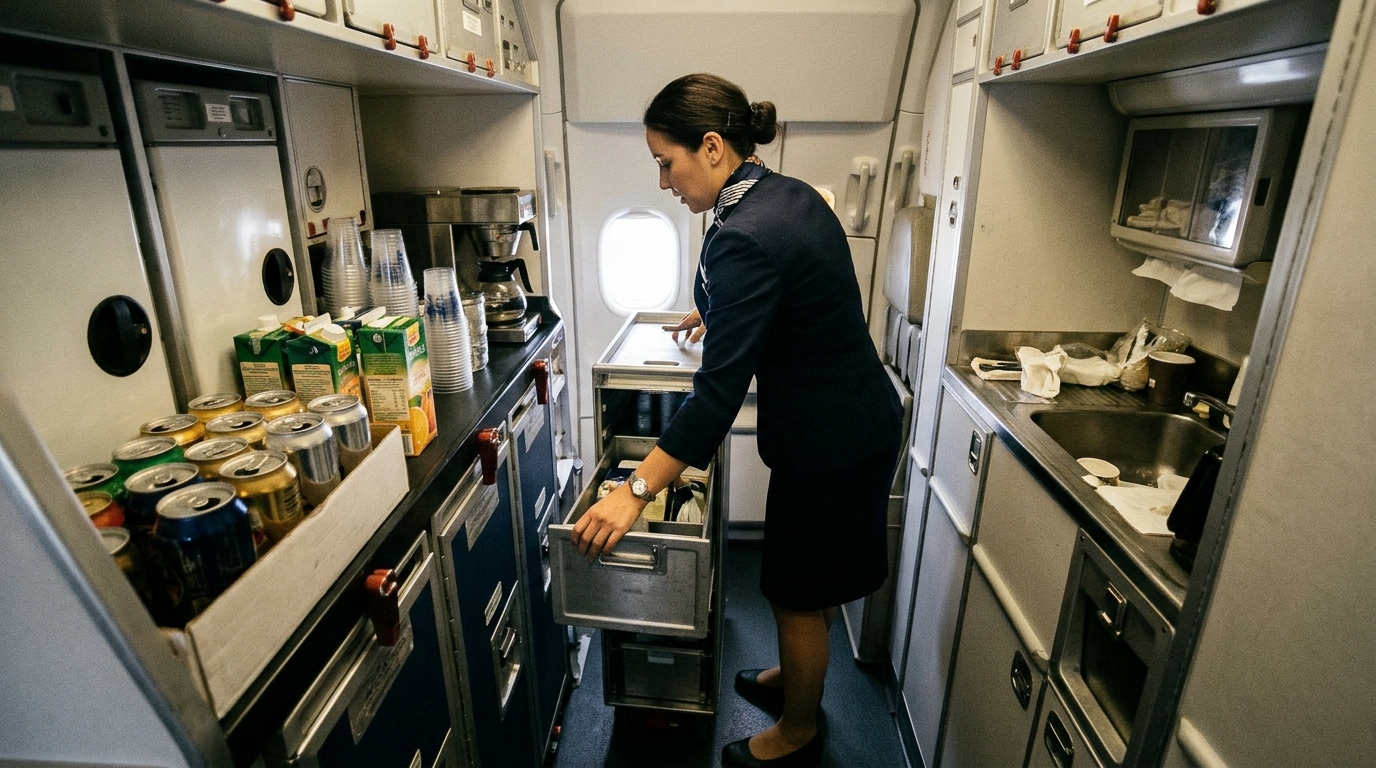
In cruise you work the galley cart down the aisle serving beverages and meals, handle special requests, and keep watching the cabin; O*NET lists monitoring passenger behavior for threats to safety as a core task, so you are reading body language and alcohol consumption while you pour drinks.
Descent means securing carts, compliance checks on seat belts and tray tables, and the jumpseat for landing. Then the next leg, often three or four before the day ends at a hotel in another city. Directing an evacuation, if one is ever ordered, is your job (U.S. Bureau of Labor Statistics, 2025).
Signs This Career Might Suit You
- You have held a customer-facing job — retail, hospitality, restaurant service, call centre — and found you could stay level with a rude customer instead of matching their tone.
- You check things twice by habit: expiry dates, seals, whether a door actually latched.
- You can sleep in a strange hotel room, in daylight, with a 4am alarm set, and still function.
- You have calmed someone down in public without anyone helping you.
- You like being on your feet for most of a shift and dislike desk work.
- You can switch from pouring coffee to giving firm, loud instructions in under a second without feeling awkward about it.
Signs This Career Might Not Be for You
- Reserve status means living near your assigned home airport and waiting for a call (U.S. Bureau of Labor Statistics, 2025). If you need a fixed weekly schedule for childcare, a second job or evening classes, the first years will be genuinely difficult.
- The physical load is real: lifting bags into overhead bins, pushing loaded galley carts, bracing against turbulence. Flight attendants have one of the highest injury and illness rates of all occupations, with sprains, strains and bruises common (U.S. Bureau of Labor Statistics, 2025).
- You will face verbal confrontation over seat assignments, bag space and alcohol service — then finish the service with that passenger three feet away.
- Training never ends. You must complete new training for each aircraft type and pass recurrent training every year to keep your FAA certification (U.S. Bureau of Labor Statistics, 2025), so you sit exams for as long as you hold the job.
- Holidays, weekends and overnight flights are normal working time, not exceptions.
Skills and Traits That Matter Most
| Skill/Trait | Why It Matters on the Job |
|---|---|
| Attentiveness | Catching an out-of-date first aid kit seal or a discharged fire extinguisher during the preflight check, before the door closes. |
| Communication skills | Delivering the safety demonstration so a full cabin actually listens, and briefing exit row passengers on what you need from them. |
| Customer-service skills | Handling a seat dispute during boarding and a meal special request in the same ten minutes without the service falling behind. |
| Decision-making skills | Deciding whether to stop alcohol service to a passenger you have been monitoring, and when to involve the captain. |
| Physical stamina | Pushing a loaded galley cart up a sloping aisle on the third leg of the day, then running a full compliance check before landing. |
| Stress tolerance and self-control | Staying measured during turbulence, a diversion, or a confrontation at the forward galley while other passengers watch. |
Attentiveness, communication, customer service, decision-making and physical stamina are the qualities the U.S. Bureau of Labor Statistics (2025) names for this occupation. O*NET adds optimism, adaptability, empathy, stress tolerance, self-control and social orientation.
Pay, Hours, and Outlook
| What to look up | Where the figure comes from |
|---|---|
| Median annual wage | U.S. Bureau of Labor Statistics, 2025 |
| Lowest 10 percent and highest 10 percent wage range | U.S. Bureau of Labor Statistics, 2025 |
| Typical on-duty shift length | U.S. Bureau of Labor Statistics, 2025 |
| Total number of flight attendant jobs | U.S. Bureau of Labor Statistics, 2025 |
| Projected job growth, 2025–35 | U.S. Bureau of Labor Statistics, 2025 |
| Projected average annual openings over the decade | U.S. Bureau of Labor Statistics, 2025 |
All six are published and updated in the Occupational Outlook Handbook by the U.S. Bureau of Labor Statistics (2025). Look up the current median wage, wage range, duty-day length, employment level, 2025–35 growth projection and average annual openings there rather than relying on figures quoted second-hand.
How the money is structured matters as much as the median. At most U.S. airlines, pay is based on flight hours rather than total time away from home, usually with a per diem on trips and a seniority rate that rises each year; the exact structure is set by each airline and, where one exists, the union contract, so ask recruiters how boarding time, training and reserve days are paid. Federal duty and rest rules apply across the U.S.; carriers outside the U.S. operate under their own national rules.
How People Usually Get Started
- Confirm you meet the baseline requirements before applying: the airline's minimum age, eligibility to work in the U.S., a valid passport, and the ability to pass a background check and drug test, with vision correctable to at least 20/40 (U.S. Bureau of Labor Statistics, 2025).
- Complete the typical entry-level education the U.S. Bureau of Labor Statistics (2025) lists for the occupation in its Occupational Outlook Handbook — check the "How to Become One" section, since airlines may ask for more.
- Build the related work experience BLS (2025) says is typically needed first: hotel front desk, restaurant service, retail, cruise or resort hospitality, or call centre work handling complaints.
- Apply directly to airline employers — regional carriers, major network and low-cost airlines, charter operators and corporate flight departments. Hiring runs in waves, and regionals often open to first-time applicants earlier than the majors.
- Pass the airline's own initial training course. It is employer-provided, residential at most carriers, and ends with FAA certification; no outside school can certify you instead (U.S. Bureau of Labor Statistics, 2025).
- Start on reserve near your assigned home airport, then complete training for each new aircraft type and recurrent training every year to keep your FAA certification current (U.S. Bureau of Labor Statistics, 2025).
Frequently asked questions
Do I need a college degree to become a flight attendant?
The U.S. Bureau of Labor Statistics (2025) lists a typical entry-level education level for this occupation in its Occupational Outlook Handbook — check that entry, because it is lower than many applicants assume. Individual airlines can set higher bars, and some weigh language skills or hospitality experience more heavily than schooling. BLS (2025) also lists work experience in a related occupation as typically needed, so a service background often counts for more.
Can I pay for flight attendant school before I apply?
No outside course can give you the credential. Flight attendants must be certified by the Federal Aviation Administration, and that certification follows employer-provided training after you are hired (U.S. Bureau of Labor Statistics, 2025). Treat any private program promising certification with suspicion.
Is the job physically demanding?
Yes, specifically. You stand and walk for most of a duty day, lift carry-on bags into overhead bins, push loaded galley carts and work in a moving cabin. BLS (2025) reports flight attendants have one of the highest rates of injuries and illnesses of all occupations, with sprains, strains and bruises common, and lists physical stamina as an important quality.
How long do I have to stay on reserve?
New flight attendants almost always start on reserve, living near their home airport and waiting to be called (U.S. Bureau of Labor Statistics, 2025). How long you stay there depends on your airline's seniority list and hiring pace — at a fast-growing carrier it can be months, at a stable one it can run for years. Ask recruiters what junior crew at that base currently hold before you accept an offer.
Sources
- U.S. Bureau of Labor Statistics — Flight Attendants : Occupational Outlook Handbook (2025)
- O*NET / My Next Move (U.S. Department of Labor) — Flight Attendants at My Next Move

Written by
Priya turns job-market numbers into something readable, chasing the story behind a wage chart or an unemployment figure. She's most interested in what statistics miss about an actual day at work.