 Hire Compass HQ
Paralegal Interview Questions and How to Answer Them
What hiring attorneys and paralegal managers actually probe for, from document-review scenarios to the line between legal support and legal advice.
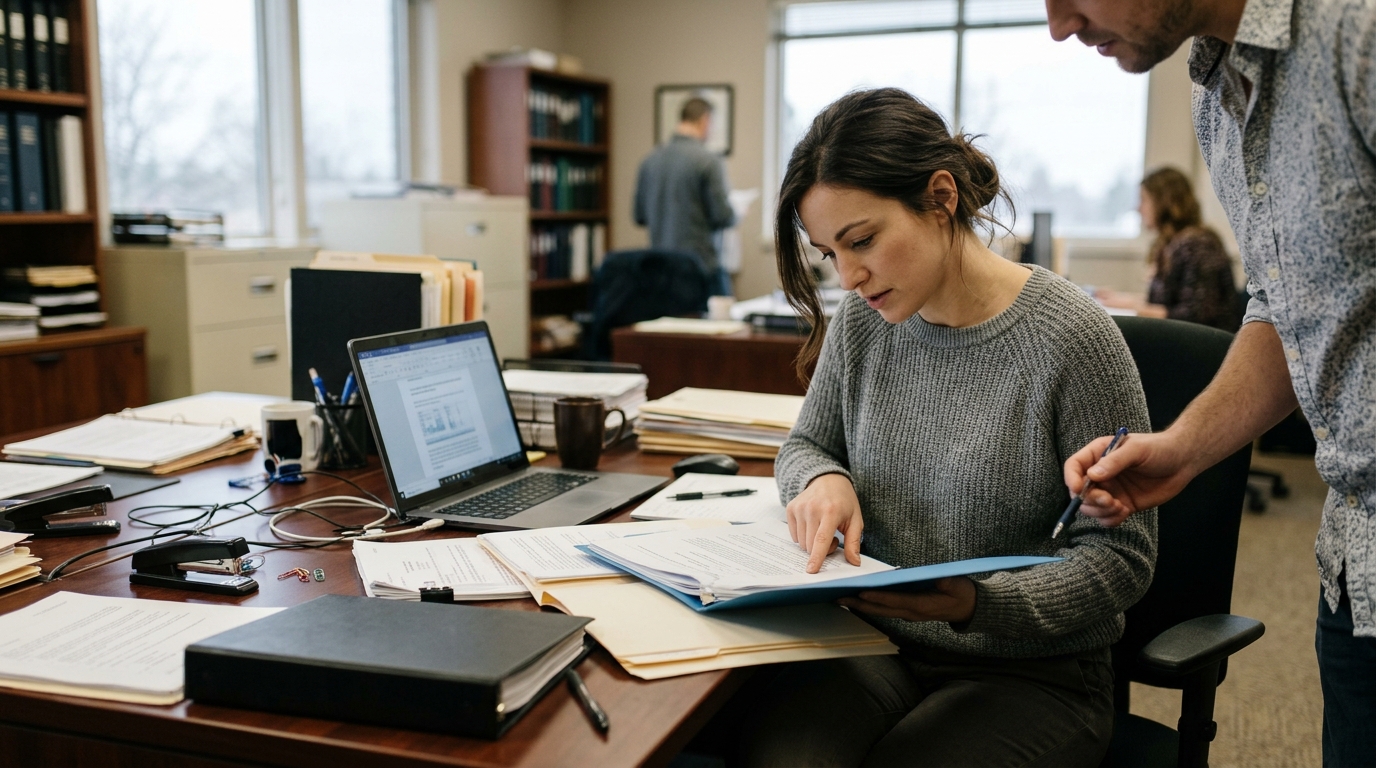
Paralegal interviews test three things at once: whether you can keep a docket and a document set under control, whether you can write and research accurately, and whether you know exactly where your authority stops. Expect scenario questions about discovery, deadlines and client calls rather than abstract questions about strengths.
This guide covers the usual stages, eight questions phrased the way an interviewer will say them, sample answers you can adapt, and a script for the hardest question in the room.
What to Expect From a Paralegal Interview
Most paralegal hiring runs two to four stages, and the shape depends on the employer. At a small firm you may meet the owner-attorney once, take a drafting exercise, and hear back the same week. At a large firm, an in-house legal department or a government office, expect a recruiter screen by phone, then a hiring manager interview with the paralegal supervisor or the supervising attorney, then a panel with the attorneys you would support.
A skills assessment is common at any size: proofreading a pleading, cite-checking a short brief, building an exhibit index, or running a database search. The Department of Labor's occupational database lists information retrieval software such as LexisNexis and Westlaw, document management tools such as Adobe Acrobat and SharePoint, and Microsoft Outlook among the software paralegals use (O*NET OnLine, undated), so questions about those are normal rather than a trick.
What makes this interview distinct is the ethics layer. Interviewers test whether you recognize unauthorized practice of law, protect confidential client information, and can discuss prior work without disclosing it. Procedure questions are jurisdiction-specific too: filing rules, deadline computation and e-filing systems differ by state and between federal districts, so say which courts you have actually filed in.
Common Paralegal Interview Questions and Sample Answers
Walk me through how you'd organize the documents in a case with tens of thousands of pages of production.
Sample answer
I'd confirm the Bates range, production format and any protective order with the attorney before I touch anything. Then everything goes into the document management system — I've used SharePoint for storage and Adobe Acrobat for OCR, Bates stamping and redactions — tagged by custodian, date and issue. I build a privilege log and a hot-documents folder as I review, plus a running chronology the associate can search. On a construction case, that chronology let the partner pull any change order in under a minute during deposition prep.
Tell me about a time you caught an error in a document before it went out the door.
Sample answer
We were filing an opposition brief on the afternoon it was due. My job was the cite-check and exhibit list. Running the citations through the citator in Westlaw, I found the lead case had been reversed in part on exactly the point the brief relied on, and one exhibit was attached twice while another was missing. I flagged both to the associate within ten minutes and pulled two replacement authorities. The brief was revised and e-filed with about forty minutes to spare, and the firm added a standing citator check to its pre-filing checklist.
How do you track deadlines across thirty or forty active matters?
Sample answer
Every date goes on the shared firm calendar first, never only in my own. I calculate from the applicable rules of civil procedure and the judge's standing orders, then set reminders at thirty, fourteen and three days out. I keep the shared calendar in Outlook and matter-level ticklers in the case management system, and reconcile the two against the docket every Monday. Because computation rules differ by state and by federal district, I check local rules before entering anything and ask the attorney to confirm unfamiliar jurisdictional dates.
A client calls and asks whether she should accept the settlement offer on the table. What do you say?
Sample answer
I tell her plainly that I'm a paralegal and can't advise her on the offer or give an opinion about her options. Then I take a full message — what she's asking, when the offer expires, the best number to reach her — and get it to the supervising attorney the same hour, flagging the expiration date for the calendar. I tell her specifically when to expect a call back rather than leaving it open, and I note the call in the matter file.
You're given a research question with no starting citation. How do you approach it?
Sample answer
First I pin down the jurisdiction and procedural posture, because a state court answer may look nothing like the federal one. I start in a secondary source — a practice guide or treatise — to pick up the vocabulary and leading cases, then run terms-and-connectors searches in Westlaw or LexisNexis and citator everything I intend to quote. I deliver a short memo: the question as I understood it, the answer, the three strongest authorities with pin cites, and any contrary authority. If I can't find support, I say so.
Our filings go through the court's e-filing portal. What do you do when the clerk rejects a submission?
Sample answer
I read the rejection notice for the specific defect — usually a caption mismatch, missing signature block, wrong document type, or an exhibit over the size limit. I correct it and refile immediately, then tell the attorney the same day with the new confirmation number. If the rejection puts the filing date itself at risk, I flag it right away so the attorney can decide how to address it, because the rules on that differ by court. Every confirmation PDF goes in the matter folder, named by date and document.
Do you hold a paralegal certification, and if not, do you plan to pursue one?
Sample answer
I completed a paralegal certificate program; the Bureau of Labor Statistics notes that an associate's degree or a certificate in paralegal studies is the typical entry route, with some employers preferring a bachelor's degree (U.S. Bureau of Labor Statistics, 2025). I'm working toward the NALA Certified Paralegal credential, which has a Knowledge Exam followed by a Skills Exam (NALA, undated). I've also looked at the NFPA route, where the PCCE leads to the CRP designation and the PACE exam leads to the RP designation for people with more practical experience (NFPA, undated).
Tell me about a time you had to explain a process to an upset client without crossing into legal advice.
Sample answer
A client called furious that nothing had happened on her case for six weeks. My task was to explain the discovery timeline without characterizing her prospects. I walked her through what had been served and what we were waiting on, gave her the next calendared date, and said I'd ask the attorney to call her about anything involving strategy. I sent a short written summary afterward. She stopped calling daily, the attorney kept the substantive conversation, and the file had a clean record of the exchange.
How to Answer the Hardest Question You'll Face
The hardest question in a paralegal interview is some version of: "Tell me about a mistake you made that affected a case or a client." Denying mistakes reads as dishonest or inexperienced, and the interviewer is listening for whether you escalated fast and changed your system afterward.
Sample answer
Early in a litigation role I calendared a discovery response date from the date on the certificate of service rather than actual service, which put us two days off. I caught it reconciling the calendar against the docket on a Monday, about a week before the response was due. I went straight to the supervising attorney that morning rather than trying to absorb it myself, showed her both dates and my calculation, and told her the deadline was tighter than we had planned for. She asked opposing counsel for a short written extension, we got it, and we served complete responses on the corrected date. Afterward I rewrote my intake step: every deadline is computed from the proof of service, entered on the shared calendar, then verified a second time against the docket within twenty-four hours. I also started asking an attorney to confirm any first-of-its-kind deadline in an unfamiliar court. The reconciliation habit is the reason I caught this one in time.
Keep the error real but not catastrophic, keep the escalation immediate, and spend the last third of the answer on the system you changed.
Frequently asked questions
When should I bring up pay in a paralegal interview?
Let the recruiter or hiring manager raise it at the screening stage, and ask then how the role is structured — salaried or hourly, overtime treatment, any billable-hour target or bonus. Negotiate after a written offer. For current figures, check the Bureau of Labor Statistics Occupational Outlook Handbook and surveys from state and local paralegal associations, since rates vary by state, city and practice area.
What if I don't know the case management or e-filing system the firm uses?
Say so directly, then name the comparable systems you have used and how quickly you learned them. Interviewers expect transferable skills across document management and e-filing platforms. What they don't forgive is bluffing about a court portal you've never filed in — that's checkable in your first week, and filing errors carry deadline consequences.
How should I follow up after a paralegal interview?
Send a short email within 24 hours to each person you met, referencing something specific — the discovery platform they described, or the trial calendar they mentioned. If you were given a drafting or cite-checking exercise, note one thing you'd refine. If you've heard nothing a week past their stated timeline, one polite check-in to the recruiter is appropriate.
Can I use a real work document as my writing sample?
Not without clearing it. Client files are confidential, so use coursework, a redacted sample with names, case numbers and identifying facts removed, or a memo written on a hypothetical. Bring a clean printed copy and be ready to explain what you were asked to produce, which sources you used, and who reviewed it.
What should I ask the interviewer?
Ask function-specific questions: how many matters each paralegal carries, who handles cite-checking versus the associates, which document management and research platforms the firm licenses, whether paralegals attend depositions or travel for trial, and how work is assigned when two attorneys need you the same afternoon.
Sources
- U.S. Bureau of Labor Statistics — Paralegals and Legal Assistants : Occupational Outlook Handbook (2025)
- NALA (National Association of Legal Assistants) — About the CP® Exam

Written by
Felix writes a column on the inner life of work — burnout, ambition, the quiet math people do about whether a job is worth it. He prefers plain language to management jargon and says so often.