 Hire Compass HQ
Warehouse Associate Interview Questions and How to Answer Them
From safety scenarios to pick-rate questions, learn what shift supervisors actually listen for and how to answer when you have no warehouse history.
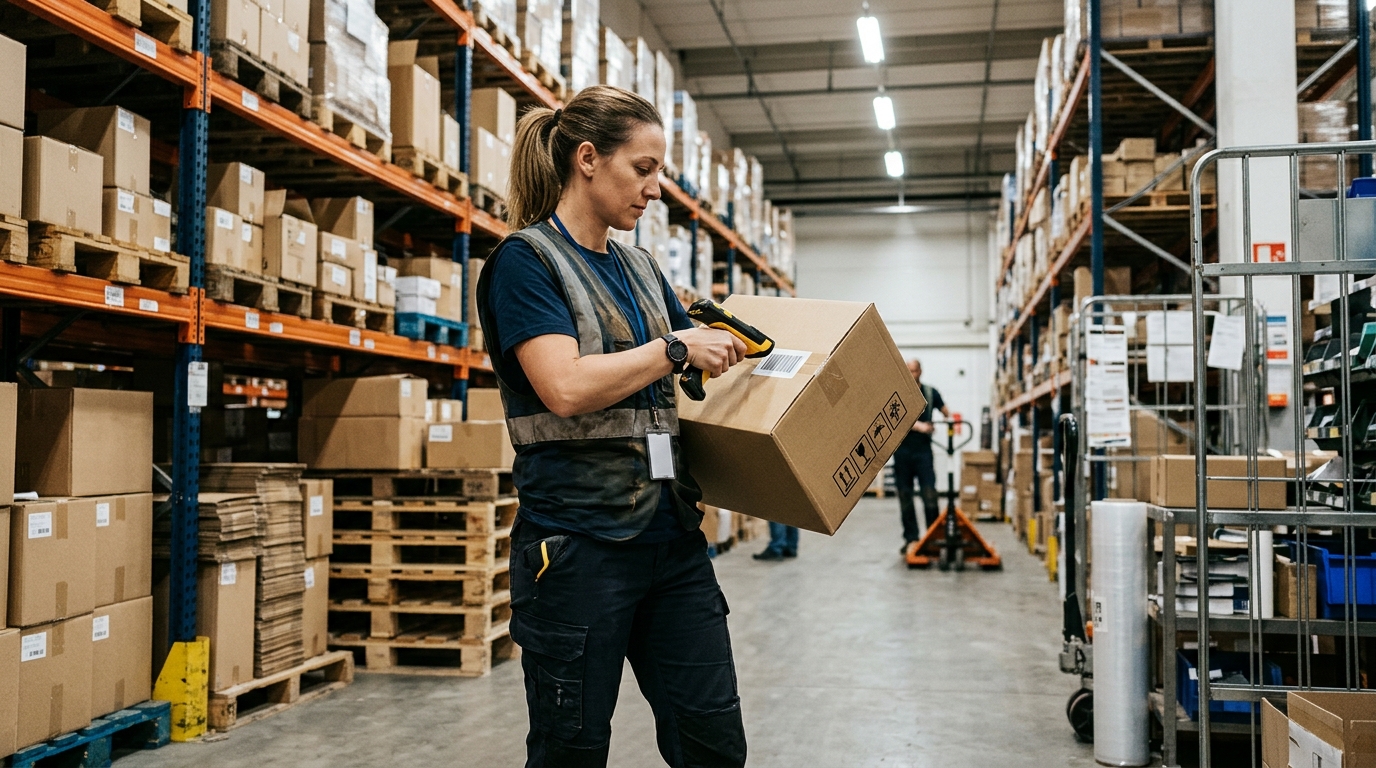
A warehouse associate interview is usually short, practical and focused on three things: whether you will show up, whether you can keep moving for a full shift, and whether you work safely around equipment and freight. Because the occupation typically requires no formal educational credential and no prior work experience, with competency gained through short-term on-the-job training (U.S. Bureau of Labor Statistics, 2025), interviewers rarely test knowledge — they test judgment and attitude to safety.
Below: the stages to expect, nine questions phrased the way a supervisor asks them, answers that reference scanners, pallet jacks and pick accuracy, and a script for the question that trips up first-time candidates.
What to Expect From a Warehouse Associate Interview
Most warehouse associate hiring runs through one to three stages, and at high-volume distribution sites it is often just one. A recruiter or staffing coordinator usually makes first contact by phone to confirm shift availability, lifting requirements and start date. The next stage is normally a face-to-face or video interview with the shift supervisor or warehouse hiring manager — the person who will assign your work. Larger sites may add a short panel with an operations manager and a safety lead, or a floor walk with a team lead who points at a pallet jack, a conveyor or a handheld scanner and asks what you would do with it.
What makes this different from a generic interview is the absence of credential screening. The occupation lists no formal educational credential, no prior work experience, and short-term on-the-job training as what is typically needed (U.S. Bureau of Labor Statistics, 2025). So the questions go straight to conduct: attendance, endurance and safety. Workers in this field have some of the highest rates of injuries and illnesses of all occupations, mostly sprains, strains and overexertion from moving heavy objects (U.S. Bureau of Labor Statistics, 2025), and safety rules are largely standardized through the Occupational Safety and Health Administration (U.S. Bureau of Labor Statistics, 2025). Expect at least two safety questions, and a direct one about nights and weekends, since materials ship around the clock (U.S. Bureau of Labor Statistics, 2025).
Common Warehouse Associate Interview Questions and Sample Answers
"Tell me what you think a warehouse associate actually does all day."
"You read a work order or take oral instruction from a supervisor to find the assignment (O*NET OnLine, undated), then move freight, stock or materials between storage areas, loading docks and delivery vehicles, by hand or with a pallet jack or truck, scanning packages so the count stays accurate (U.S. Bureau of Labor Statistics, 2025). Here I'd expect that to mean unloading inbound trailers, putaway by location, picking against a list, and staging pallets for outbound. It's repetitive by design, because repetition is what keeps the count right."
"This job means bending, lifting and staying on your feet for a whole shift. How do you know you can handle that?"
"The work needs endurance for strenuous tasks all day, with bending, kneeling and crouching (U.S. Bureau of Labor Statistics, 2025). My last job was eight-hour restaurant shifts carrying stock up from a basement walk-in — roughly 40-pound cases, about 30 of them before open. I pace it: loads close to the body, anything awkward split into two trips instead of one hero carry, and water on a schedule rather than when I notice I'm thirsty. I haven't missed a shift for a physical reason."
"Tell me about a time you spotted a safety hazard at work. What did you do about it?"
"Situation: closing a grocery stockroom, I found a leaking detergent case in the main aisle beside the staging rack. Task: that aisle was the only route to the dock, so leaving a note for the morning crew wasn't an option. Action: I coned it off with two empty totes, told the shift lead on the radio, absorbed the spill, broke down the case and logged it as damaged stock. Result: nobody walked through it, the variance was explained the same night, and the lead added that rack to the closing checklist."
"Which powered equipment have you been trained and evaluated on?"
"Daily use of a walk-behind hand pallet jack, which is generally not covered by OSHA's powered industrial truck standard (OSHA eTool summary, undated). I have not been certified on a counterbalance forklift, reach truck or order picker. There's no federal forklift license — the employer's written certification under the powered industrial truck standard is the legal record (ehscareers.com citing 29 CFR 1910.178, undated), and the employer must ensure each operator is competent through training and evaluation before unsupervised operation, with re-evaluation at least every three years (OSHA, undated). I'd rather go through your program than claim a card from elsewhere."
"Tell me about a time you made a counting or picking error. How did you handle it?"
"Situation: on a 60-line order I picked from the bin next to the one on the list — same product, different case pack. Task: the pallet was shrink-wrapped and staged against a 4pm cutoff. Action: I flagged it to the lead rather than quietly swapping cases, cut the wrap, pulled the 12 wrong cases, rescanned the correct location and re-verified the line count on the handheld before re-wrapping. Result: the truck left on time with the right pack size, and I now scan-verify the bin label before pulling, not after."
"Your supervisor tells you one thing, but the work order on your scanner says something different. What do you do?"
"I stop and ask before anything moves. Associates work from written work orders or oral instructions from a supervisor (O*NET OnLine, undated), and the cheapest moment to fix a conflict is before the pallet travels. I'd repeat both back — 'the scanner has me in aisle 12, you're saying 14, which do you want?' — do what the supervisor confirms, then ask whether the system record needs correcting so the next picker doesn't hit it. If I can't reach the supervisor, I follow the written order and note the discrepancy."
"We run shifts that can include nights and weekends. Is that a problem?"
"No. Materials ship around the clock, so overnight and weekend coverage comes with warehousing (U.S. Bureau of Labor Statistics, 2025). I worked a 4am bakery start for a year, so I build sleep around the schedule rather than fight it, and I have transport that doesn't depend on a bus timetable. Tell me the shift pattern and how far ahead the schedule posts and I'll plan around it — I'd rather know the pattern now than find out in week three."
"What would you do if you were told to lift something you didn't think you could lift safely?"
"Ask for a team lift or equipment instead of attempting it. Sprains, strains and overexertion from moving heavy objects are the main injuries in this work (U.S. Bureau of Labor Statistics, 2025), and most are one decision away from not happening. Concretely: check the case weight on the label, get a second person or a pallet jack, and if neither is free, tell the lead the line is blocked and why. I'd rather hold one line for two minutes than be off the floor for six weeks."
"Why warehouse work rather than retail or food service?"
"I want work with a measurable end point. At the end of a shift I can see trailers unloaded, orders retrieved and prepared for shipping (U.S. Bureau of Labor Statistics, 2025), and a count that matches the scanner. I also want somewhere skills stack on the job: hand pallet jack, then reach truck or forklift training and evaluation, then inventory or shipping. Retail gave me the stock-handling basics, but the progression I want runs through a distribution floor."
How to Answer the Hardest Question You'll Face
The hardest question is usually: "You've never worked in a warehouse before — why should I take you over someone who has?" You can't out-experience the other candidate. You can show you understand the physical and safety demands well enough that the supervisor believes you won't quit in week two or get hurt in week one.
Scripted answer — no warehouse experience
"You're right that I haven't worked a distribution floor. What I have done is eighteen months of overnight grocery stocking: six-hour shifts, pulling pallets off the delivery with a hand pallet jack, breaking them down and facing roughly 40 cases an hour, scanning damages and short-shipments into the handheld before the morning count. The parts that carry over are the parts that cause problems here — reading an assignment and working it without being chased, keeping the scan count honest when guessing would be faster, and lifting the same way at hour six as at hour one.
I also know what I don't know. I haven't been trained or evaluated on a counterbalance forklift or a reach truck, and I wouldn't operate one until you've certified me, because the record has to name the operator, the training date, the evaluation date and who evaluated me (OSHA, undated). Competency here is normally built through short-term on-the-job training, with safety rules learned on site (U.S. Bureau of Labor Statistics, 2025). Put me with a trainer for a week and judge me on my error rate."
Frequently asked questions
When should I bring up pay in a warehouse associate interview?
Let the recruiter or supervisor raise it first — in high-volume warehouse hiring, the shift rate, night differential and overtime rules are usually stated up front. If they aren't, ask at the end how pay is structured: base, shift differential, overtime threshold, and any attendance or peak-season bonus. Check current local rates through your state workforce agency before you negotiate.
What do I say if I'm asked an equipment question I can't answer?
Say so, then show how you'd close the gap: "I haven't run a reach truck, only a hand pallet jack — I'd want your training and evaluation first." Supervisors expect new hires to learn on the job and follow a supervisor's instructions (U.S. Bureau of Labor Statistics, 2025). Bluffing about forklift experience loses offers and creates a real safety liability.
Will there be a physical test, lift test or drug screen?
It varies by employer and by state. Some distribution centers run a pre-employment physical assessment or lift demonstration, some require a drug screen, some do neither. Ask the recruiter what the pre-start steps are and how long they take. Requirements also differ between temp-agency placements and direct hires at the same site.
What should I ask the interviewer at the end?
Ask which shift pattern the role covers and how far ahead schedules post; whether the job is inbound unloading, putaway or order picking; which handheld scanner or warehouse system the floor runs; how pick accuracy and rate are measured; and when new hires become eligible for powered industrial truck training and evaluation.
How soon should I follow up after the interview?
Warehouse hiring usually moves in days rather than weeks, especially before peak shipping season. If you haven't heard within three to five business days, call or email the recruiter or supervisor once, name the shift you interviewed for and restate your start availability. One follow-up is enough; repeated calls to a busy shift supervisor work against you.
Sources
- U.S. Bureau of Labor Statistics — Hand Laborers and Material Movers : Occupational Outlook Handbook (2025)
- O*NET OnLine (U.S. Dept. of Labor) — 53-7062.00 - Laborers and Freight, Stock, and Material Movers, Hand

Written by
Mireille thinks about work the way some people think about weather: always shifting, worth tracking closely. She edits pieces on hiring trends and the small negotiations that shape a career, and has little patience for advice that assumes everyone wants the same thing from a job.