 Hire Compass HQ
How to Prepare for a Bank Teller Interview
Branch hiring moves fast, so know who runs each round, how the cash accuracy test works, and which past jobs prove you can be trusted with money.
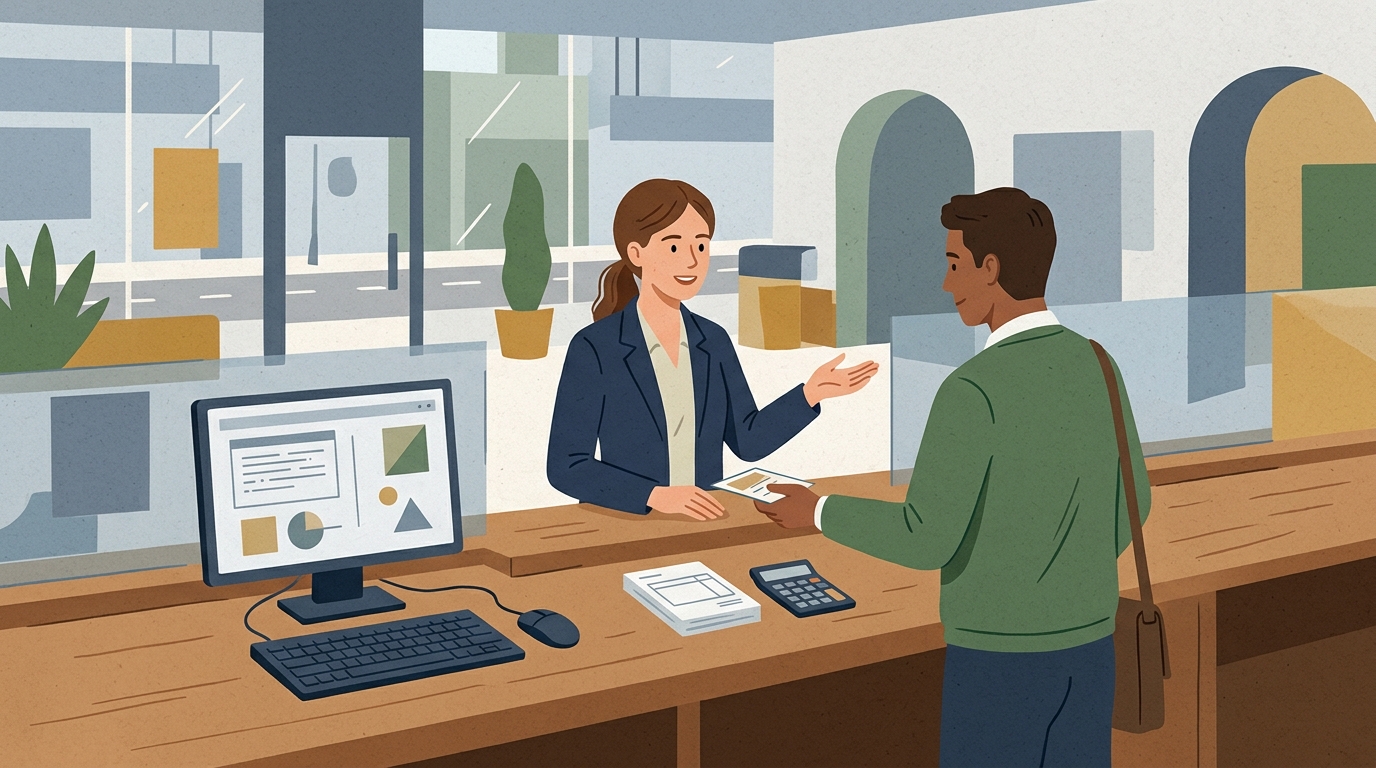
A bank teller interview tests three things: whether you can handle cash and balance a drawer accurately, whether you stay calm and clear with customers at the counter, and whether you can be trusted with other people's money. Expect questions about cash discrepancies, difficult customers, and repetitive, detail-heavy work.
Most bank teller interviews run 30 to 45 minutes for an initial screen and up to 60 minutes for a final round with a branch manager (Final Round AI, undated). Some institutions include a short cash handling or math accuracy test (Final Round AI, undated), and retail banks hiring at volume often run group interview formats paired with a timed assessment of basic math accuracy and attention to detail (AceRound, undated).
Step-by-Step Interview Preparation Plan
- Re-read the posting and mark which duties you have already done. Tellers typically balance currency, coin and checks in cash drawers at the end of a shift and calculate daily transactions using computers, calculators or adding machines (ONET OnLine, U.S. Department of Labor, undated), and they cash checks and pay out money after verifying that signatures are correct, that written and numerical amounts agree, and that accounts have sufficient funds (ONET OnLine, undated). Produce a two-column list — done, not yet done — because you will be asked about both.
- Find out what the role is actually called there. Reported job titles for this work include Bank Teller, Roving Teller, Customer Service Associate, Personal Banking Representative, Financial Services Representative and Branch Operations Specialist (O*NET OnLine, undated). A roving or universal title usually means travel between branches or a wider product remit, so prepare a line on your availability and your willingness to make referrals.
- Research the institution and write it down as bullet points. Look up whether it is a national bank, a regional bank or a credit union; which branches sit within commuting distance; any merger, new branch or app announcement on its newsroom page; two competitors on the same street; and the names of three consumer products, such as a checking account, a savings product or a credit card. Credit unions will often ask what you understand by member ownership.
- Draft three STAR stories and time them. One about a numerical or cash error you caught or caused, one about an angry or confused customer, one about repetitive work done accurately across a long shift. Keep each under two minutes, and make the situation, the task, your actions and the result separately audible.
- Rehearse arithmetic out loud, without a calculator. Count back change from a note, strap a mixed pile of bills, and add a column of check amounts. Some institutions include a short cash handling or math accuracy test (Final Round AI, undated), and volume hirers often use a timed assessment of basic math accuracy and attention to detail (AceRound, undated).
- Prepare for the screening conversation. Candidates for banking positions will likely have to pass a background check covering criminal and consumer history (Indeed, undated), and a sample teller job description lists the ability to pass a background check and credit check as a requirement (Glider.ai, undated). If something sits on your record or credit file, decide in advance how you will describe it in two calm sentences. What is screened and how it is used varies by employer and by state, so ask the recruiter what the check covers rather than assuming.
- Learn the software vocabulary. ONET lists teller and account-processing software including Information Technology Incorporated Premier Teller, Southern Data Systems TellerPro and Jack Henry & Associates Vertex, plus Microsoft Office applications (CUHire.com citing ONET OnLine, undated). You are not expected to know a named platform — training ranges from a few days to one year of on-the-job training (CareerOneStop / My Next Move, U.S. Department of Labor, undated) — but naming the category shows you know the counter is a screen as much as a cash drawer.
- Confirm the format and who runs each stage. Ask the recruiter directly: an initial phone or video screen is usually handled by a recruiter or staffing coordinator, the main interview by the branch manager or assistant branch manager, and some employers add a panel with a head teller or operations supervisor. Group formats are common at retail banks hiring at volume (AceRound, undated).
Day-Before and Day-Of Checklist
- Print two copies of your résumé with cash-handling and customer-facing roles dated to the month, plus a sheet of your references' job titles and phone numbers.
- Write your three STAR stories on an index card and read them aloud the evening before, then again on the way in.
- Put your identification documents together for the screening paperwork, since banking candidates will likely face a background check covering criminal and consumer history (Indeed, undated).
- Note your school name and graduation year — entry-level education for tellers is typically a high school diploma or equivalent (U.S. Bureau of Labor Statistics, 2025) — because application forms ask on the spot.
- Bring any banking coursework certificates you hold, such as an ABA Bank Teller Certificate (American Bankers Association, undated) or a NAFCU Teller Certification issued by the National Association of Federal Credit Unions (TealHQ, undated).
- Pack a pen and small notepad for the branch manager's name and any assessment instructions.
- Leave the calculator and phone in your bag; assume any math test is pen-and-paper and timed (AceRound, undated).
- Lay out clean, pressed clothes and shoes you can stand in. ONET describes teller work as combining standing and sitting at a station, repetitive hand movements, frequent computer use and constant contact with others (CUHire.com citing ONET OnLine, undated).
- Map the branch and the parking the day before, and arrive early enough to read the product leaflets in the lobby before you are called.
- Write your availability by day and hour, including Saturdays, on the same card as your stories.
- Prepare a one-line answer to "why banking" that names something concrete: counter work, account products, or the balancing and reconciliation side.
- Bring three written questions for the interviewer so you are not improvising at the end.
Questions to Ask Your Interviewer
- How many tellers are on the line here on a typical weekday, and how does that change on Fridays or at month-end?
- What teller platform do you use at the counter, and how long before a new hire works it unsupervised? Training for tellers ranges from a few days to one year of on-the-job training (CareerOneStop / My Next Move, U.S. Department of Labor, undated), so the answer tells you a lot.
- What is the procedure when a drawer is out at the end of a shift, and at what point does it go to the head teller or branch manager?
- Are referrals part of how teller performance is measured here, and how are they tracked and reviewed?
- Which special services do tellers handle directly — ordering bank cards and checks, for example (CareerOneStop, U.S. Department of Labor, undated) — and which get passed to a banker?
- Is this a fixed-branch role or a roving one covering several locations, and who sets the weekly schedule?
- Who does a new teller report to day to day: the head teller, the assistant branch manager or the branch manager?
- Does the bank sponsor banking coursework such as the ABA Bank Teller Certificate or the related Universal Banker Certificate (American Bankers Association, undated), and at what point in employment?
- What have tellers from this branch moved into — personal banking, operations, lending support?
- The Bureau of Labor Statistics projects a 13% decline in teller employment from 2025 to 2035 (U.S. Bureau of Labor Statistics, August 2025); how is the teller job at this branch changing?
Frequently asked questions
How long will a bank teller interview take, and how many rounds should I expect?
Most bank teller interviews run 30 to 45 minutes for an initial screen and up to 60 minutes for a final round with a branch manager (Final Round AI, undated). That usually means a recruiter screen by phone or video, then an in-branch interview with the branch manager or assistant manager. Some employers add a panel including a head teller, and high-volume retail hirers may use a group format (AceRound, undated).
What should I wear to a teller interview?
Match or slightly exceed what staff behind the counter wear: a collared shirt, neat trousers or a skirt, closed shoes. Credit unions and community banks are sometimes less formal, but under-dressing is the riskier error in a role handling customers' money. If you are unsure, visit the branch as a member of the public first and look.
How do I prepare for a cash-handling or math test?
Assume pen and paper and a time limit. Practise counting back change aloud, adding columns of mixed amounts, and checking that written and numerical amounts on a check agree — tellers verify exactly that before paying out (O*NET OnLine, U.S. Department of Labor, undated). For comparison, the ABA's Certified Bank Teller exam is 75 multiple-choice questions covering banking fundamentals, teller duties and customer service (Learn.org, undated).
Will I need experience or a certificate to be taken seriously?
Entry-level education is typically a high school diploma or equivalent (U.S. Bureau of Labor Statistics, 2025), and some roles may not require even that (CareerOneStop / My Next Move, U.S. Department of Labor, undated). A sample posting asks for about one year of cash handling or customer service experience (Glider.ai, undated). Certificates such as the ABA Bank Teller Certificate (American Bankers Association, undated) help, but are rarely required before hire.
How should I handle questions about my credit history?
Expect screening: banking candidates will likely face a background check covering criminal and consumer history (Indeed, undated), and a sample teller posting requires passing both a background and a credit check (Glider.ai, undated). What is checked, and how it can be used, varies by employer and by state. Prepare two factual sentences about anything adverse, and ask the recruiter what the screening covers.
Sources
- U.S. Bureau of Labor Statistics — Tellers : Occupational Outlook Handbook (2025-08)
- U.S. Bureau of Labor Statistics — Office and Administrative Support Occupations (2025)

Written by
Desmond writes about the mechanics of job hunting — resumes, interviews, the strange rituals of being evaluated by strangers. He's drawn to the gap between how hiring is supposed to work and how it actually happens.