 Hire Compass HQ
How to Prepare for a Medical Assistant Interview
Know which clinical skills, credential details and EHR systems a clinic hiring manager will probe, and how to prove them in a short interview.
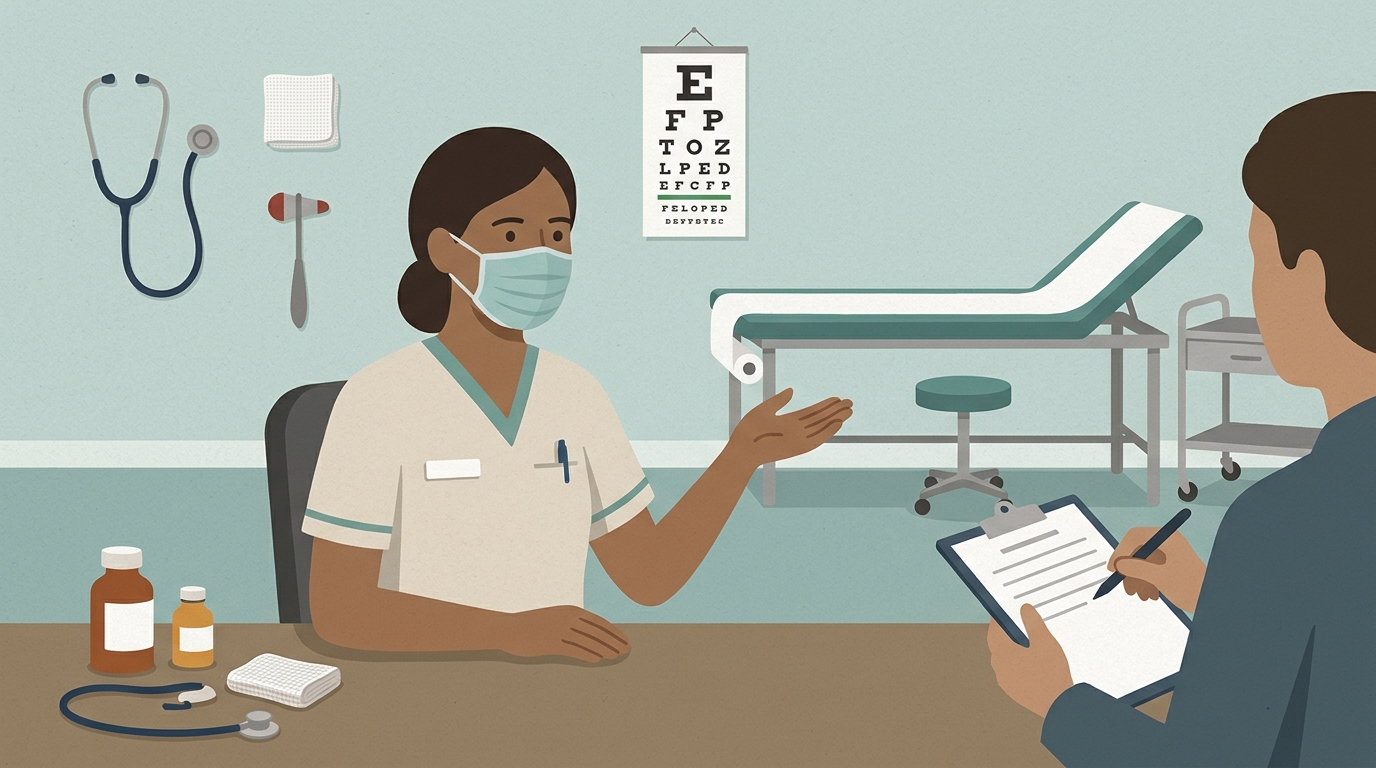
A medical assistant interview usually tests three things: whether you can run clinical tasks safely, whether you can keep a schedule and a chart moving, and whether your credentials match what the employer and your state expect. Preparation means having your training and certification documents in order, being able to describe your rooming and vitals routine step by step, and knowing which electronic health record the practice uses.
Hiring for medical assistant roles commonly runs one to three rounds — a recruiter or HR screen, a clinic or practice manager interview, and sometimes a panel with a lead medical assistant and a provider — though the number of rounds and the timeline vary by employer and by whether the site is a small private practice or part of a hospital system.
Step-by-Step Interview Preparation Plan
- Turn the posting into a one-page sheet. Write down the specialty (family medicine, pediatrics, ophthalmology, orthopedics), the exact clinical duties listed, the administrative duties, the hours, and whether the role is back office, front office or both. Reported job titles for this occupation range from Clinical Medical Assistant to Ophthalmic Assistant and Optometric Assistant (O*NET OnLine, U.S. Department of Labor, 2026), and each implies a different skills mix — note which one this posting matches.
- Confirm your credential status in writing. Some states require medical assistants to graduate from an accredited program, be licensed or certified, or meet other prerequisites in order to practice, and although most states do not require certification, employers may prefer or require it along with qualifications such as Basic Life Support (BLS) certification (U.S. Bureau of Labor Statistics, 2025). Produce a short list: credential name, issuing body, expiration date. The CMA (AAMA) is awarded through the Certifying Board of the American Association of Medical Assistants (AAMA, undated), the RMA is issued by American Medical Technologists (U.S. Department of Defense COOL, undated), and the CCMA is offered by the National Healthcareer Association for medical assistants providing direct patient care (National Healthcareer Association, undated). Check your own state's rules with its health or medical board.
- Build a numbers sheet from your practicum or last job. Medical assisting programs typically include supervised experience such as a practicum (U.S. Bureau of Labor Statistics, 2025), so use yours if you are new. Write down patients roomed per day, injection types given, whether you draw blood and how often, EKG or spirometry experience, specimen handling, and how many providers you supported at once.
- Name the EHR and prepare one story about it. Medical software associated with this occupation includes eClinicalWorks EHR software and Epic Systems, both listed as in-demand software (O*NET OnLine, U.S. Department of Labor, 2026). Look for the system name in the posting or the patient portal branding, or ask the recruiter. Then prepare a specific example: refill requests you processed, how you queued results for provider review, or how you corrected a charting error.
- Rehearse answers out loud, timed. Record yourself and keep each under 90 seconds. Expect versions of these:
"Walk me through exactly what you do from the moment you call a patient back to the moment the provider walks in."
I confirm name and date of birth, take them to the room, take vitals — manual blood pressure if the automatic cuff reads high — then review medications and allergies on screen with the patient, document the chief complaint in their own words, and flag anything abnormal in the chart before I tell the provider the room is ready.
"Tell me about a time a patient became upset with you."
Situation: A patient at our family practice had waited 40 minutes because the provider was pulled into an urgent visit. Task: I was rooming him and he wanted to leave without being seen. Action: I apologized, told him exactly how long the provider would be, took his vitals and history so the visit would run shorter, and offered to reschedule if he could not stay. Result: He stayed, the visit took about ten minutes, and he asked for me by name at his follow-up.
- Confirm the format, the people and the route. Ask the recruiter or office coordinator who conducts each stage — HR or recruiter phone screen, clinic or practice manager interview, panel with a lead medical assistant and a physician or nurse practitioner — and whether there is a hands-on skills check or a short terminology and EHR test. Then find three facts about the employer you can name aloud (number of providers and sites, a recent clinic opening or new service line, the competing practices in town), plus the building, the entrance to use, the parking cost and the drive time at the same hour as your interview.
Day-Before and Day-Of Checklist
- Three printed copies of your resume with your clinical skills as a bulleted block, not buried in prose.
- A folder with your certification wallet card or certificate (CMA, RMA, CCMA or other), the certifying organization's name and your credential number.
- Your current BLS card, since employers may require it (U.S. Bureau of Labor Statistics, 2025).
- Your diploma or transcript, plus the program's accreditation detail — graduates of programs accredited by CAAHEP or ABHES are eligible to take the CMA (AAMA) exam (American Association of Medical Assistants, undated).
- Any state-required license or registration document, since requirements differ by state (U.S. Bureau of Labor Statistics, 2025).
- Immunization and TB screening records, which many clinics request at or shortly after the interview.
- Photo ID for the badge desk or background check paperwork.
- A reference list with three names, job titles, phone numbers and emails, confirmed by call or text the day before.
- Clean scrubs or business casual, confirmed with the recruiter the day before, and closed-toe non-slip shoes if a skills demonstration is on the agenda.
- Hair tied back, short nails and no jewelry that would fail a hand-hygiene check, in case you are asked to show a blood pressure or injection technique, plus a watch with a second hand for counting pulse and respirations.
- A small notebook with your printed questions, the interviewers' names and titles, and the three facts you found about the practice.
- Phone silenced before you enter the building; walk in 10 to 15 minutes early, which usually means parking 25 to 30 minutes early on a hospital campus.
Questions to Ask Your Interviewer
- Which electronic health record does this clinic use, and how much of the visit documentation is the medical assistant expected to enter before the provider comes in?
- How many providers would I be assigned to, and how many patients does a medical assistant typically room in a day here?
- Which clinical tasks sit with the medical assistant in this office — injections, venipuncture, EKGs, specimen prep — and which go to the nurse?
- Are there standing orders or protocols I would work under, and who reviews them against this state's scope rules for medical assistants?
- How is the back office and front office split, and would I cover check-in, scheduling or prior authorizations on some days?
- Who would train me in the first few weeks — a lead medical assistant, a preceptor, or classroom onboarding — and how long before I carry a full schedule?
- Does the medical assistant team handle inventorying and ordering medical, lab and office supplies, a core task listed for this occupation (O*NET OnLine, U.S. Department of Labor, 2026), and how is that rotated?
- Do you support continuing education for recertification? The CMA (AAMA) renews every five years through continuing education units or re-examination (CareerOneStop, U.S. Department of Labor, undated), RMA holders need 30 CCP points over a three-year cycle (U.S. Department of Defense COOL, undated), and the CCMA renews every two years (National Healthcareer Association, undated).
- What would tell you, three months in, that you hired the right medical assistant for this team?
Frequently asked questions
How early should I arrive for a medical assistant interview?
Walk into the office 10 to 15 minutes before your appointment time. On a hospital or multi-building clinic campus, that usually means arriving 25 to 30 minutes early to park, find the staff or visitor entrance and clear a badge desk. If you get there very early, wait in the car and review your question list rather than sitting in the patient waiting room.
Should I wear scrubs or business clothes?
Ask the recruiter or office coordinator when the interview is scheduled, because expectations differ between small private practices and large health systems. If you are told there is a hands-on skills check, wear clean scrubs and closed-toe non-slip shoes. If there is no skills portion, business casual with a tidy, low-jewelry presentation is the safer default.
What kind of skills test might I be given?
Some employers add a short practical check during or after the manager interview: taking a manual blood pressure, measuring vitals, demonstrating hand hygiene, or a written quiz on medical terminology and abbreviations. Others ask you to navigate a demo EHR screen. Ask in advance what format it takes, how long it lasts and whether equipment is provided.
I just finished my program and am not certified yet. What do I say?
Say where you are in the process and give a date. Medical assistants typically need postsecondary education such as a certificate, and programs typically include supervised experience (U.S. Bureau of Labor Statistics, 2025) — so lead with your practicum hours and tasks. Then name the exam you have scheduled and the accredited program that makes you eligible.
How should I handle the pay question?
Medical assistant pay is usually hourly and set by the employer, varying by state, metro area, specialty and shift. Ask the recruiter for the posted range early, and check current national and state figures in the U.S. Bureau of Labor Statistics Occupational Outlook Handbook before you answer. Also ask what counts as overtime and whether certification affects the starting step.
Sources
- U.S. Bureau of Labor Statistics — Medical Assistants : Occupational Outlook Handbook (2025)
- O*NET OnLine (U.S. Department of Labor) — 31-9092.00 - Medical Assistants (2026)

Written by
Priya turns job-market numbers into something readable, chasing the story behind a wage chart or an unemployment figure. She's most interested in what statistics miss about an actual day at work.