 Hire Compass HQ
How to Become a Welder: Step-by-Step Guide
This trade rewards steady hands and spark tolerance more than classroom hours — here is what training, testing and your first year on the floor involve.
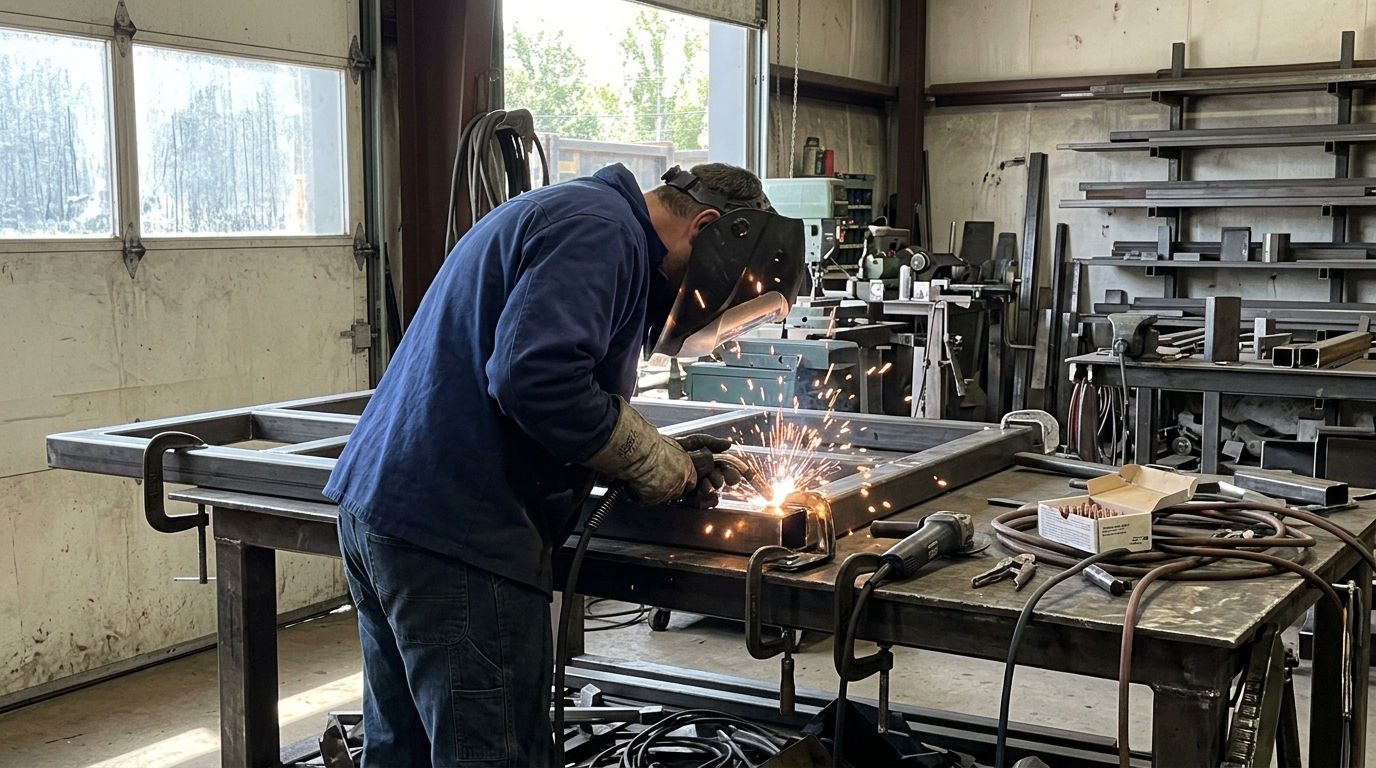
Welding is a trade you can enter with a high school diploma or equivalent as the typical entry-level education (U.S. Bureau of Labor Statistics, 2025), followed by moderate-term on-the-job training (U.S. Bureau of Labor Statistics, 2025). Most people get there through a community college certificate, a private trade school program, or an employer-based apprenticeship — some of which require no prior experience, while others target people who already finished a vocational-technical welding program (U.S. Bureau of Labor Statistics, 2025).
The median annual wage for welders, cutters, solderers and brazers was $53,750 in May 2025, or $25.84 per hour (U.S. Bureau of Labor Statistics). Employment is projected to grow 2 percent from 2025 to 2035, slower than the average for all occupations (U.S. Bureau of Labor Statistics, 2025), so hiring favors people who can pass a weld test on the spot.
Step-by-Step Path to This Career
- Finish a high school diploma or GED (4 years, or a few months of GED prep). This is the typical entry-level education for welders, cutters, solderers and brazers (U.S. Bureau of Labor Statistics, 2025). Take shop or drafting if offered, and get comfortable reading a tape measure down to 1/16 inch.
- Complete the electrical safety training OSHA requires of welders (a few days). The Occupational Safety and Health Administration requires welders to complete training on electrical safety (U.S. Bureau of Labor Statistics, 2025). Most programs build this in; if you are learning on the job, confirm you have had it before you strike an arc.
- Pick a training route and enroll (12 weeks to about one year). Your options are a community college welding certificate, a private technical or trade welding school, or an employer-based apprenticeship — and some apprenticeships require no prior experience at all (U.S. Bureau of Labor Statistics, 2025). ONET places the occupation in Job Zone 1-2, with job training ranging from a few days to one year (ONET OnLine, National Center for O*NET Development).
- Log booth hours on the main processes (3-9 months, alongside step 3). Work through stick (SMAW), MIG (GMAW) on a wire feeder, flux-cored (FCAW) and TIG (GTAW) with a foot pedal and filler rod. Expect equal time on an angle grinder, chop saw, plasma cutter and oxy-acetylene torch, because fit-up and cleanup are most of the work.
- Pass the AWS Certified Welder test at an accredited test facility (one test day; book 2-6 weeks ahead). The American Welding Society's Certified Welder credential is performance-based with no prerequisite courses or certifications, and tests procedures used in structural steel, petroleum pipelines, sheet metal and chemical refinery welding (American Welding Society / Indiana Department of Workforce Development). Pick the test that matches the work you want.
- Check licensing where you plan to work (1-2 weeks). Welders must be licensed in some states and localities, and requirements vary; contact the individual state or local licensing agency (U.S. Bureau of Labor Statistics, 2025). Do this before you move for a job.
- Take an entry-level job and keep the credential current (several months of supervised work, then every 3 years). Entry-level workers with formal technical training still receive several months of on-the-job training (U.S. Bureau of Labor Statistics, 2025). The AWS credential is good for 3 years with a renewal fee, and requires recertification by examination, approved endorsements, a recertification course or continuing education every 9 years (American Welding Society / Indiana Department of Workforce Development).
Education and Training Options Compared
| Path | Time | Typical Cost | Outcome |
|---|---|---|---|
| Community college welding certificate | Up to one year of job-level training for this Job Zone (O*NET OnLine) | Tuition and fees billed per credit hour, with the tool kit charged on top at colleges such as Alvin Community College in Texas (Lessons.com) | College-issued welding certificate plus transcripted credit hours |
| Private technical or trade welding school | 12 weeks for a Foundational Pipe Welder program (Western Welding Academy) | One all-inclusive tuition figure quoted by the school (Western Welding Academy), typically bundling tuition, tools and textbooks (Yahoo Finance, 2024) | School certificate of completion plus booth hours aimed at a pipe test |
| Employer-based apprenticeship | A few days to one year of job training (O*NET OnLine) | Paid by the employer; you earn while training | Moderate-term on-the-job training (U.S. Bureau of Labor Statistics, 2025) and a job you are already in |
| AWS Certified Welder test alone | One test day, booked weeks ahead | Exam fee set by the American Welding Society, which also lists related instructional hours (American Welding Society / Indiana Department of Workforce Development) | AWS Certified Welder credential, valid 3 years, no prerequisite courses |
Some apprenticeships require no prior experience, while others target applicants who have completed a vocational-technical welding program (U.S. Bureau of Labor Statistics, 2025) — read each posting before assuming you are unqualified.
What You'll Actually Be Doing Once You Start
Your first 6-12 months involve less arc time than you expect. Entry-level welders spend much of the day preparing: grinding mill scale and paint off joints with a 4.5-inch angle grinder, cutting stock on a band saw or plasma cutter, deburring edges, and tacking parts into a fixture so a more experienced welder can run the final pass. You will change contact tips and liners on the MIG gun, keep the wire feeder loaded, store stick electrodes properly, and sweep slag and spatter out of the booth at shift end.
The welding itself is usually repetitive and flat: short fillet welds on a production jig, brackets, or beads on parts inspected before shipping. You will learn to read a weld symbol on a shop print and to set voltage and wire-feed speed from a procedure sheet rather than by feel, with your work checked visually and with a fillet weld gauge by a lead welder.
Senior welders handle what you do not yet: out-of-position work overhead and vertical-up, code work on pipe or pressure vessels, qualifying to a written welding procedure specification, and deciding how an assembly gets fitted. That mentoring is why entry-level workers with formal technical training still receive several months of on-the-job training (U.S. Bureau of Labor Statistics, 2025).
Physically, you will kneel and lie on concrete to reach joints, hold your arms up under a helmet for sustained stretches, and work in leathers in a shop with no air conditioning in summer. You will take grinding sparks and spatter on your sleeves daily and be exposed to welding fume and arc light that require a correctly shaded helmet and extraction or a respirator. OSHA requires electrical safety training (U.S. Bureau of Labor Statistics, 2025) because the machines carry real shock risk in damp or confined spaces.
Costs and Time Investment
| Cost item | What to budget | Step |
|---|---|---|
| GED prep and test, if needed | Fee set by your state's testing agency — check its current price | Step 1 |
| OSHA-required electrical safety training | Usually included in program tuition; priced separately if taken standalone | Step 2 |
| Community college tuition and fees | Billed per credit hour, with the tool kit charged on top at colleges such as Alvin Community College in Texas (Lessons.com) | Step 3 |
| Private welding school tuition | One all-inclusive figure for a 12-week program (Western Welding Academy) | Step 3 |
| Tools, PPE and textbooks | Welding school totals typically bundle tuition, tools and equipment, and textbooks (Yahoo Finance, 2024); price hood, gloves, leathers and grinder separately if not supplied | Steps 3-4 |
| AWS Certified Welder exam fee | Set by the American Welding Society, which also lists related instructional hours (American Welding Society / Indiana Department of Workforce Development) | Step 5 |
| State or local license fee | Set by the state or local licensing agency, where licensing applies (U.S. Bureau of Labor Statistics, 2025) | Step 6 |
| AWS renewal fee | Charged every 3 years to keep the credential active (American Welding Society / Indiana Department of Workforce Development) | Step 7 |
Prices change each term and differ sharply between a public community college and a private trade school. Get a written total from each admissions office and from the AWS Accredited Test Facility you plan to use before you commit.
Common Entry Mistakes to Avoid
- Booking the AWS Certified Welder test (step 5) before you can run the position and thickness consistently. The test is performance-based (American Welding Society / Indiana Department of Workforce Development), so a wandering bead costs you the fee again. Fix: have an instructor watch you pass the exact coupon, in the exact position, three times in a row first.
- Testing on the wrong procedure. The program covers structural steel, petroleum pipelines, sheet metal and chemical refinery welding (American Welding Society / Indiana Department of Workforce Development). Fix: choose between structural and pipe before booking, and ask local shops which test they hire against.
- Assuming the credential works anywhere (step 6). Welders must be licensed in some states and localities, and requirements vary (U.S. Bureau of Labor Statistics, 2025). Fix: call the state or local licensing agency for the city you are moving to before you sign a lease.
- Enrolling without pricing tools separately (step 3). Some colleges charge the tool kit on top of tuition and fees (Lessons.com). Fix: ask admissions for an itemized list of what tuition covers — hood, gloves, leathers, grinder, textbooks.
- Expecting full welder duties on day one (step 7). Entry-level workers with formal technical training still receive several months of on-the-job training (U.S. Bureau of Labor Statistics, 2025), and much of year one is grinding, fit-up and tacking. Fix: treat the helper period as paid practice and ask for arc time on scrap during downtime.
Frequently asked questions
How long does it take to go from no experience to a paying welding job?
Job training for this occupation ranges from a few days to one year (O*NET OnLine, National Center for O*NET Development), and private programs such as a 12-week Foundational Pipe Welder course sit at the short end (Western Welding Academy). Community college certificates generally run longer because they follow semesters. Either way, plan on several more months of on-the-job training after hiring, even with formal technical training behind you (U.S. Bureau of Labor Statistics, 2025).
Do I need the AWS Certified Welder credential to get hired?
Not always — many employers run their own weld test — but the American Welding Society's Certified Welder credential is performance-based with no prerequisite courses or certifications required (American Welding Society / Indiana Department of Workforce Development). It is valid for 3 years with a renewal fee, and recertification is required every 9 years. It helps most when the test matches the work, such as a pipeline or structural steel procedure.
Does a welding credential transfer between states?
The AWS Certified Welder credential is issued nationally by the American Welding Society, but welders must be licensed in some states and localities and requirements vary (U.S. Bureau of Labor Statistics, 2025). Contact the individual state or local licensing agency for the area where you want to work. Employers commonly require their own weld test regardless of what you hold.
Is the job market worth the training cost?
Employment of welders, cutters, solderers and brazers is projected to grow 2 percent from 2025 to 2035, slower than the average for all occupations (U.S. Bureau of Labor Statistics, 2025), so most openings come from replacement. The median annual wage was $53,750 in May 2025, or $25.84 per hour (U.S. Bureau of Labor Statistics). Weigh that against your quoted total, since welding school costs typically bundle tuition, tools and textbooks (Yahoo Finance, 2024).
Can I skip school and learn entirely on the job?
Sometimes. Workers may enter through an employer-based apprenticeship, and some apprenticeships require no prior experience while others target applicants who completed a vocational-technical welding program (U.S. Bureau of Labor Statistics, 2025). Whichever route you take, OSHA requires welders to complete electrical safety training, so confirm your employer provides it.
Sources
- U.S. Bureau of Labor Statistics — Welders, Cutters, Solderers, and Brazers : Occupational Outlook Handbook (2025-05)
- O*NET OnLine (National Center for O*NET Development) — 51-4121.00 - Welders, Cutters, Solderers, and Brazers

Written by
Felix writes a column on the inner life of work — burnout, ambition, the quiet math people do about whether a job is worth it. He prefers plain language to management jargon and says so often.