 Hire Compass HQ
A Day in the Life of a Medical Assistant
Rooming patients, drawing specimens, chasing referrals and answering a phone that never stops — here is how a medical assistant's clinic day actually splits up.
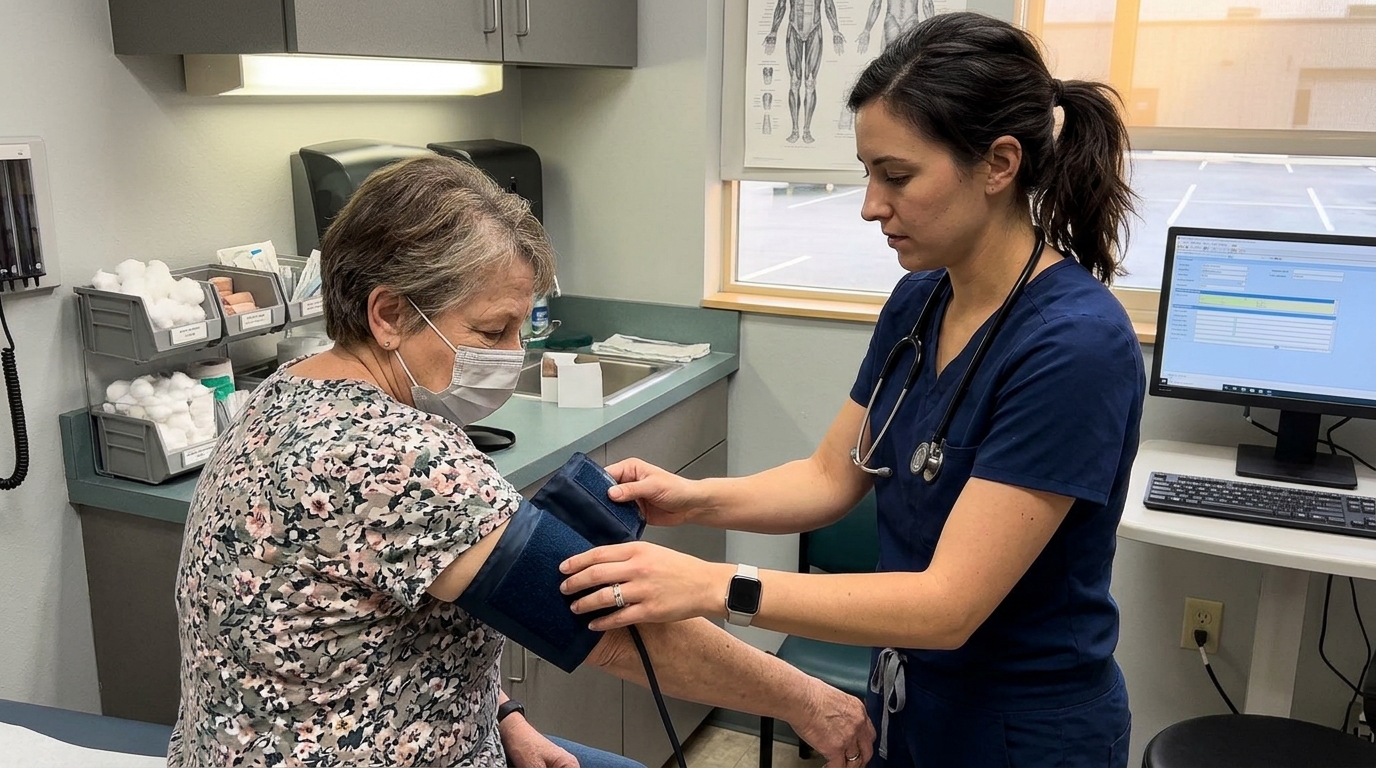
A medical assistant's day moves between two jobs at once: the clinical side — vital signs, specimens, injections, prepping treatment rooms — and the administrative side, from scheduling to documenting medical histories (U.S. Bureau of Labor Statistics, 2025). Most work full time, and in hospitals or other facilities open around the clock, that can mean evening, weekend or holiday shifts (U.S. Bureau of Labor Statistics, 2025).
What a shift looks like depends heavily on the setting. The largest employers are physicians' offices, hospitals, outpatient care centers, and offices of other health practitioners (U.S. Bureau of Labor Statistics, 2025), and a specialty clinic day looks nothing like a busy hospital float assignment.
Hour-by-Hour Schedule
This is a representative weekday in a primary care or specialty office. Hospital and outpatient schedules shift the same tasks into different hours.
- 7:15 AM — Opens and preps. Unlocks exam rooms, checks that each treatment room is stocked and the table paper changed, and confirms the autoclave cycle from the night before ran to completion. Preparing treatment rooms is a standard daily task for this occupation (O*NET OnLine).
- 7:40 AM — Morning huddle. Reviews the day's schedule with the provider — typically 18 to 28 patients — and flags which visits need labs drawn, which need an interpreter, and which are new patients with no records on file.
- 8:00 AM — First rooming block. Interviews patients to obtain medical information, measures vital signs, weight and height, and records the history in the chart (O*NET OnLine). A rooming takes roughly 5 to 8 minutes per patient.
- 9:00 AM — Specimen collection. Collects, logs and prepares blood or tissue specimens for testing (O*NET OnLine) — labeling at the bedside, spinning tubes, and matching each requisition before the courier pickup.
- 9:45 AM — Injections and point-of-care testing. Administers what the provider orders and state scope allows, documents lot numbers and sites, and runs rapid tests, logging results into the chart.
- 10:30 AM — Room turnover and sterilization. Cleans and sterilizes instruments and disposes of contaminated supplies (O*NET OnLine) between procedure patients, then restocks suture trays and gauze.
- 11:15 AM — Phone block. Returns patient calls, relays provider instructions and reschedules. Telephone conversations are a daily feature of the job (O*NET OnLine).
- 12:15 PM — Staggered lunch. Often 30 minutes, often interrupted if a walk-in arrives or a result needs calling back.
- 1:00 PM — Afternoon rooming resumes. Same rhythm as the morning, plus explaining treatment procedures and the physician's instructions to patients before they leave (O*NET OnLine).
- 2:30 PM — Referrals and documentation. Works the chart queue: scanning outside records, entering test results, and sending referral and prior authorization requests through the electronic health record.
- 4:00 PM — Same-day add-ons. Triage calls that became appointments arrive now; rooming compresses to three or four minutes to keep the schedule from collapsing.
- 5:15 PM — Close down. Wipes surfaces, discards sharps containers at the fill line, restocks for the morning, confirms no results are sitting unacknowledged, and signs out.
In a hospital or outpatient center with around-the-clock hours, the same block of work may run 3:00 PM to 11:30 PM or on a weekend rotation (U.S. Bureau of Labor Statistics, 2025).
The Good and the Challenging Parts
The parts people stay for are usually specific moments, not the job description.
One is catching something. You take a routine blood pressure at rooming, see a reading far outside the patient's normal range, repeat it manually, and tell the provider before they walk in — the visit changes course because of a measurement you took. Another is the first-stick blood draw on a patient who told you they faint every time: you talk them through it, the tube fills, and they leave without incident. A third is quieter — a patient who did not understand their discharge instructions in the room asks you on the way out, and your plain-language explanation of the physician's instructions (O*NET OnLine) is what actually gets the medication taken correctly.
The frustrations are equally concrete. The schedule is the main one: a 15-minute slot that needs 30 minutes puts you behind by mid-morning, and every patient after that is waiting because of a delay you did not cause but have to apologize for. Administrative work piles up behind clinical work — referral and authorization requests sit in a queue while you are rooming, so documentation gets finished after the last patient leaves rather than during the day.
The constant contact with others reported in this occupation (ONET OnLine) cuts both ways. You are rarely alone, which suits some people and exhausts others by 4:00 PM. And workers report exposure to disease or infections every day (ONET OnLine) — gloves, hand hygiene and masking are routine, not occasional.
Scope is a recurring irritation. What you are permitted to do varies: some states require medical assistants to graduate from an accredited program, hold a license or certification, or meet other prerequisites, while most states do not require certification — though employers may prefer or require it, along with credentials such as Basic Life Support (U.S. Bureau of Labor Statistics, 2025). A task you performed daily in one state or clinic may not be yours to do in the next one.
Tools, Equipment, and Work Environment
- Electronic health record systems — eClinicalWorks EHR software, Epic Systems and MEDITECH software are among the medical software technologies used in this occupation (O*NET OnLine). Most of your documentation, orders and messaging lives in one of them.
- Medical condition coding software (O*NET OnLine), used when entering diagnoses and supporting billing and referral paperwork.
- Vital signs equipment — automated and manual blood pressure cuffs, digital thermometers, pulse oximeters, a stadiometer and a floor scale, used to measure vital signs, weight and height at nearly every rooming (O*NET OnLine).
- Phlebotomy and specimen handling supplies — tubes, butterfly needles, tourniquets, a centrifuge, specimen labels and a sharps container, for collecting, logging and preparing blood or tissue specimens (O*NET OnLine).
- An autoclave and disinfection supplies, for cleaning and sterilizing instruments and disposing of contaminated supplies between patients (O*NET OnLine).
- Personal protective equipment — workers report wearing common protective or safety equipment such as safety shoes, glasses and gloves every day (O*NET OnLine).
- A multi-line phone or headset, since telephone conversations occur daily (O*NET OnLine) — triage callbacks, results, pharmacies and scheduling.
- An indoor, environmentally controlled setting, reported every day in this occupation (O*NET OnLine): exam rooms, hallways and a shared workstation, with either a lot of standing and walking between patients or long seated stretches on administrative tasks (U.S. Bureau of Labor Statistics, 2025).
Frequently asked questions
How long are the shifts, and do I have to work weekends?
Most medical assistants work full time (U.S. Bureau of Labor Statistics, 2025). In physicians' offices, that usually tracks clinic hours; in hospitals and other facilities open around the clock, evening, weekend and holiday shifts are part of the rotation (U.S. Bureau of Labor Statistics, 2025). Ask at interview which of the four largest employer settings — physicians' offices, hospitals, outpatient care centers, or offices of other health practitioners (U.S. Bureau of Labor Statistics, 2025) — the role sits in, because the schedule follows from that.
Is the job physically hard on you?
It depends on the role. Some medical assistants spend a lot of time standing or walking as they visit patients, while others sit at a computer for much of the day on administrative tasks (U.S. Bureau of Labor Statistics, 2025). Expect daily exposure to disease or infections and daily use of protective equipment such as gloves and safety glasses (O*NET OnLine), which is why supportive, closed-toe safety shoes are standard.
Can any of this be done remotely?
The clinical half cannot. Rooming patients, measuring vital signs, preparing treatment rooms, sterilizing instruments and collecting specimens all happen in person, in an indoor clinical setting reported daily for this occupation (O*NET OnLine). Some administrative tasks — scheduling, records, referral paperwork — can be structured remotely by certain employers, but a medical assistant job posting generally means on-site.
How long does it take to be ready for a first shift?
Medical assistants typically need postsecondary education such as a certificate, though some enter with a high school diploma and learn on the job (U.S. Bureau of Labor Statistics, 2025). Postsecondary programs take about 1 or 2 years and include medical terminology, anatomy and pharmacology plus a supervised practicum (U.S. Bureau of Labor Statistics, 2025); on-the-job training may take several months depending on the facility (U.S. Bureau of Labor Statistics, 2025). Many employers prefer or insist on CMA (AAMA) certification, which is tied to graduating from a CAAHEP- or ABHES-accredited program (American Association of Medical Assistants).
Sources
- U.S. Bureau of Labor Statistics — Medical Assistants : Occupational Outlook Handbook (2025)
- O*NET OnLine — 31-9092.00 - Medical Assistants

Written by
Mireille thinks about work the way some people think about weather: always shifting, worth tracking closely. She edits pieces on hiring trends and the small negotiations that shape a career, and has little patience for advice that assumes everyone wants the same thing from a job.