 Hire Compass HQ
What Does a Veterinary Technician Do? Duties, Skills, and Salary
From restraining a nervous dog for radiographs to running blood counts before surgery, here is how the role works and what credentialing actually takes.

A veterinary technician is the credentialed nurse of a veterinary team: working under a licensed veterinarian, they run the medical tests that help diagnose animals' injuries and illnesses, give treatments, and monitor patients under anesthesia (U.S. Bureau of Labor Statistics, August 2025). Most enter with a two-year associate's degree in veterinary technology, and most states require passing the Veterinary Technician National Examination (VTNE) to become credentialed (U.S. Bureau of Labor Statistics, 2025 and 2024).
It is hands-on, physical work. Veterinary technologists and technicians have one of the highest rates of injuries and illnesses of all occupations, including bites, scratches and kicks (U.S. Bureau of Labor Statistics, 2025).
What Does a Veterinary Technician Actually Do?
A veterinary technician performs medical tests, nursing care and treatments on animal patients under the supervision of a licensed veterinarian (U.S. Bureau of Labor Statistics, August 2025). The job exists so the veterinarian can diagnose and operate while someone else collects the samples, runs the lab work, keeps the patient stable and explains discharge instructions to the owner.
The outputs are concrete. Over one shift you might produce a set of radiographs, a completed blood count and urinalysis, an anesthetic record covering a two-hour orthopedic surgery, a sterilized surgery pack, a dozen vaccines drawn up and given, and a written case history taken before the exam (U.S. Bureau of Labor Statistics, 2025; O*NET OnLine, 2026). Technicians are educated to function as the veterinarian's nurse, laboratory technician, radiography technician, anesthetist, surgical nurse and client educator (National Association of Veterinary Technicians in America, undated).
The job is most often confused with that of a veterinary assistant. Assistants help with restraint, cleaning and husbandry, but graduates of veterinary assistant certificate programs are generally not eligible to sit for the credentialing exam in most states, because those are assistant programs rather than veterinary technology programs (National Association of Veterinary Technicians in America, undated). The credential is the dividing line, and it shows in the title: Certified Veterinary Technician (CVT), Licensed Veterinary Technician (LVT) and Registered Veterinary Technician (RVT) are all reported titles for the same occupation, with the wording set by the state (O*NET OnLine, 2026).
Typical Daily Responsibilities
- Collects case histories from owners at the start of each appointment, recording weight, diet, medications and the reason for the visit before the veterinarian enters the room (U.S. Bureau of Labor Statistics, 2025).
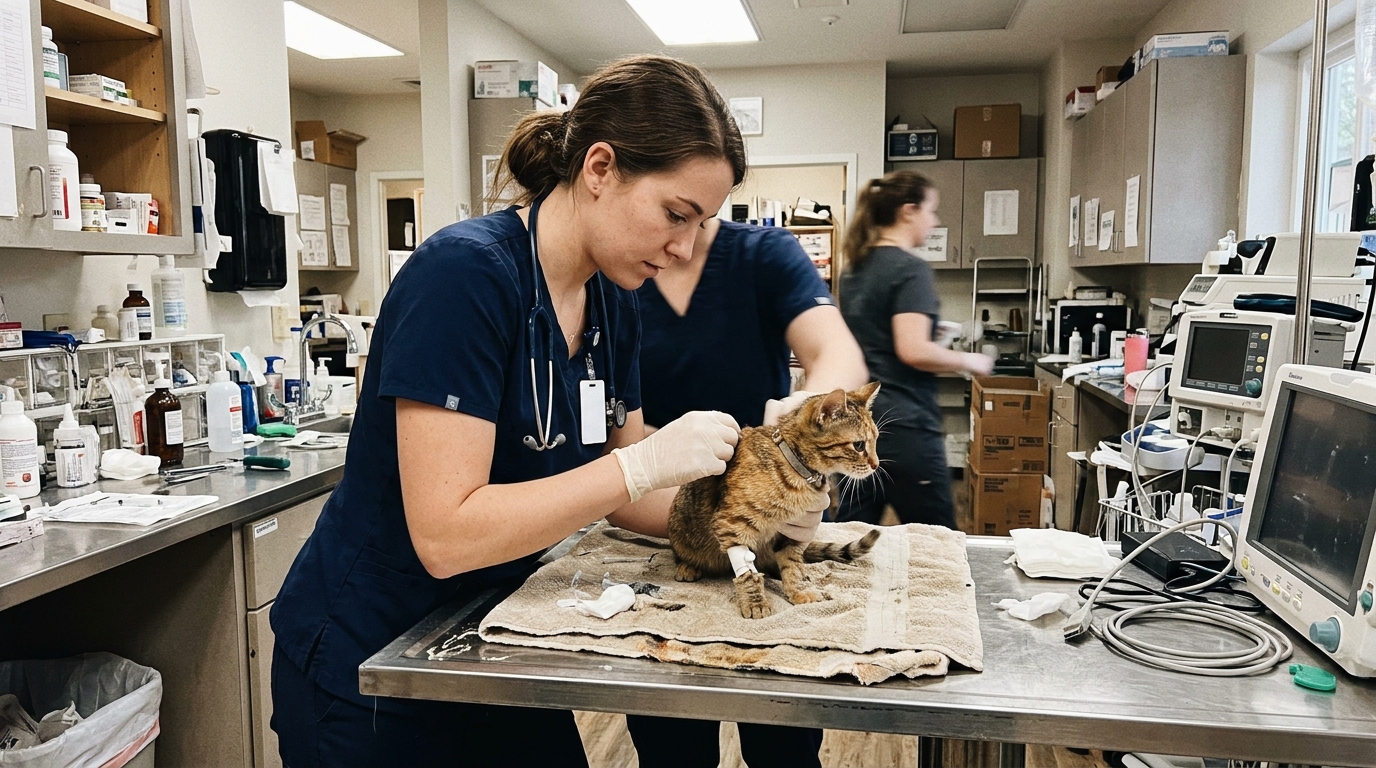
- Restrains animals for physical exams, nail trims and sample collection all day, positioning each patient so the veterinarian can work safely (U.S. Bureau of Labor Statistics, 2025).
- Draws blood and runs in-house lab work such as blood counts and urinalyses, usually batching morning draws so results are back before midday surgeries (U.S. Bureau of Labor Statistics, 2025; O*NET OnLine, 2026).
- Takes radiographs, repositioning the patient for each view and checking exposure before the veterinarian reads the images (U.S. Bureau of Labor Statistics, 2025).
- Administers anesthesia for scheduled surgical cases and logs heart rate, respiration, blood pressure and temperature on the anesthetic record at set intervals until recovery (U.S. Bureau of Labor Statistics, 2025).
- Prepares animals and instruments on procedure days: clipping and scrubbing the surgical site, then cleaning, packing and sterilizing instruments between cases (O*NET OnLine, 2026).
- Prepares and gives vaccines, serums and prescribed medications during appointments and to hospitalized patients on their treatment schedule (U.S. Bureau of Labor Statistics, 2025; O*NET OnLine, 2026).
- Observes behavior and provides nursing care or emergency first aid, checking inpatients on rounds at the start and end of each shift, bathing or grooming animals when a medical condition requires it, and packaging tissue samples before the daily courier pickup (U.S. Bureau of Labor Statistics, 2025; O*NET OnLine, 2026).
Skills, Tools, and Qualifications
| Requirement/Skill | Why It's Needed | How to Get It |
|---|---|---|
| Associate's degree in veterinary technology (AVMA CVTEA-accredited) | Technicians typically need a 2-year associate's degree; technologists usually need a 4-year bachelor's degree (U.S. Bureau of Labor Statistics, 2025) | Enroll in a program accredited by the AVMA Committee on Veterinary Technician Education and Activities; all students complete clinical experience in a veterinary practice (American Veterinary Medical Association, undated) |
| Veterinary Technician National Examination (VTNE) | Most states require it for credentialing as a CVT, LVT or RVT (U.S. Bureau of Labor Statistics, 2024) | Sit the exam through the American Association of Veterinary State Boards after graduating; eligibility varies by state board |
| State credential (CVT, LVT or RVT) | Title and scope of practice differ by state, and employers hire to the state's wording (O*NET OnLine, 2026) | Apply to your state veterinary board after passing the VTNE and check its own jurisprudence and continuing education rules |
| Anesthesia, radiography and lab equipment | Daily work includes induction and monitoring, x-rays, blood counts and tissue prep (U.S. Bureau of Labor Statistics, 2025; O*NET OnLine, 2026) | Clinical rotations plus on-the-job training on the digital radiography unit, anesthesia machine and vaporizer, multiparameter monitor, infusion pumps, centrifuge, microscope, autoclave and in-house hematology and chemistry analyzers |
| Manual dexterity (hard skill) | Needed for venipuncture, intubation, catheter placement and instrument handling (U.S. Bureau of Labor Statistics, 2025) | Repetition during clinical placements; CVTEA graduates are deemed competent in over 300 essential skills (American Veterinary Medical Association, undated) |
| Physical strength (soft/physical) | Required to manage and lift animals safely (U.S. Bureau of Labor Statistics, 2025) | Team lifting and restraint technique taught in training and reinforced on the job |
| Communication and compassion (soft) | You take histories and act as client educator, often while delivering bad news (U.S. Bureau of Labor Statistics, 2025; National Association of Veterinary Technicians in America, undated) | Client-communication coursework, then supervised discharge appointments |
| Veterinary Technician Specialist (VTS) | Optional specialization, for example emergency and critical care or anesthesia | Complete a NAVTA/CVTS-approved specialty academy's certification process and exam; as of April 2022 there were 16 approved academies (National Association of Veterinary Technicians in America, April 2022) |
Salary and Job Outlook
| Metric | Figure | Source/Year |
|---|---|---|
| National median annual wage | Published on the occupation's Occupational Outlook Handbook page; check it there for the current figure | U.S. Bureau of Labor Statistics, May 2025 |
| Top 10 percent earned more than | $63,180 per year | U.S. Bureau of Labor Statistics, May 2025 |
| Bottom 10 percent earned less than | The low-end threshold is published alongside the median in the same wage release | U.S. Bureau of Labor Statistics, May 2025 |
| Projected employment growth, 2025-2035 | Much faster than the average for all occupations | U.S. Bureau of Labor Statistics, 2025 |
| Projected annual job openings | An annual average is published for the decade | U.S. Bureau of Labor Statistics, 2025 |
| Share working in veterinary services | 89 percent | U.S. Bureau of Labor Statistics, 2025 |
Pay is almost always an hourly wage rather than a salary, with overtime, on-call or shift differentials in emergency and 24-hour hospitals. It varies by state, metro area and employer type — general practice, specialty referral, research, shelter or government. For current numbers, use the BLS Occupational Employment and Wage Statistics tables for veterinary technologists and technicians rather than job-board averages, and compare states from the same release year.
How to Get Started
- Confirm the credential your state uses (1-2 weeks). Check your state veterinary board for whether it issues a CVT, LVT or RVT, what it requires beyond the VTNE, and which programs it accepts. Requirements vary by state, so do this before paying tuition.
- Get hands-on exposure first (2-6 months). Work or volunteer as an assistant, kennel attendant or shelter volunteer. You will find out quickly whether you can handle restraint, euthanasia appointments and the risk of bites, scratches and kicks (U.S. Bureau of Labor Statistics, 2025).
- Enroll in an AVMA CVTEA-accredited program (2 years for an associate's degree, 4 years for a bachelor's). Most accredited programs lead to an associate's degree; some lead to a bachelor's, the usual route for the technologist title (American Veterinary Medical Association, undated; U.S. Bureau of Labor Statistics, 2025). Do not substitute a veterinary assistant certificate — those graduates are generally not eligible for the credentialing exam in most states (National Association of Veterinary Technicians in America, undated).
- Complete the clinical experience built into the program. It is required of all students in accredited programs, and graduates are deemed competent in over 300 essential skills (American Veterinary Medical Association, undated). Keep a skills log of anesthetic cases, venipunctures and radiographic views; it works as your portfolio at interview.
- Apply for and pass the VTNE (allow 2-4 months from application to result). The exam is offered by the American Association of Veterinary State Boards and is required by most states (U.S. Bureau of Labor Statistics, 2024).
- Apply for your state credential, then your first job (1-3 months). Send your exam result and transcripts to the board, then apply to practices — 89 percent of the occupation works in veterinary services (U.S. Bureau of Labor Statistics, 2025). Later, specialization is possible through a NAVTA/CVTS-approved academy (National Association of Veterinary Technicians in America, April 2022).
Frequently asked questions
How long does it take to become a veterinary technician?
The usual route is a two-year associate's degree in veterinary technology; the technologist title usually requires a four-year bachelor's degree (U.S. Bureau of Labor Statistics, 2025). Add roughly 2-4 months after graduation to apply for, sit and receive results from the VTNE, plus the time your state board takes to issue the credential. Most people go from first class to credentialed and working in about 2.5 to 3 years.
What is the difference between a veterinary technician and a veterinary assistant?
A credentialed technician is educated to work as the veterinarian's nurse, laboratory technician, radiography technician, anesthetist, surgical nurse and client educator (National Association of Veterinary Technicians in America, undated). Assistants support those tasks but hold no credential, and graduates of assistant certificate programs are generally not eligible to sit for the credentialing exam in most states. If you want to induce anesthesia and run diagnostics, you need an AVMA CVTEA-accredited technology program.
Do I need a license in every state?
Most states require you to pass the Veterinary Technician National Examination, offered by the American Association of Veterinary State Boards, to become credentialed (U.S. Bureau of Labor Statistics, 2024). The title differs by state — Certified, Licensed or Registered Veterinary Technician — and so do extras such as jurisprudence exams and continuing education (O*NET OnLine, 2026). Check your own state board before choosing a program, because reciprocity between states is not automatic.
How much do veterinary technicians earn, and is the job market growing?
The BLS publishes a national median annual wage for the occupation in its May 2025 wage data, and the highest-paid 10 percent earned more than $63,180 a year (U.S. Bureau of Labor Statistics, May 2025). Pay is usually hourly, with differentials for overnight and emergency shifts, and varies by state, metro area and practice type. Employment is projected to grow much faster than the average for all occupations from 2025 to 2035, and 89 percent of these jobs are in veterinary services (U.S. Bureau of Labor Statistics, 2025).
Is the work physically dangerous?
Yes, more than most jobs. Veterinary technologists and technicians have one of the highest rates of injuries and illnesses of all occupations, including being bitten, scratched or kicked (U.S. Bureau of Labor Statistics, 2025). Physical strength to manage and lift animals is listed as an important quality, so if a back or hand injury limits lifting and restraint, think hard before committing to a two-year program.
Sources
- U.S. Bureau of Labor Statistics — Veterinary Technologists and Technicians : Occupational Outlook Handbook (2025-08)
- U.S. Bureau of Labor Statistics — Veterinary Technologists and Technicians : Occupational Outlook Handbook (print version) (2024)

Written by
Felix writes a column on the inner life of work — burnout, ambition, the quiet math people do about whether a job is worth it. He prefers plain language to management jargon and says so often.