 Hire Compass HQ
Vet Tech vs Vet Assistant: Which Career Fits You?
One role runs anesthesia and lab work after a two-year degree; the other starts with a high school diploma and on-the-job training.
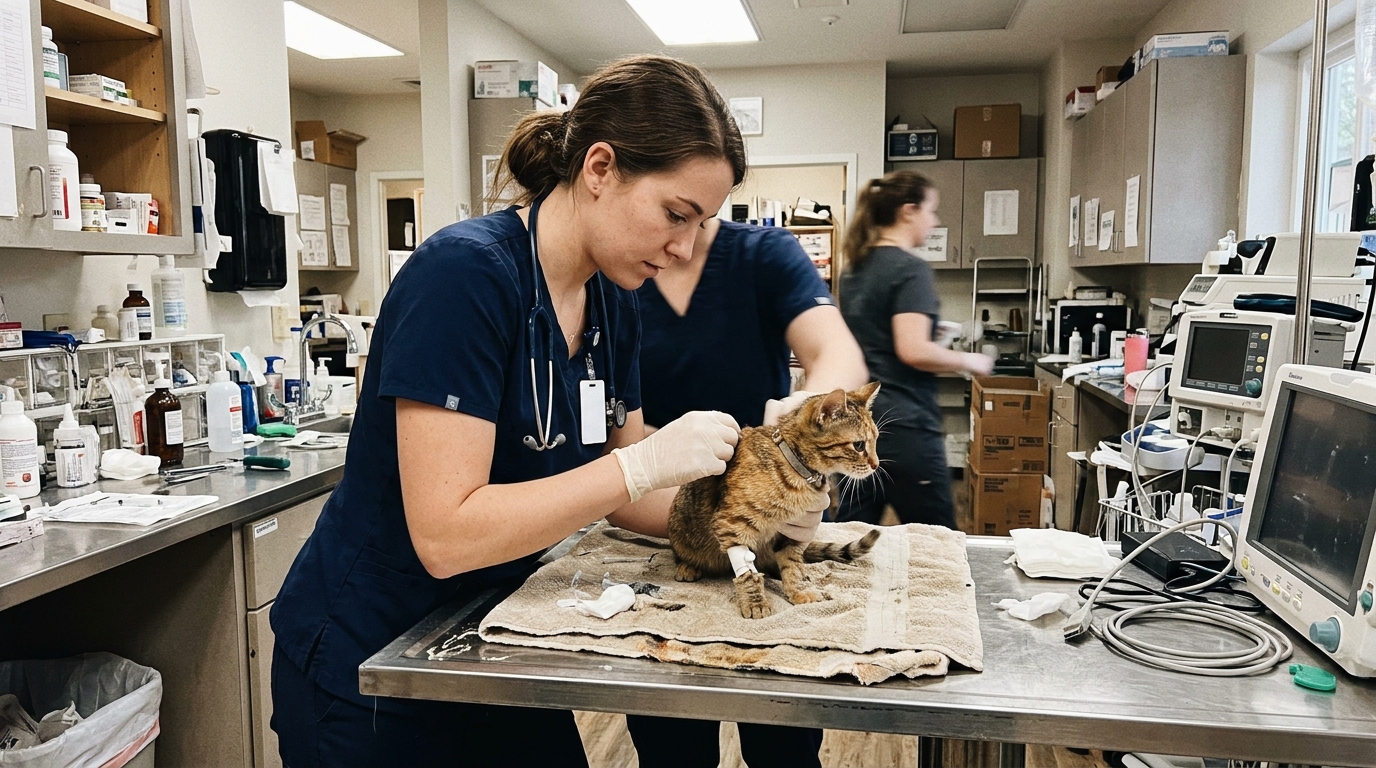
Veterinary technicians and veterinary assistants work in the same treatment rooms, but a credential separates them. Technicians typically complete an associate's degree and, in most states, pass a credentialing exam before they can administer anesthesia, take x-rays and run blood counts (U.S. Bureau of Labor Statistics, 2025). Assistants usually enter with a high school diploma or equivalent and learn through short-term on-the-job training, focused on feeding, bathing, cleaning, restraint and sterilizing instruments (U.S. Bureau of Labor Statistics, 2025).
Both occupations are projected to grow 9% from 2025 to 2035 (U.S. Bureau of Labor Statistics, 2025), so the choice turns less on job availability and more on how much schooling you want to do first and how much clinical responsibility you want to carry.
Side-by-Side Comparison
Core daily tasks
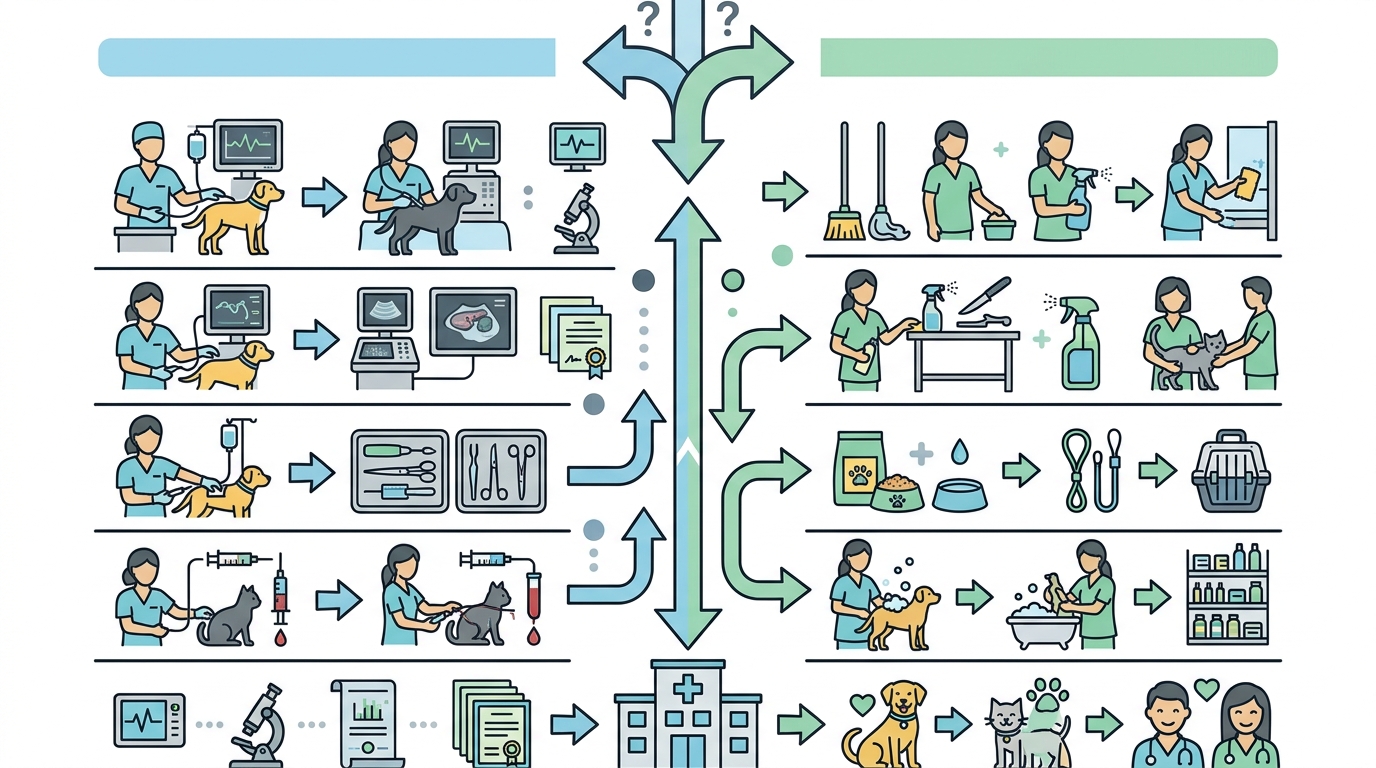
A technician's day is built around clinical procedures: observing animal behavior and condition, restraining animals during exams, administering anesthesia and medications, taking x-rays, and performing laboratory tests such as urinalyses and blood counts (U.S. Bureau of Labor Statistics, 2025). In practice that can mean monitoring anesthesia for every surgical patient on the day's list — several spays, neuters and dentals before lunch — then running in-house bloodwork between appointments and charting the results for the veterinarian.
An assistant's day is built around animal care and room turnover: feeding, bathing and exercising animals, cleaning and disinfecting cages and exam and operating rooms, restraining animals, maintaining and sterilizing instruments, and assisting in collecting blood, urine and tissue samples (U.S. Bureau of Labor Statistics, 2025). That usually means feeding and walking every hospitalized or boarded animal first thing, disinfecting each exam room between appointments, and running instrument packs through the autoclave after each surgery.
The overlap is restraint and sample collection. The split is who delivers the anesthesia and who runs the test — that is technician work (U.S. Bureau of Labor Statistics, 2025).
Required education and credentials
| Requirement | Veterinary technician | Veterinary assistant |
|---|---|---|
| Typical entry-level education | Associate's degree (U.S. Bureau of Labor Statistics, 2025) | High school diploma or equivalent (U.S. Bureau of Labor Statistics, 2025) |
| Longer path | Technologists usually need a 4-year bachelor's degree; technicians a 2-year associate's degree (U.S. Bureau of Labor Statistics, 2025) | Short-term on-the-job training after hire (U.S. Bureau of Labor Statistics, 2025) |
| Exam | Most states require passing the Veterinary Technician National Examination (VTNE), offered by the American Association of Veterinary State Boards (U.S. Bureau of Labor Statistics) | None required |
| Certification | Registered, licensed or certified in most states, with the title set by the state | Not mandatory, but demonstrates competency in animal husbandry, health and welfare, and facility administration (U.S. Bureau of Labor Statistics, 2025) |
The credential's name depends on where you work: reported titles include Certified Veterinary Technician (CVT), Licensed Veterinary Technician (LVT) and Registered Veterinary Technician (RVT) (ONET OnLine, U.S. Department of Labor). The VTNE evaluates entry-level technicians' competency to practice, and most states and provinces require a passing score as one criterion for credentialing (New York State Association of Veterinary Technicians), so check your own state veterinary board before enrolling anywhere. For assistants, ONET lists Job Zone Two, "Some Preparation Needed" — a high school diploma plus a few months to one year of on-the-job experience (O*NET OnLine, U.S. Department of Labor).
Typical schedule
Both jobs follow the animals, not the clock. Technologists and technicians may have to work evenings, weekends or holidays, because hospitalized patients need monitoring and emergency clinics run overnight (U.S. Bureau of Labor Statistics, 2025). Some veterinary assistants and laboratory animal caretakers work part time, and they may work nights, weekends or holidays (U.S. Bureau of Labor Statistics, 2025). Part-time patterns are explicitly common among assistants, which makes the role easier to combine with school. Exact shifts depend on the employer — a single-doctor general practice, a 24-hour emergency hospital, a shelter and a university research facility all schedule differently.
Physical demands
Neither job is a desk job. Technologists and technicians have one of the highest rates of injuries and illnesses of all occupations, including being bitten, scratched or kicked by scared or aggressive animals (U.S. Bureau of Labor Statistics, 2025). Assistants and laboratory animal caretakers also have one of the highest rates of injuries and illnesses of all occupations, and the work may be physically and emotionally demanding, including assisting in euthanizing animals (U.S. Bureau of Labor Statistics, 2025). The strain differs in shape: assistants spend more of the shift lifting, bathing, walking and sanitizing kennels; technicians spend more of it standing at a table restraining patients, positioning animals for x-rays and handling anesthetic agents.
Salary and Growth Comparison
Both columns use the same source and the same reference year — the U.S. Bureau of Labor Statistics, 2025 — so the two occupations are measured the same way.
| Metric | Veterinary technologists and technicians | Veterinary assistants and laboratory animal caretakers | Source/Year |
|---|---|---|---|
| Median pay, per year | $47,380 | $38,150 | U.S. Bureau of Labor Statistics, 2025 |
| Median pay, per hour | $22.78 | $18.34 | U.S. Bureau of Labor Statistics, 2025 |
| Typical entry-level education | Associate's degree | High school diploma or equivalent | U.S. Bureau of Labor Statistics, 2025 |
| Jobs held | 131,400 | 132,100 | U.S. Bureau of Labor Statistics, 2025 |
| Projected growth, 2025-2035 | 9% | 9% | U.S. Bureau of Labor Statistics, 2025 |
| Projected employment change, 2025-2035 | +12,300 | +12,000 | U.S. Bureau of Labor Statistics, 2025 |
Median means half of workers earned more and half earned less, so these are midpoints, not starting figures — new hires in either role commonly earn below the median.
Pay is usually structured as an hourly wage in both roles, with overtime beyond the standard week and shift differentials common for overnight, weekend and holiday coverage in hospitals that run 24 hours. Some practices add a pay step for a state credential or specialty certification. Rates vary by state, by metro area and by employer type — general practice, emergency and specialty, shelter and research facilities do not pay alike. Check Bureau of Labor Statistics state and metro wage data and current local postings before treating any national number as what you would earn.
On growth, the two are effectively tied: 9% projected growth for each from 2025 to 2035, on bases of 131,400 and 132,100 jobs held in 2025 (U.S. Bureau of Labor Statistics, 2025). Neither path has a national demand advantage, and no projection guarantees anyone a job.
Which One Fits You
If you want to start working within a year. The assistant role is the faster entry: a high school diploma or equivalent plus short-term on-the-job training, with ONET describing preparation as a diploma plus a few months to one year of on-the-job experience (U.S. Bureau of Labor Statistics, 2025; ONET OnLine, U.S. Department of Labor). The technician route adds a 2-year associate's degree and, in most states, the VTNE before you can be credentialed (U.S. Bureau of Labor Statistics, 2025).
If the higher median pay matters most. Go technician. Median pay was $47,380 a year for technologists and technicians against $38,150 for assistants and laboratory animal caretakers (U.S. Bureau of Labor Statistics, 2025). You are trading roughly two years of schooling and an exam for that difference, so weigh tuition and reduced earnings while you study.
If you want to perform clinical procedures rather than support them. Only the technician scope includes administering anesthesia and medications, taking x-rays and performing urinalyses and blood counts (U.S. Bureau of Labor Statistics, 2025). If monitoring an anesthetized patient is the part of the job you want, the degree and credential are the gate, not an optional extra.
If hands-on animal husbandry is the point, or you need part-time hours. Assistants spend more of the day feeding, bathing and exercising animals and keeping cages, exam rooms and operating rooms disinfected, and part-time work is specifically noted for this occupation alongside nights, weekends and holidays (U.S. Bureau of Labor Statistics, 2025). Working as an assistant while studying for a technician degree is a common way to do both.
If you are weighing the physical and emotional load. Both occupations have one of the highest rates of injuries and illnesses of all occupations, and assistant work is additionally described as physically and emotionally demanding, including assisting in euthanizing animals (U.S. Bureau of Labor Statistics, 2025). Neither role avoids this.
Before committing, confirm requirements with your own state's veterinary board: most states require technicians to be registered, licensed or certified, and the title differs by state — CVT, LVT or RVT (U.S. Bureau of Labor Statistics, 2025; O*NET OnLine, U.S. Department of Labor).
Frequently asked questions
Can I move from veterinary assistant to veterinary technician later?
Yes, and the assistant role is a common starting point, but the move is not automatic from experience alone. The comparison table lists an associate's degree as typical entry-level education for technicians, and most states require passing the Veterinary Technician National Examination, offered by the American Association of Veterinary State Boards, before you can be registered, licensed or certified (U.S. Bureau of Labor Statistics, 2025). The restraint and sample-collection work you do as an assistant overlaps with technician duties, which helps in clinical rotations, but the degree and exam still stand between the two.
Which one trains faster?
The assistant role. The table shows a high school diploma or equivalent as typical entry-level education, with short-term on-the-job training after hire, and O*NET describes the preparation as a diploma plus a few months to one year of on-the-job experience (U.S. Bureau of Labor Statistics, 2025; O*NET OnLine, U.S. Department of Labor). The technician path is a 2-year associate's degree — or a 4-year bachelor's for technologists — followed by state credentialing in most states (U.S. Bureau of Labor Statistics, 2025).
Does one field have better job prospects than the other?
Not at the national level. The table shows both at 9% projected growth from 2025 to 2035, with 131,400 technician jobs and 132,100 assistant jobs held in 2025 and projected changes of +12,300 and +12,000 (U.S. Bureau of Labor Statistics, 2025). Choose on daily tasks, schedule, pay and training time instead, and check local postings, since demand varies by state and employer type.
Sources
- U.S. Bureau of Labor Statistics — Veterinary Technologists and Technicians : Occupational Outlook Handbook (2025)
- U.S. Bureau of Labor Statistics — Veterinary Assistants and Laboratory Animal Caretakers : Occupational Outlook Handbook (2025)

Written by
Mireille thinks about work the way some people think about weather: always shifting, worth tracking closely. She edits pieces on hiring trends and the small negotiations that shape a career, and has little patience for advice that assumes everyone wants the same thing from a job.