 Hire Compass HQ
Physical Therapist vs Occupational Therapist: Which Career Fits You?
Both careers rebuild function after injury or illness, but one works on movement and pain while the other works on the tasks of daily life.
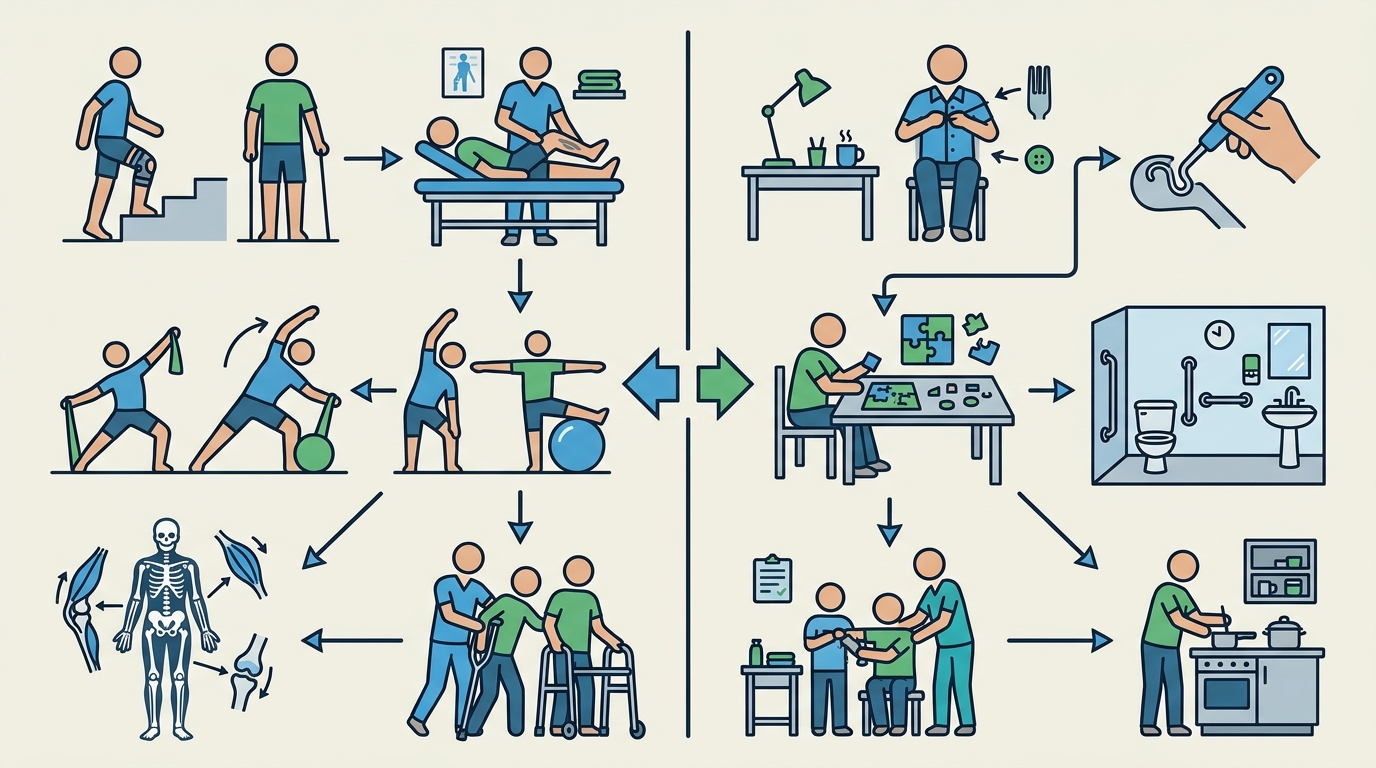
Physical therapists diagnose problems with movement and function, then treat with exercise, stretching, hands-on therapy and equipment, recording progress visit by visit (U.S. Bureau of Labor Statistics). Occupational therapists evaluate and treat people with injuries, illnesses or disabilities so they can develop, recover, improve and maintain the skills needed for daily living and working (U.S. Bureau of Labor Statistics, 2025).
The biggest practical split is the entry credential: physical therapists need a Doctor of Physical Therapy degree (U.S. Bureau of Labor Statistics, 2020), while a master's degree is the typical entry-level education for occupational therapists (U.S. Bureau of Labor Statistics, 2025). Both are licensed in every state, and both involve close contact and lifting.
Side-by-Side Comparison
Core daily tasks
- Physical therapist: The day opens with paperwork before the first patient — reviewing referrals and medical history — then diagnosing the person's functions and movements. You develop an individualized care plan and treat using exercises, stretching manoeuvres, hands-on therapy and equipment, evaluating and recording progress at each visit (U.S. Bureau of Labor Statistics). On the ONET profile for physical therapists, 93% of respondents rated physical proximity as "very close (near touching)" (ONET OnLine, National Center for O*NET Development).
- Occupational therapist: You evaluate and treat people who have injuries, illnesses or disabilities, then work through goals so they can develop, recover, improve and maintain the skills needed for daily living and working (U.S. Bureau of Labor Statistics, 2025). Each session is built around a task the client needs to do again — dressing, writing, preparing a meal, handling a tool at work — rather than around one joint or muscle group. Setting shapes the day: the largest employers are offices of physical, occupational and speech therapists and audiologists; hospitals; educational services; home healthcare services; and nursing care facilities (U.S. Bureau of Labor Statistics, 2025). A school caseload runs on the bell schedule; a home health caseload runs on travel between houses.
Required education and licensure
- Physical therapist: A Doctor of Physical Therapy (DPT) degree is needed to enter the profession, and all states require a licence (U.S. Bureau of Labor Statistics, 2020). DPT programs typically last 3 years, there were more than 200 CAPTE-accredited physical therapist programs, and students complete at least 30 weeks of supervised clinical work (U.S. Bureau of Labor Statistics, 2017). Licensure requires passing the National Physical Therapy Examination, administered by the Federation of State Boards of Physical Therapy (U.S. Bureau of Labor Statistics).
- Occupational therapist: The typical entry-level education is a master's degree (U.S. Bureau of Labor Statistics, 2025), and such programs usually take 2 to 3 years and require supervised fieldwork hours. All states require occupational therapists to be licensed, and candidates must pass a qualifying exam to use the title "Occupational Therapist Registered" (OTR) (U.S. Bureau of Labor Statistics, 2025). Application steps, fees and renewal cycles are set by each state board, so check the board where you plan to practise before applying to a program.
Typical schedule
- Physical therapist: Most work full time during normal business hours, though some work evenings or weekends (U.S. Bureau of Labor Statistics).
- Occupational therapist: Most work full time, but part-time work is common, and therapists may work nights or weekends to accommodate clients' schedules (U.S. Bureau of Labor Statistics, 2025).
Physical demands
- Physical therapist: You spend much of your time on your feet and are vulnerable to back injuries from lifting and moving patients (U.S. Bureau of Labor Statistics).
- Occupational therapist: Occupational therapists have one of the highest rates of injuries and illnesses of all occupations, often from lifting and moving clients or equipment (U.S. Bureau of Labor Statistics, 2025). Neither job is a desk job, and neither lets you avoid transfers and lifting.
Salary and Growth Comparison
Both occupations are covered by the U.S. Bureau of Labor Statistics Occupational Outlook Handbook, which publishes a Quick Facts table for each: median pay, typical entry-level education, number of jobs and projected growth. The occupational therapist profile used here carries a 2025 date while the physical therapist material carries earlier dates, so for pay, jobs and growth you should read both profiles in the same current edition rather than setting these dates against each other.
| Metric | Physical Therapist | Occupational Therapist | Source/Year |
|---|---|---|---|
| Median annual wage | In the occupation's Quick Facts table | In the occupation's Quick Facts table | U.S. Bureau of Labor Statistics, Occupational Outlook Handbook — read both profiles in the current edition |
| Number of jobs | In the Quick Facts table | In the Quick Facts table | U.S. Bureau of Labor Statistics, Occupational Outlook Handbook — same edition for both |
| Projected employment growth | Projected percent change published for the occupation | Growth projected for 2025–35, about 10,000 openings a year on average | U.S. Bureau of Labor Statistics (PT, 2020; OT, 2025) — check the current edition for matched years |
| Entry-level education | Doctor of Physical Therapy (DPT) | Master's degree | U.S. Bureau of Labor Statistics (PT, 2020; OT, 2025) |
| Program length | Typically 3 years, at least 30 weeks of supervised clinical work | Usually 2 to 3 years, plus supervised fieldwork hours | U.S. Bureau of Labor Statistics (PT, 2017; OT, 2025) |
| Licensure | All states; National Physical Therapy Examination (FSBPT) | All states; qualifying exam for the "Occupational Therapist Registered" (OTR) title | U.S. Bureau of Labor Statistics (PT, 2020; OT, 2025) |
| Post-licence specialisation | Clinical residency of about 1 year; board certification from the American Board of Physical Therapy Specialties in nine specialty areas (exam plus at least 2,000 hours in the specialty within ten years, or an accredited residency) | Set by state board and employer | U.S. Bureau of Labor Statistics |
Pay varies by setting and state. A hospital, a school district, a nursing care facility and a home health agency do not structure the same role the same way — some pay salary, some hourly, and home health roles may pay per visit. For state and industry figures, use the BLS Occupational Employment and Wage Statistics tables for both occupations from the same release.
Which One Fits You
If you want the shorter route to licensure, occupational therapy is faster on paper. A master's program usually takes 2 to 3 years plus supervised fieldwork (U.S. Bureau of Labor Statistics, 2025), against a DPT that typically lasts 3 years with at least 30 weeks of supervised clinical work (U.S. Bureau of Labor Statistics, 2017). Both end with a state licence and a qualifying exam, but only the physical therapy route commits you to a doctorate.
If you want to work on movement, pain and the mechanics of the body, physical therapy is the match: diagnosing functions and movements, then treating with exercises, stretching, hands-on therapy and equipment and recording progress visit by visit (U.S. Bureau of Labor Statistics). If you would rather the session end with someone buttoning a shirt, holding a pencil or returning to a specific job task, that is occupational therapy's stated purpose — the skills needed for daily living and working (U.S. Bureau of Labor Statistics, 2025).
If you need a schedule you can scale back, occupational therapy has the clearer precedent: part-time work is common, and nights or weekends are used to fit clients' schedules (U.S. Bureau of Labor Statistics, 2025). Most physical therapists work full time during normal business hours (U.S. Bureau of Labor Statistics).
If you want a defined specialty ladder after qualifying, physical therapy has the more formal structure: a clinical residency of about 1 year, plus board certification in nine clinical specialty areas from the American Board of Physical Therapy Specialties, requiring an exam and at least 2,000 hours of clinical work in that specialty within the last ten years, or an accredited residency (U.S. Bureau of Labor Statistics).
If you are weighing the physical toll, neither job spares you. Physical therapists are on their feet much of the day and vulnerable to back injuries from lifting patients (U.S. Bureau of Labor Statistics), and occupational therapists have one of the highest rates of injuries and illnesses of all occupations (U.S. Bureau of Labor Statistics, 2025). If close contact is a dealbreaker, note the 93% of ONET respondents who rated physical proximity as "very close (near touching)" on the physical therapists profile (ONET OnLine).
If you want choice of setting, occupational therapists are employed across offices of physical, occupational and speech therapists and audiologists, hospitals, educational services, home healthcare services and nursing care facilities (U.S. Bureau of Labor Statistics, 2025). Shadow in more than one before you apply.
Frequently asked questions
Which one trains faster?
Occupational therapy, by the program lengths in the table. Master's programs usually take 2 to 3 years plus supervised fieldwork (U.S. Bureau of Labor Statistics, 2025), while DPT programs typically last 3 years and include at least 30 weeks of supervised clinical work (U.S. Bureau of Labor Statistics, 2017). Add time to prepare for and pass the state licensing exam in both cases.
Can I switch from one to the other later?
Not by transferring credits in any routine way. The table lists two separate credentials and two separate exams: a Doctor of Physical Therapy plus the National Physical Therapy Examination from the FSBPT, and a master's degree plus the qualifying exam for the "Occupational Therapist Registered" (OTR) title (U.S. Bureau of Labor Statistics). Switching means completing the other profession's degree and exam, so choose on the day-to-day work.
Which has the higher pay ceiling?
Check it yourself rather than taking it from the dates cited here, because the two profiles carry different years. Look up the median annual wage in the Quick Facts table of each occupation in the same current edition of the BLS Occupational Outlook Handbook, then the BLS Occupational Employment and Wage Statistics tables for your state and industry. Pay structure also differs by employer.
Are both licensed in every state?
Yes. All states require physical therapists to be licensed (U.S. Bureau of Labor Statistics, 2020), and all states require occupational therapists to be licensed, with a qualifying exam needed to use the OTR title (U.S. Bureau of Labor Statistics, 2025). Application requirements, fees and renewal rules are set by each state board, so confirm them where you intend to practise.
Sources
- U.S. Bureau of Labor Statistics — Occupational Therapists : Occupational Outlook Handbook (2025)
- U.S. Bureau of Labor Statistics — Physical Therapists : Occupational Outlook Handbook (2020)

Written by
Desmond writes about the mechanics of job hunting — resumes, interviews, the strange rituals of being evaluated by strangers. He's drawn to the gap between how hiring is supposed to work and how it actually happens.