 Hire Compass HQ
Phlebotomist Job Description: What It Involves and How to Get Started
From early draw rounds to labeling tubes at the bedside, here is the day-to-day work, the training timeline, and what changes by state and employer.
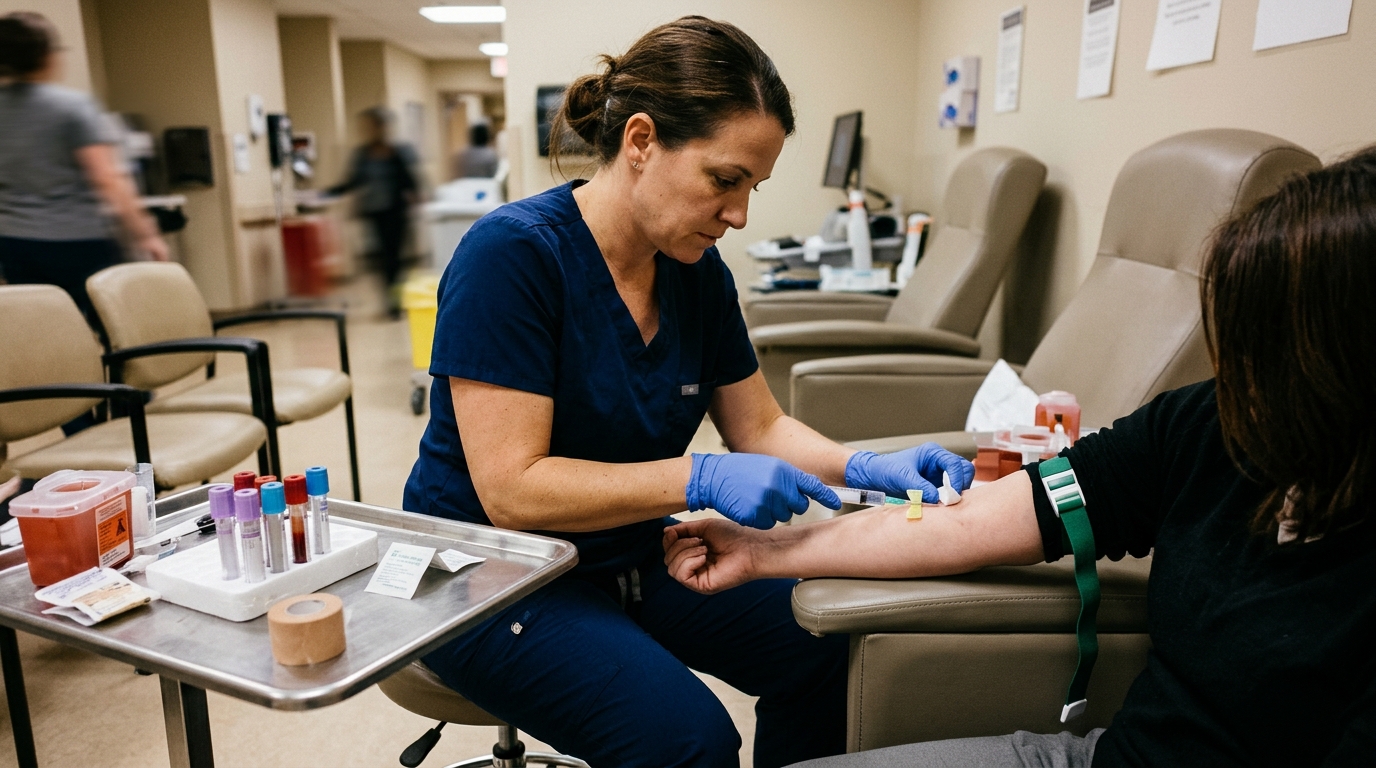
A phlebotomist collects blood samples from patients and donors, labels them correctly, and gets them into the laboratory system so tests can be run. The median annual wage was $45,230 in May 2025 (U.S. Bureau of Labor Statistics, 2025), and most people enter with a certificate from a postsecondary phlebotomy program, though some qualify with a high school diploma and on-the-job training (U.S. Bureau of Labor Statistics, 2025).
It is one of the shorter routes into clinical healthcare: certificate programs usually take less than one year (U.S. Bureau of Labor Statistics, 2025). Licensing rules differ by state, so the requirements where you live may not match what you read about somewhere else.
What Does a Phlebotomist Actually Do?
A phlebotomist draws blood from patients or blood donors and labels the collected blood so it can be tested or processed (U.S. Bureau of Labor Statistics, 2025). The role also covers entering sample information into a database and assembling, maintaining, and disposing of medical instruments such as needles, test tubes, and blood vials (U.S. Bureau of Labor Statistics, 2025).
The output is physical and countable: tubes filled to the right volume, labeled with the right patient, logged in the right order, and delivered to the lab or courier intact. ONET lists confirming patient identities by verifying personal information among the occupation's tasks, along with drawing blood from veins by vacuum tube, syringe, or butterfly venipuncture methods (ONET OnLine, U.S. Department of Labor). One mislabeled tube can mean a repeat stick for the patient and a delayed result for the ordering clinician, so the work is built around verification steps rather than speed.
Phlebotomists are commonly confused with medical laboratory technicians and technologists. The difference is what happens after collection: the phlebotomist collects, labels, and logs the specimen, while technicians and technologists run the analyzers and report results. ONET classifies phlebotomists as Job Zone Three, Medium Preparation Needed, covering occupations that typically require vocational school training, related on-the-job experience, or an associate's degree (ONET OnLine, U.S. Department of Labor).
Typical Daily Responsibilities
- Reviews the shift's collection list at the start of the day, flagging timed draws and fasting specimens that must be collected before meal trays go out.
- Confirms patient identity before every draw by verifying personal information against the requisition and wristband (O*NET OnLine, U.S. Department of Labor).
- Draws blood from veins using vacuum tube, syringe, or butterfly venipuncture methods, choosing the approach for each patient's veins and the tests ordered (O*NET OnLine, U.S. Department of Labor).
- Labels every tube at the bedside, immediately after collection and before leaving the room, since labeling collected blood for testing or processing is a core duty (U.S. Bureau of Labor Statistics, 2025).
- Enters sample information into the laboratory database after each collection round rather than at the end of the shift (U.S. Bureau of Labor Statistics, 2025).
- Restocks the collection tray between patients and maintains and disposes of needles, test tubes, blood vials, and sharps containers (U.S. Bureau of Labor Statistics, 2025).
- Checks in back-to-back scheduled appointments plus walk-ins at an outpatient draw station, explaining the procedure to each patient before the first stick.
- Sorts, spins, and stages specimens to meet fixed courier pickup times, because a missed cut-off pushes results to the next run.
- Responds to fainting or other reactions during a draw, applies pressure, stays with the patient, and documents the incident the same shift.
- Transports specimens between a collection site and the processing lab on some shifts, which is why a driver's license may be needed for transport roles (U.S. Bureau of Labor Statistics, 2025).
Skills, Tools, and Qualifications
| Requirement/Skill | Why It's Needed | How to Get It |
|---|---|---|
| Postsecondary phlebotomy certificate | The typical entry route into the occupation (U.S. Bureau of Labor Statistics, 2025) | Community colleges, vocational schools, or technical schools; usually under 1 year, covering anatomy, physiology, medical terminology, and laboratory work (U.S. Bureau of Labor Statistics, 2025) |
| High school diploma plus on-the-job training | An alternative route some employers accept (U.S. Bureau of Labor Statistics, 2025) | Apply to employers that train in-house, such as hospital labs and donor centers; availability varies by employer and region |
| ASCP Board of Certification Phlebotomy Technician (PBT) | Many employers ask for a recognized phlebotomy credential | Structured program route requires 40 clock hours of classroom training plus clinical training with a minimum of 100 successful unaided venipunctures, documented by the program director (American Society for Clinical Pathology Board of Certification) |
| State license or certification where required | States may require an accredited training program, a license or certification, or other requirements (U.S. Bureau of Labor Statistics, 2025) | Contact your state licensing agency for the rules that apply where you intend to work (U.S. Bureau of Labor Statistics, 2025) |
| Basic Life Support (BLS) certification and, for some roles, a driver's license | Patients can faint or react during a draw; phlebotomists who transport samples may need to drive (U.S. Bureau of Labor Statistics, 2025) | BLS course with classroom and skills test; state driver licensing agency for the license |
| Venipuncture technique: vacuum tube, syringe, butterfly | The three collection methods listed for the occupation (O*NET OnLine, U.S. Department of Labor) | Supervised clinical practicum inside a certificate program, then repetition on the job |
| Laboratory information and order-entry systems | Sample information must be entered into a database accurately (U.S. Bureau of Labor Statistics, 2025) | Employer orientation on the system in use, commonly Epic Beaker, Oracle Health (Cerner) Millennium, or Sunquest, plus barcode label printers and centrifuges |
| Detail orientation (soft skill) | Phlebotomists must draw the correct amount of blood, label vials carefully, and enter data accurately to avoid misplacing samples or injuring patients (U.S. Bureau of Labor Statistics, 2025) | Checklist habits built in clinical training: two-identifier checks, bedside labeling, read-back of orders |
| Patient communication and composure (soft skill) | Anxious, pediatric, and needle-phobic patients need the procedure explained before the stick | Practiced during clinical rotations; donor centers and pediatric settings reinforce it fastest |
Salary and Job Outlook
Pay is usually hourly, with shift differentials for nights, weekends, and holidays at hospitals, and it varies by state, employer type, and setting. Check current figures on the BLS Occupational Outlook Handbook and the Occupational Employment and Wage Statistics (OEWS) pages, which break wages down by state and industry.
| Metric | Figure | Source/Year |
|---|---|---|
| National median annual wage | $45,230 | U.S. Bureau of Labor Statistics, May 2025 |
| Median hourly wage | Published as the hourly equivalent of the 2025 median pay; see the current Occupational Outlook Handbook entry | U.S. Bureau of Labor Statistics, 2025 |
| Low-to-high wage range | Reported as 10th through 90th percentile wages by state and industry on the OEWS pages, not as a single national figure | U.S. Bureau of Labor Statistics, Occupational Employment and Wage Statistics |
| Median wages, cross-check | O*NET publishes its own 2025 median wage for phlebotomists | O*NET OnLine (U.S. Department of Labor), 2025 |
| Projected growth, 2025-2035 | Much faster than the average for all occupations | U.S. Bureau of Labor Statistics, 2025 |
| Benchmark for that comparison | The average projected growth rate across all occupations | U.S. Bureau of Labor Statistics, 2025 |
| Employment, base year, and projected change | Jobs held in 2025 and the projected numeric change to 2035 | U.S. Bureau of Labor Statistics, 2025 |
| Annual job openings | Average projected openings per year over the decade, including replacements | U.S. Bureau of Labor Statistics, 2025 |
How to Get Started
- Finish a high school diploma or equivalent (timing depends on where you are now). It is the baseline for both routes, since some phlebotomists qualify with a high school diploma and on-the-job training (U.S. Bureau of Labor Statistics, 2025).
- Check your state's rules before you enroll (1-2 weeks). States may require an accredited training program, a license or certification, or other conditions, so contact your state licensing agency for specifics (U.S. Bureau of Labor Statistics, 2025). This decides whether an employer-trained route is open to you.
- Complete a postsecondary phlebotomy certificate (usually under 1 year). Programs at community colleges, vocational schools, and technical schools cover anatomy, physiology, medical terminology, and laboratory work (U.S. Bureau of Labor Statistics, 2025). Confirm a supervised clinical placement is included before you pay.
- Log documented venipunctures during clinical training (typically the final 8-16 weeks of a program, varying by school). The ASCP Board of Certification Phlebotomy Technician (PBT) structured program route requires 40 clock hours of classroom training plus clinical training with a minimum of 100 successful unaided venipunctures, documented by the program director (American Society for Clinical Pathology Board of Certification).
- Add Basic Life Support certification and, for transport roles, a driver's license (BLS courses typically run as a single day). Phlebotomists may need BLS certification, and those who transport samples may need a license (U.S. Bureau of Labor Statistics, 2025).
- Apply for certification and any state credential, then start applying (allow a 1-3 month search). Entry openings cluster in hospital labs on night and weekend shifts, outpatient draw stations, donor centers, and mobile collection teams. Keep your documented draw count and clinical hours on the resume.
Frequently asked questions
How long does it take to become a phlebotomist?
The usual route is a certificate from a postsecondary phlebotomy program at a community college, vocational school, or technical school, which normally takes less than one year (U.S. Bureau of Labor Statistics, 2025). Those programs include anatomy, physiology, medical terminology, and laboratory work. If you take an employer-trained route with a high school diploma and on-the-job training, the timeline depends on that employer's training schedule.
Do phlebotomists need a license?
It depends on your state. States may require phlebotomists to complete an accredited training program, hold a license or certification, or meet other requirements, and the U.S. Bureau of Labor Statistics (2025) advises contacting your state licensing agency for the rules. Separately, individual employers often require a national credential such as the ASCP Board of Certification Phlebotomy Technician (PBT).
How much do phlebotomists earn?
The median annual wage was $45,230 in May 2025 (U.S. Bureau of Labor Statistics, 2025), and the same source publishes an hourly equivalent of that 2025 median. Pay is usually structured hourly, with differentials for night, weekend, and holiday shifts in hospital settings. For wages in your state or industry, check the BLS Occupational Employment and Wage Statistics pages, which report percentile ranges rather than one national number.
How many venipunctures do I need before I can get certified?
For the ASCP Board of Certification Phlebotomy Technician (PBT) credential via the structured program route, applicants must complete 40 clock hours of classroom training plus clinical training with a minimum of 100 successful unaided venipunctures, documented by the program director (American Society for Clinical Pathology Board of Certification). Ask any program whether it guarantees enough clinical placement to reach that count, and confirm who signs the documentation.
Is phlebotomy a growing field?
Employment of phlebotomists is projected to grow from 2025 to 2035 much faster than the average for all occupations (U.S. Bureau of Labor Statistics, 2025), and the same source projects an average number of openings each year over that decade, including replacements for workers who leave. Current figures for openings, 2025 base-year employment, and projected numeric change are on the BLS Occupational Outlook Handbook page.
Sources
- U.S. Bureau of Labor Statistics — Phlebotomists : Occupational Outlook Handbook (2025)
- O*NET OnLine (U.S. Department of Labor) — 31-9097.00 - Phlebotomists

Written by
Yuki covers the broader shifts in how people work: shrinking industries, growing ones, the policies that quietly decide who gets steady income. She tends to start stories with a worker's own account before zooming out.