 Hire Compass HQ
Dental Assistant: An Hour-by-Hour Look at the Job
From the 7:30 a.m. sterilizer load to the last chart note, here is how a dental assistant's day is split between chairside work, x-rays, and the front desk.
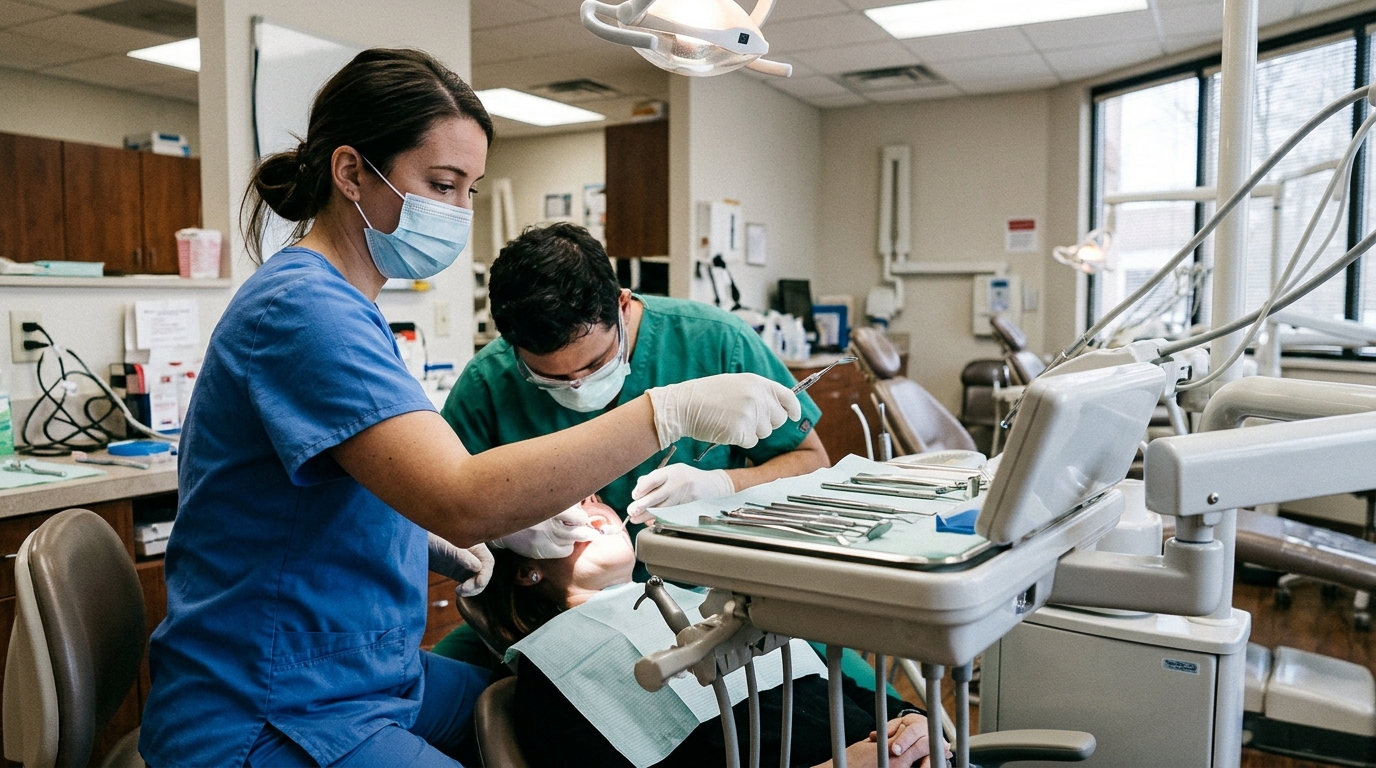
A dental assistant's day runs on the appointment book. You prepare patients and operatories, pass instruments and hold suction during procedures, sterilize and reset rooms between appointments, take x-rays where your state allows it, and keep treatment records, schedules and billing straight (U.S. Bureau of Labor Statistics, 2025).
Most of that happens in a general dental office: of about 388,600 dental assistant jobs counted in 2025, 91 percent were in offices of dentists (U.S. Bureau of Labor Statistics, 2025). Most assistants work full time, and some work evenings or weekends (U.S. Bureau of Labor Statistics, 2025).
Hour-by-Hour Schedule
A representative day in a two-dentist general practice. Timing shifts with the schedule, the specialty and the office's hours.
- 7:30 AM — Open and start sterilization. Turn on compressors and the autoclave, run the first instrument load, flush waterlines before the first patient.
- 7:45 AM — Morning huddle. Walk the schedule with the dentist and hygienist; assistants work under the supervision of dentists and closely with hygienists day to day (U.S. Bureau of Labor Statistics, 2025). Flag the lab case that has not arrived.
- 8:00 AM — Seat the first patient and take x-rays. Place the apron over the chest and lap, position the x-ray machine, seat the sensor, expose four bitewings (U.S. Bureau of Labor Statistics, 2025).
- 8:40 AM — Chairside for a composite filling. Pass instruments, hold the suction hose, place the matrix band and operate the curing light while the dentist works (U.S. Bureau of Labor Statistics, 2025).
- 9:30 AM — Room turnover. Break down the tray, disinfect surfaces, replace barrier film and set up the next instrument tray — usually 10 to 15 minutes between patients.
- 10:15 AM — Records and imaging. Process the morning's images, attach them to the chart and write treatment notes while details are fresh (U.S. Bureau of Labor Statistics, 2025).
- 11:00 AM — Expanded duties, where the state allows. Polish coronal surfaces to remove stains and plaque, or apply sealants or fluoride, if your state's scope of practice and your certification permit it (U.S. Bureau of Labor Statistics, 2025).
- 11:45 AM — Lab tasks. Take an impression for a crown, package the case and complete the lab slip (U.S. Bureau of Labor Statistics, 2025).
- 12:30 PM — Lunch and supply check. Count gloves, anesthetic and bonding agent and place the week's order, one of the listed tasks for the role (O*NET OnLine, U.S. Department of Labor, 2026).
- 1:15 PM — Emergency patient worked in. Assist in the management of a dental emergency, such as a lost temporary crown, which pushes the afternoon back by 20 minutes (O*NET OnLine, U.S. Department of Labor, 2026).
- 3:00 PM — Oral hygiene instruction. Five to ten minutes showing a teenager with new orthodontic brackets how to floss around them (U.S. Bureau of Labor Statistics, 2025).
- 4:30 PM — Front desk and close-down. Schedule recall appointments, go over an estimate and payment plan with a patient, then run the final sterilizer load (U.S. Bureau of Labor Statistics, 2025).
The Good and the Challenging Parts
The satisfactions are specific and happen inside a single appointment. A patient who has avoided the dentist for six years sits down with white knuckles; you explain what the apron and sensor are for, talk through each step, and by the second visit they book their own recall without being chased.
There is also a craft side. Getting a clean periapical image on the first exposure — correct sensor placement, correct angle, no cone cut — means no retake and no second dose of radiation. Positioning the machine and following safety procedures to minimize risk from it is part of the job (U.S. Bureau of Labor Statistics, 2025), and doing it well is visible to everyone in the room.
The frustrations are equally concrete. The 1:15 emergency is the clearest: a schedule balanced at the morning huddle collapses, the 4:00 patient waits 25 minutes while you apologize at the front desk, and you still have to turn over the room. You absorb that, without having caused it.
The second is physical and constant. You spend the day within arm's length of people's faces — 88 percent of survey respondents described physical proximity in this job as 'very close (near touching),' and 83 percent reported using their hands continually to handle, control or feel objects, tools or controls (O*NET OnLine, U.S. Department of Labor, 2026). Wrists, shoulders and neck take the load from leaning into a mouth with a suction hose for most of eight hours.
Two things catch new assistants off guard. Radiation exposure is a daily condition for most: 84 percent of respondents said they are exposed every day (O*NET OnLine, U.S. Department of Labor, 2026), manageable with aprons, badges and protocol but not optional. And your permitted duties may be narrower than an assistant's across the state line, since some states allow polishing, sealants, fluoride and topical anesthetic and others do not (U.S. Bureau of Labor Statistics, 2025). Check your state dental board before assuming a task is yours.
Tools, Equipment, and Work Environment
- Intraoral x-ray unit, digital sensor and lead apron. You position the machine, place the apron over the patient's chest and lap, seat the sensor and expose the image (U.S. Bureau of Labor Statistics, 2025).
- High-volume evacuation suction and saliva ejector. Held in one hand for most of a restorative appointment to keep the field dry while you pass instruments with the other (U.S. Bureau of Labor Statistics, 2025).
- Matrix bands, retainers and the LED curing light. Standard chairside hardware for composite restorations, handed over or held in sequence as the dentist works (U.S. Bureau of Labor Statistics, 2025).
- Steam autoclave, ultrasonic cleaner and instrument cassettes. Instruments are cleaned, bagged, run through a cycle and logged; sterilizing instruments and setting up trays are listed tasks (O*NET OnLine, U.S. Department of Labor, 2026).
- Practice management and charting software. Offices typically run one system for charts, imaging, recall and billing — Dentrix and Eaglesoft are common examples — and you are in it between every patient to record treatment information (O*NET OnLine, U.S. Department of Labor, 2026).
- Safety glasses, surgical masks, nitrile gloves and protective clothing, all day, worn to protect you and patients from infectious disease (U.S. Bureau of Labor Statistics, 2025); 88 percent of respondents said protective equipment is worn every day (O*NET OnLine, U.S. Department of Labor, 2026).
- A climate-controlled operatory roughly 8 feet square. 74 percent of respondents reported working indoors in an environmentally controlled setting every day and 81 percent reported constant contact with others (O*NET OnLine, U.S. Department of Labor, 2026). Expect to alternate between an assistant's stool and standing at the sterilization bay.
- A supply room you are responsible for. Ordering and monitoring dental supplies is part of the job, so you will know stock levels of anesthetic carpules, bonding agent and gloves by heart (O*NET OnLine, U.S. Department of Labor, 2026).
Frequently asked questions
How long is a dental assistant's shift, and do you work weekends?
Most dental assistants work full time, and some work evenings or weekends because many practices offer appointments outside standard business hours (U.S. Bureau of Labor Statistics, 2025). In a general office you typically arrive 20 to 30 minutes before the first patient to start the sterilizer and stay past the last one to finish records. Ask about posted office hours and who covers emergency calls before accepting an offer.
Can any part of this job be done remotely?
Not the clinical part. Passing instruments, holding suction and taking x-rays all require you to be within touching distance of the patient, and 91 percent of the roughly 388,600 dental assistant jobs in 2025 were in offices of dentists (U.S. Bureau of Labor Statistics, 2025). Scheduling and billing are desk work, but the role itself is on-site.
How long does it take to qualify, and is a license required?
Many dental assisting programs take about 1 year and lead to a certificate or diploma; 2-year associate's degree programs are less common (U.S. Bureau of Labor Statistics, 2025). Some states require graduation from an accredited program plus an exam, while others have no formal educational requirement and assistants train on the job. States typically do not license entry-level assistants, but some require registration or certification for duties such as radiography or infection control, and expanded-duty certification like coronal polishing requires passing an exam and holding current CPR certification (U.S. Bureau of Labor Statistics, 2025).
What does the pay and job outlook look like?
The median annual wage for dental assistants was $48,070 in May 2025, with the lowest 10 percent earning less than $37,130 and the highest 10 percent more than $62,250 (U.S. Bureau of Labor Statistics, May 2025). Pay is usually an hourly rate set by the individual practice and often moves with expanded-function certifications. Employment is projected to grow 7 percent from 2025 to 2035, with about 53,000 openings a year on average (U.S. Bureau of Labor Statistics, 2025); check the BLS Occupational Employment and Wage Statistics pages for your state, since metro rates differ widely.
Sources
- U.S. Bureau of Labor Statistics — Occupational Outlook Handbook: Dental Assistants (2025)
- O*NET OnLine (U.S. Department of Labor) — 31-9091.00 - Dental Assistants - Summary Report (2026)

Written by
Felix writes a column on the inner life of work — burnout, ambition, the quiet math people do about whether a job is worth it. He prefers plain language to management jargon and says so often.