 Hire Compass HQ
A Day in the Life of a Warehouse Worker
From the 6 a.m. stretch huddle to the last sealed trailer, here is how the hours break down on a warehouse floor and what the job asks of your body.
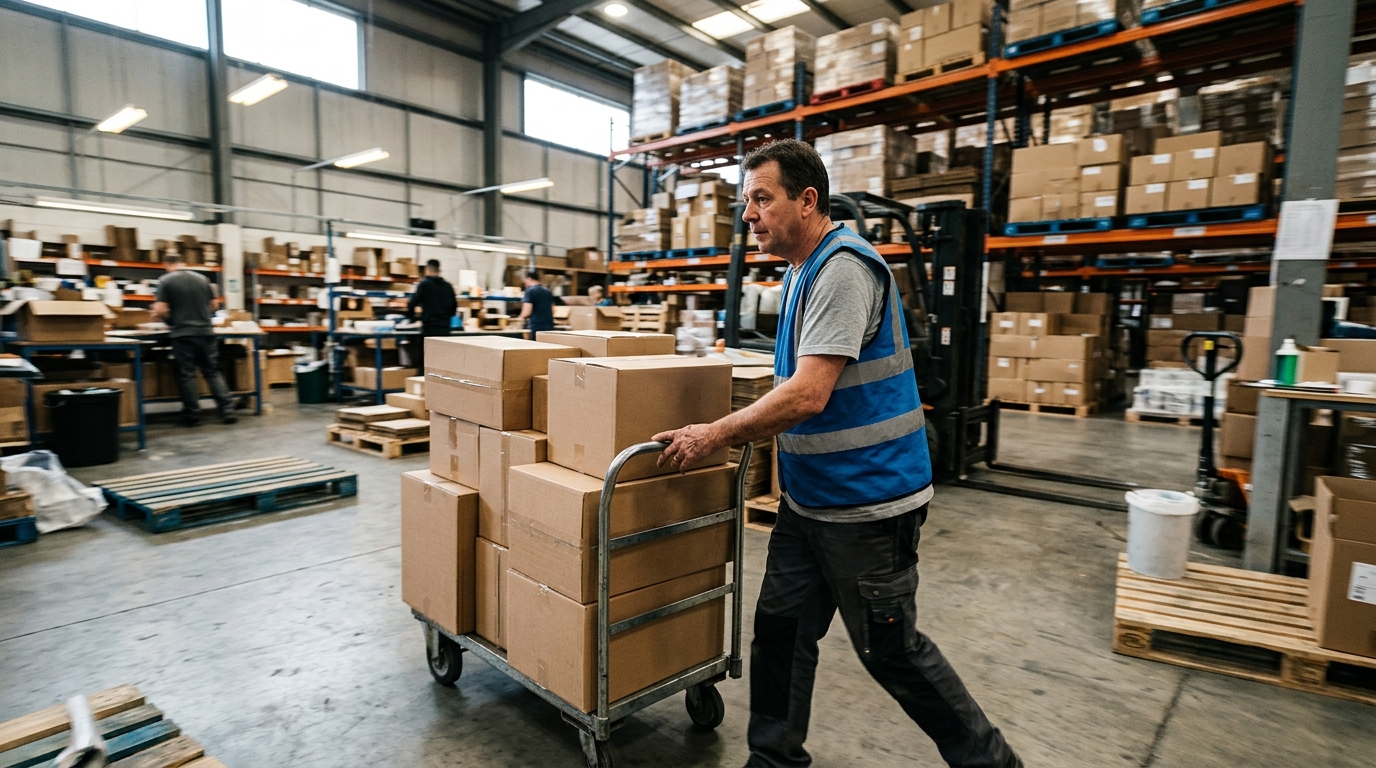
A warehouse worker moves goods through a building: unloading trailers, putting stock away in racks, picking orders with a handheld scanner, packing and wrapping cartons, and keeping records of what moved where. The U.S. Bureau of Labor Statistics (2025) groups most of these jobs under hand laborers and material movers and describes the work as usually repetitive and physically demanding, with lifting, carrying, bending, kneeling, crouching or crawling.
Most people in the occupation work full time, though part-time work is common, and schedules vary and may include nights and weekends (U.S. Bureau of Labor Statistics, 2025). The day below is a composite day shift at a distribution center.
Hour-by-Hour Schedule
- 5:45 AM — Badge in and gear up. Steel-toed boots, hi-vis vest, cut-resistant gloves, and an RF scanner checked out and paired to your user ID.
- 6:00 AM — Stretch-and-flex huddle. Ten to fifteen minutes of guided stretching, a short safety topic, and the day's volume: inbound trailers and orders due by the carrier cutoff.
- 6:15 AM — Unload the first trailer. Breaking down a floor-loaded trailer by hand, stacking cartons onto pallets, checking seal and count against the paperwork. The heaviest lifting block of the day.
- 7:30 AM — Putaway. Driving a pallet jack to an assigned rack location and scanning the location label so the warehouse management system knows where the stock is (jobdescription.org, undated). Roughly a dozen pallets before first break.
- 8:45 AM — First break, 15 minutes. Back on the floor on time, because the next pick wave releases automatically.
- 9:00 AM — Order picking. Working a pick path through the aisles with the RF scanner, scanning each location and each item to confirm the pick (Indeed job postings, undated). Expect several hundred scans across a morning.
- 10:30 AM — Pack and wrap. Packing and wrapping products by hand, taping cartons, applying labels, stretch-wrapping finished pallets so they survive the trailer.
- 11:30 AM — Lunch, usually 30 minutes. In a large building the break room is a five-minute walk each way, which eats into the half hour.
- 12:00 PM — Cycle counts. Counting a set of bins and keeping records of goods moved (U.S. Bureau of Labor Statistics, 2025), then flagging mismatches for a lead to research.
- 1:15 PM — Spotting and signaling. Standing clear of the racks and signaling a forklift operator lowering pallets from the top beam — a listed duty for this occupation (U.S. Bureau of Labor Statistics, 2025).
- 2:15 PM — Housekeeping and equipment care. Sweeping aisles, breaking down cardboard for the baler, cleaning equipment, and plugging electric pallet jacks into the charging bank.
- 3:00 PM — Load out and handover. Staging the last pallets at the dock door, confirming counts, then briefing the next shift on what is still open.
Overtime past this point is common at peak. On a 10- or 12-hour schedule the same blocks repeat with a second meal break.
The Good and the Challenging Parts
The satisfactions land inside the shift. There is the moment the last pallet of a 1,200-carton trailer clears the dock plate and the door comes down ten minutes before the carrier cutoff — the work is finished, visibly, and nobody carries it into tomorrow. There is the cycle count that pays off: a bin reads zero in the system, you find forty units one rack over where someone scanned the wrong location label, and an order that would have shipped short goes out complete.
The other satisfaction is skill. OSHA requires that all forklift operators be trained and certified under a specific federal regulation (CertifyMe.net citing OSHA, 2025), with a periodic re-evaluation of each operator's performance (GoWarehouse.io citing OSHA, undated). Once you hold that certification, you spend less of the shift lifting cartons by hand and more of it moving pallets.
The frustrations are just as specific. ONET's work context survey for this occupation reports high levels of standing and repetitive motion, plus noise exposure and the importance of repeating the same tasks (ONET OnLine, U.S. Department of Labor, undated). On a pick wave you repeat the same four motions several hundred times, and conveyor and baler noise means you talk over it or wait for a gap.
Then there is risk. Hand laborers and freight, stock and material movers have some of the highest rates of injuries and illnesses of all occupations, and moving heavy objects may lead to sprains, strains or overexertion (U.S. Bureau of Labor Statistics, 2025). A heavy carton lifted badly at hour nine is the one that puts you on light duty. Add schedules that may include nights and weekends (U.S. Bureau of Labor Statistics, 2025), and for many workers the Saturday shift during peak is harder than the lifting.
Tools, Equipment, and Work Environment
- RF handheld scanners. Warehouse and fulfillment postings list using RF scanners to track inventory and orders as a core duty (Indeed job postings, undated); the scanner directs your pick path and confirms each location and item.
- Warehouse management system (WMS). Every putaway is a scan of the rack location label so the WMS knows where stock sits (jobdescription.org, undated). Errors here create the cycle-count work later.
- Manual and electric pallet jacks. Operating pallet jacks appears in warehouse postings as a core duty (Indeed, undated). Electric units sit on a charging bank and must be plugged in at end of shift.
- Forklifts and other powered industrial trucks. You cannot operate one until you are trained and certified under OSHA's federal forklift regulation (CertifyMe.net citing OSHA, 2025), with a periodic performance re-evaluation after that (GoWarehouse.io citing OSHA, undated).
- Stretch wrappers, tape guns, box cutters and cardboard balers. Packing or wrapping products by hand is a listed duty for the occupation (U.S. Bureau of Labor Statistics, 2025).
- PPE: steel-toed boots, hi-vis vest, cut-resistant gloves, hearing protection. ONET's survey reports significant noise exposure for these workers (ONET OnLine, U.S. Department of Labor, undated), so hearing protection is standard near balers and conveyors.
- Concrete floors, dock doors and temperature swings. The work happens in stockrooms, warehouses and manufacturing plants, lifting and carrying heavy objects, with bending, kneeling, crouching or crawling (U.S. Bureau of Labor Statistics, 2025). Many dock areas are unheated; cold-storage sites issue freezer gear.
- Cleaning kit for vehicles and equipment. Cleaning vehicles, machinery and equipment is part of the occupation's duties (U.S. Bureau of Labor Statistics, 2025), usually in the last half hour.
Frequently asked questions
How long are warehouse shifts, and can I choose days?
Most hand laborers and material movers work full time, part-time work is common, and schedules may include nights and weekends (U.S. Bureau of Labor Statistics, 2025). In practice that means 8-hour five-day schedules, 10-hour four-day schedules, or 12-hour rotations, depending on the building. Shift choice is usually by seniority or bid, and peak-season mandatory overtime is set by the employer.
How hard is this on your body over a few years?
Physical stamina for strenuous tasks throughout the day and physical strength for lifting and carrying are listed as important qualities for the occupation (U.S. Bureau of Labor Statistics, 2025), and O*NET's survey reports high levels of standing and repetitive motion (O*NET OnLine, U.S. Department of Labor, undated). These workers also have some of the highest injury and illness rates of all occupations, with sprains, strains and overexertion tied to moving heavy objects (U.S. Bureau of Labor Statistics, 2025). The stretch sessions and lift-technique training are not a formality.
Is there any remote or hybrid version of this job?
No. The work happens in stockrooms, warehouses, manufacturing plants and similar settings where goods are physically moved (U.S. Bureau of Labor Statistics, 2025). The nearest alternatives are inventory control, dispatch or WMS support roles, which are still usually based on site.
What do I need before I apply, and how is pay structured?
BLS publishes a typical entry-level education and training requirement for hand laborers and material movers (U.S. Bureau of Labor Statistics, 2025) — check the current Occupational Outlook Handbook, since employers set their own minimums. Some roles need a state-issued license: driving trucks over a certain capacity requires a commercial driver's license, which involves passing written, skill and vision tests, and rules differ by state (U.S. Bureau of Labor Statistics, 2025). Pay is almost always hourly, often with shift differentials and overtime; for current figures, check the BLS median annual wage for hand laborers and material movers (May 2025) and O*NET's 2025 median wage for occupation code 53-7062.00.
Sources
- U.S. Bureau of Labor Statistics — Hand Laborers and Material Movers : Occupational Outlook Handbook (2025)
- O*NET OnLine (U.S. Department of Labor) — 53-7062.00 - Laborers and Freight, Stock, and Material Movers, Hand

Written by
Yuki covers the broader shifts in how people work: shrinking industries, growing ones, the policies that quietly decide who gets steady income. She tends to start stories with a worker's own account before zooming out.