 Hire Compass HQ
What to Expect in a Second Interview
Who you meet in round two, how long each conversation runs, and what employers are testing once they already believe you can do the basic job.
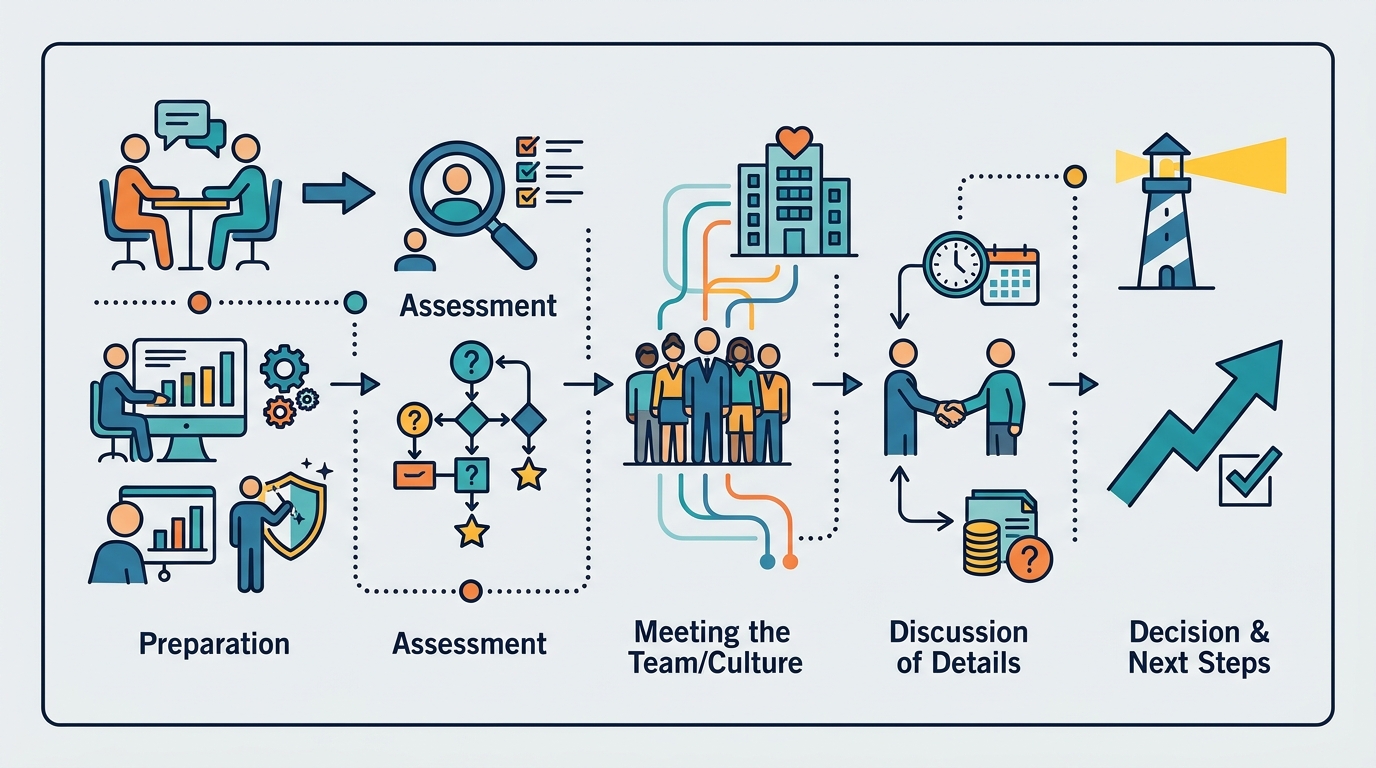
A second interview is where an employer stops asking whether you can do the work and starts asking how you would do it on their team, with their tools and their problems. Expect longer conversations, more people in the room, and more specific questions about decisions you have made before.
The shape varies a lot: a second interview for a retail supervisor role may be one 45-minute conversation, while the same stage for an engineering, clinical or director-level role can run several hours across multiple interviewers.
Overview of the Second Interview Hiring Process
For most roles that use them, a second interview is one of two to four total rounds. Entry-level and hourly positions often stop at two; professional, technical and management roles more often run three or four, with the second interview sitting in the middle rather than at the end.
Timing between the first and second interview commonly runs from a few days to about three weeks. Larger employers, public-sector agencies and roles that require a scored panel tend to be slower, because interviewers' calendars and internal approvals have to line up. Small employers can move in 48 hours.
The second interview itself typically takes 45 minutes to three hours. Some fields compress it into a single block — a hiring manager plus two peers, back to back — while others spread it over two days. Onsite or "final-stage" days that run three to six hours are common for clinical, academic, sales leadership and senior engineering roles.
Format varies by employer, by industry and by country. US public-sector and many union-covered employers use structured, scored panels where every candidate gets identical questions. Private employers more often mix a structured hiring-manager interview with informal peer conversations. Some states and licensed fields add credential or background checks around this stage. Ask the recruiter directly how many rounds remain after this one; they will usually tell you, and it changes how you prepare.
Typical Stages of the Interview Process
Not every employer uses every stage. Use this as a map, then confirm the actual agenda with whoever schedules you.
- Scheduling and briefing call — recruiter or HR coordinator, 10 to 20 minutes. You get the agenda, the names and job titles of each interviewer, the format (video, onsite, panel), and any pre-work. Ask for the interviewers' titles in writing if they are not offered.
- Pre-interview assignment or assessment — issued by the recruiter, reviewed by the hiring manager or a technical lead, 1 to 4 hours of your time. Common forms: a written case, a take-home exercise, a work sample, or a timed skills or personality assessment. Usually due 24 to 72 hours before the interview.
- Hiring manager deep-dive — the person you would report to, 45 to 60 minutes. The longest and most consequential conversation. Expect detailed follow-up on examples you gave in round one, plus questions about how you prioritize and handle pressure.
- Peer or panel interview — two to five future colleagues or cross-functional partners, 30 to 60 minutes. In structured panels each interviewer asks assigned questions and scores answers independently. In informal versions, peers test whether they would want to hand you work.
- Presentation or practical exercise — hiring manager plus panel, 30 to 60 minutes including questions. Used heavily in sales, teaching, marketing, data, engineering and management roles: present the take-home, teach a sample lesson, walk through a pipeline, or work a live scenario.
- Skip-level or executive conversation — your prospective manager's manager or a department head, 20 to 45 minutes. Shorter, broader, and focused on judgment, ambition and fit with where the team is going.
- Closing conversation — recruiter, 10 to 15 minutes. Availability, start date, references, remaining rounds, and the decision timeline. Pay structure is often discussed here; check current rates for your role and location on public job postings and state or federal wage data before you answer.
Interview Rounds at a Glance
| Stage | Format | Typical Duration | What It Evaluates |
|---|---|---|---|
| Scheduling and briefing call | Phone call or email from recruiter | 10–20 min | Logistics, your availability, whether you follow instructions |
| Pre-interview assignment | Take-home case, work sample or timed assessment | 1–4 hours of your time | Craft quality, structure, how you handle ambiguity |
| Hiring manager deep-dive | 1:1 video or in person | 45–60 min | Depth behind your examples, prioritization, how you'd run the role |
| Peer or panel interview | 2–5 interviewers, often structured and scored | 30–60 min | Collaboration, cross-team communication, consistency of your answers |
| Presentation or practical exercise | Live demo, case walkthrough or scenario | 30–60 min | Applied skill under observation, response to pushback |
| Skip-level or executive conversation | 1:1 with a senior leader | 20–45 min | Judgment, scope you can handle, alignment with team direction |
| Closing conversation | Recruiter call | 10–15 min | References, start date, pay expectations, remaining steps |
Questions You're Likely to Be Asked at Each Stage
"Is there anything that has changed since we last spoke, or anything you'd like the interviewers to know in advance?"
Asked on the scheduling call. The recruiter is checking that you are still available, still interested, and whether you need accommodations or scheduling adjustments. It is also a quiet test of whether you have competing offers.
"Walk us through how you approached the exercise and what you would do differently with more time."
Asked when you submitted a take-home or assessment. The reviewer wants your reasoning, not your output — they already read the output. Naming the trade-off you made (scope cut, assumption, data you lacked) scores better than defending the work.
"Tell me about a time you had to deliver something on a deadline you didn't think was realistic. What did you do?"
The hiring manager's behavioral staple. They are testing whether you renegotiate, escalate or quietly miss the date — and whether your story has a measurable result.
STAR structure that works here
Situation: Our monthly reporting pack took four working days and leadership wanted it by day two. Task: I owned the pack and had no extra headcount. Action: I audited the twelve manual steps in the spreadsheet, moved the three joins into a scheduled SQL query, and cut two charts nobody opened after asking the three recipients what they actually used. Result: Turnaround dropped to one and a half days and held there for the next six months.
"If you joined and found the process we use for this is messier than you expected, how would you handle it in your first 90 days?"
A peer or panel question. Colleagues are testing whether you would steamroll existing work or learn it first. Answers that name a sequence — observe, document, propose, pilot — land better than promises to "fix" things.
"Why did you choose this recommendation over the alternative you mentioned?"
Asked during a presentation or practical exercise, usually as the first pushback. The panel is watching whether you hold a defensible position under challenge or abandon it the moment someone frowns. Say what evidence would change your mind.
"Where do you want your work to be making a difference two years from now?"
The skip-level question. A senior leader is gauging scope, direction and retention risk, not testing recall. Connect your answer to something concrete about the team's current priorities that an earlier interviewer told you about.
"Who can we contact as references, and when could you start?"
The recruiter's closing question. Practical, but your hesitation is informative — have three names, titles and current contact details ready, and a start date you can actually honor given your notice period.
Frequently asked questions
What should I ask in a second interview?
Ask things only this team can answer. Examples: "Which parts of this role are currently being covered by someone else, and what happens to that work when I start?"; "What tools does the team use day to day for this, and who owns them?"; "How is success for this role measured in the first six months?" Save pay and logistics questions for the recruiter's closing call.
Does a second interview mean I'm a finalist?
Not always. At employers that run two rounds, yes — you are likely one of two to four people left. At employers running three or four rounds, the second interview narrows a larger group. Ask the recruiter how many rounds remain and how many candidates are at this stage; most will tell you.
Should I repeat answers I already gave in the first interview?
Yes, when a new interviewer asks. They often have not read the first interviewer's notes, and panels sometimes repeat questions deliberately to compare answers. Keep the facts identical, then add a detail you did not have time for — a number, a tool, or what happened after the project ended.

Written by
Yuki covers the broader shifts in how people work: shrinking industries, growing ones, the policies that quietly decide who gets steady income. She tends to start stories with a worker's own account before zooming out.