 Hire Compass HQ
What It's Really Like to Work as a Paralegal
A close look at the filings, deadlines, research databases and trial prep that fill a paralegal's week, and who tends to last in the role.
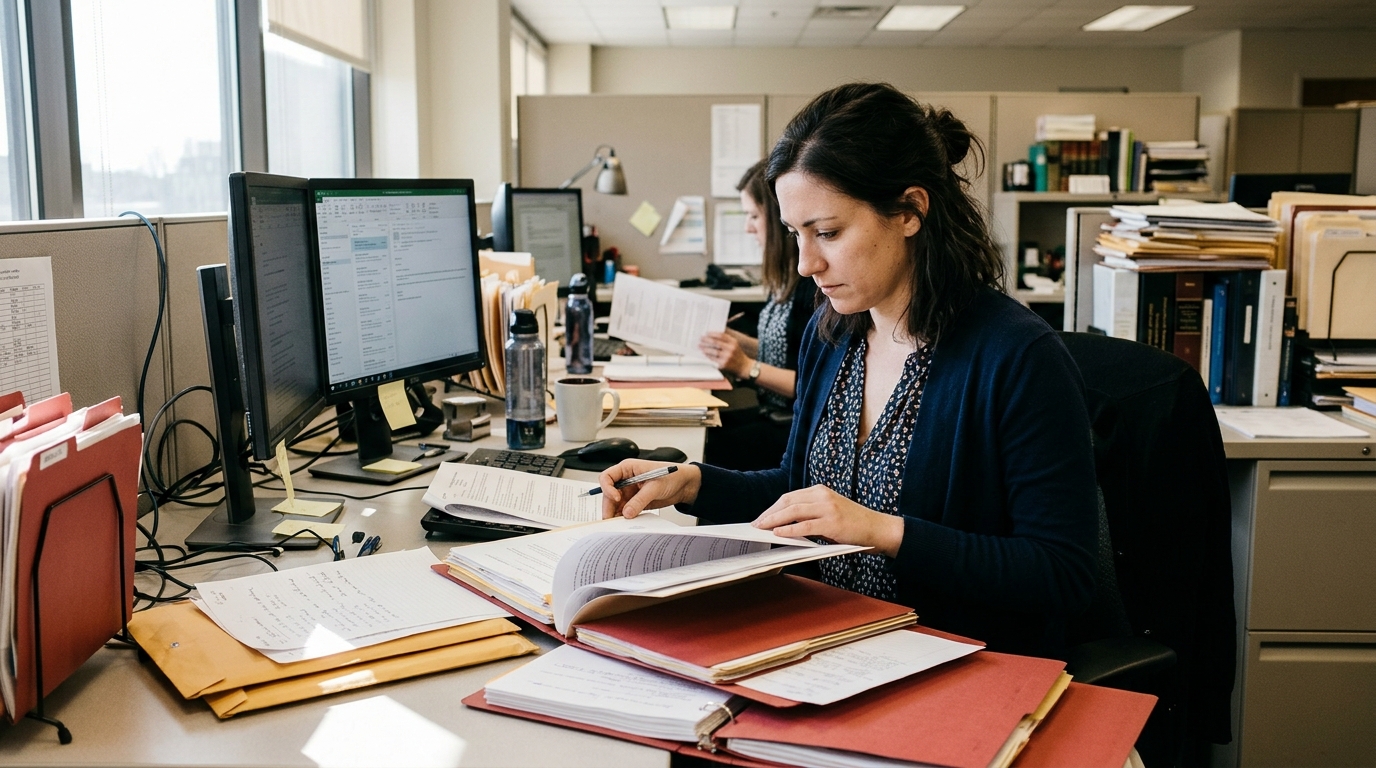
Paralegals do the research, drafting, document organization and court filing that lawyers sign off on. Most work full time in offices for law firms and government agencies, with legal services employing about 75% of the occupation (U.S. Bureau of Labor Statistics, 2025), and the work is largely seated, deadline-driven and detail-heavy.
It suits people who like precision and tracking many moving pieces at once. If you want courtroom argument or client representation, this is the wrong seat.
What This Career Involves Day to Day
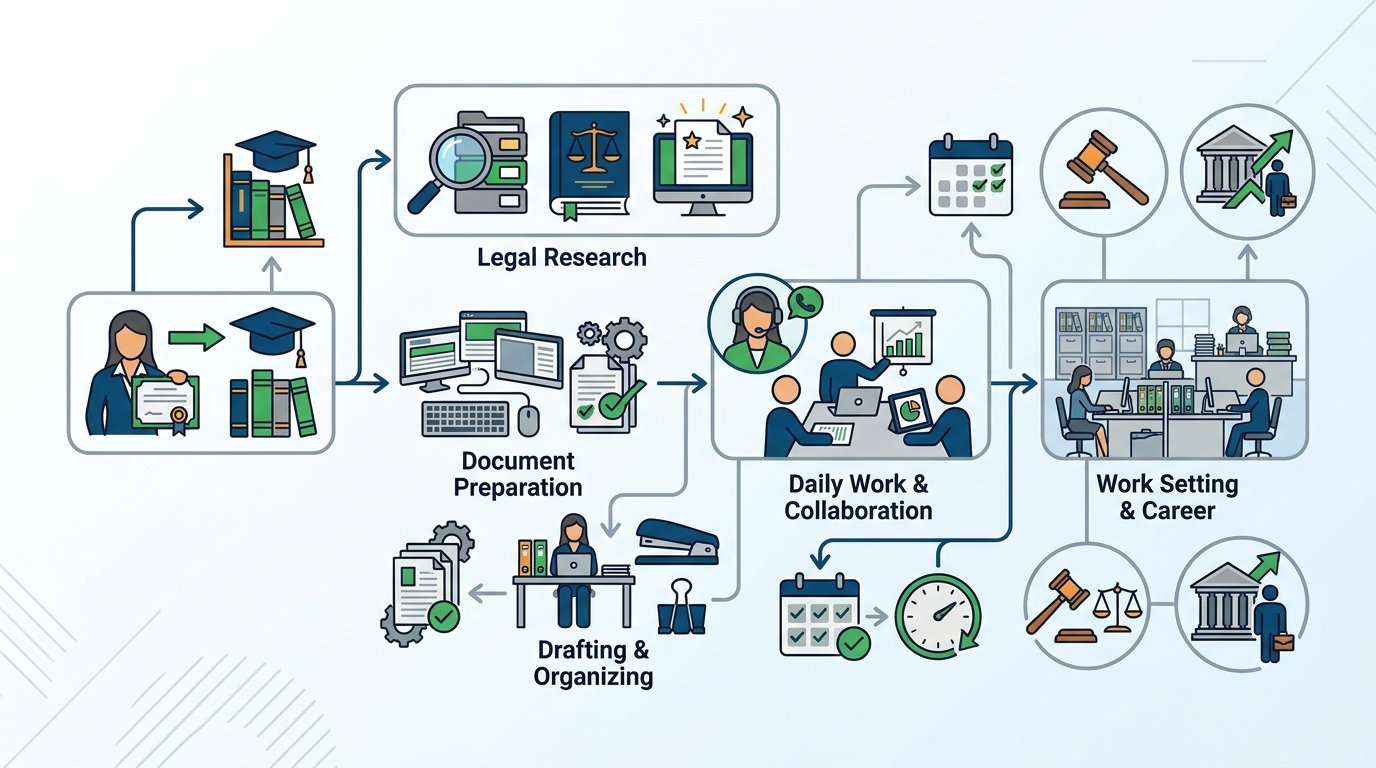
A typical day starts in Microsoft Outlook, clearing overnight email from attorneys, opposing counsel and court clerks — every surveyed paralegal said they use email daily (O*NET OnLine). The first hour goes to triage: which filing deadline lands today, which attorney needs a draft before a 2 p.m. call.
Mid-morning is often legal research in LexisNexis or Thomson Reuters Westlaw, pulling case law on a motion and summarizing it in a memo the supervising attorney will rely on. After that, drafting: a contract revision, a brief section, or an affidavit prepared for a witness to review and sign (O*NET OnLine; U.S. Bureau of Labor Statistics, 2025).
Afternoons tend to be document work. You Bates-stamp and redact PDFs in Adobe Acrobat, file the finished set into a document management system such as Microsoft SharePoint, and e-file pleadings with the court clerk through the court's electronic filing portal — watching the clock, because a missed cutoff can cost the client the motion.
Before a trial, the rhythm changes. You index exhibits, assemble trial binders, schedule depositions and witness interviews, and sit in the courtroom handing the attorney the right document at the right moment. Work is almost entirely indoors — 97% of surveyed workers reported an environmentally controlled setting every day (O*NET OnLine).
Signs This Career Might Suit You
- You proofread your own emails twice before sending and catch other people's typos without trying — 79% of surveyed paralegals rated being exact or accurate as extremely important (O*NET OnLine).
- You've kept a tracker for several overlapping projects and preferred it to doing one thing at a time.
- You like finding the answer more than arguing it, and you'd happily spend two hours in a database tracing how a rule has been applied.
- You're comfortable making someone else's work look right, rather than being the one whose name is on it.
- You can concentrate for long stretches at a desk; 80% of surveyed workers sit continually or almost continually (O*NET OnLine).
- You handle a firm deadline by working backwards from it instead of avoiding it.
- You've worked closely with a small team and liked it — 62% of surveyed paralegals said contributing to a team is extremely important (O*NET OnLine).
Signs This Career Might Not Be for You
- Overlapping deadlines are constant. The work can be fast paced with multiple projects under tight deadlines (U.S. Bureau of Labor Statistics, 2025), and 54% of surveyed workers reported time pressure once a week or more (O*NET OnLine) — evenings disappear during a trial or a closing.
- The job is desk-bound. Sitting almost continually in front of two monitors (O*NET OnLine) brings eye strain and back and wrist trouble within months if you need to move.
- Document review is repetitive. Redacting, Bates-stamping and indexing hundreds of pages in Adobe Acrobat is normal, and if repetition frustrates you, you'll resent the bulk of discovery work.
- You don't get the final say. Attorneys revise your drafts and set strategy, so wanting to make the legal calls turns the role into a constant near-miss.
- Growth is flat. Employment is projected to show little or no change from 2025 to 2035 (U.S. Bureau of Labor Statistics, 2025), so you compete mainly for replacement openings.
Skills and Traits That Matter Most
| Skill/Trait | Why It Matters on the Job |
|---|---|
| Detail orientation | A wrong date on an affidavit or a missed redaction in an Adobe Acrobat PDF goes out to opposing counsel and can't be taken back. |
| Organizational skills | You index trial exhibits and maintain electronic filing systems in SharePoint while three matters run at once. |
| Research skills | Case law you pull and summarize in LexisNexis or Westlaw is what the attorney's motion gets built on. |
| Written communication | The briefs, contracts and research memos you draft go to attorneys, clients and courts under someone else's signature. |
| Interpersonal skills | Obtaining affidavits and scheduling depositions means getting cooperation from witnesses and court clerks who don't work for you. |
| Calm under time pressure | E-filing a pleading with the court clerk before a same-day cutoff leaves no room for panic. |
The U.S. Bureau of Labor Statistics (2025) lists communication, detail orientation, interpersonal, organizational and research skills as the important qualities for this occupation.
Pay, Hours, and Outlook
| Measure | Figure |
|---|---|
| Median annual wage | $62,890 (about $30.24 per hour), May 2025 |
| Lowest 10 percent | Less than $44,740, May 2025 |
| Highest 10 percent | More than $101,500, May 2025 |
| Typical hours | Most work full time, with longer weeks near deadlines and trials |
| Projected growth, 2025–2035 | Little or no change |
| Annual openings | About 40,800 per year on average |
All figures above come from the U.S. Bureau of Labor Statistics, a federal government statistical agency (wages May 2025; projections 2025–2035). Those openings come mostly from workers transferring to other occupations or leaving the labor force rather than from new positions.
Pay is usually salaried for law firm staff, though some employers pay hourly with overtime, and bonuses tied to firm performance are common in private practice. The range depends heavily on practice area, employer size, state and metro area — legal services employs 75% of paralegals (U.S. Bureau of Labor Statistics, 2025), while government agencies pay on published scales. Check the Bureau of Labor Statistics Occupational Employment and Wage Statistics pages for current figures in your state.
How People Usually Get Started
- Earn an associate's degree or a certificate in paralegal studies. The U.S. Bureau of Labor Statistics (2025) reports this is the typical entry requirement; some employers prefer a bachelor's degree, and others accept a high school diploma plus experience. O*NET places the occupation in Job Zone Three, usually one to two years of training.
- Build hands-on skill with the tools before you apply — Westlaw or LexisNexis research, Adobe Acrobat redaction and Bates numbering, and a document management system such as SharePoint.
- Take an internship or an entry-level legal assistant, file clerk or litigation support role at a law firm, a corporate legal department, or a county or federal agency. This is where you learn court e-filing rules, which vary by state and by court.
- Specialize in a practice area — litigation, real estate, corporate, estates. Attorneys hire for familiarity with their specific filings and timelines.
- Sit for a certification once you're eligible. NALA's Certified Paralegal credential requires a two-part exam, with pathways including a bachelor's degree plus one year of paralegal experience or a high school diploma plus five years (NALA). The National Federation of Paralegal Associations offers the Paralegal CORE Competency Exam (CRP designation) and the advanced Paralegal Advanced Competency Exam (RP designation), with eligibility counting full-time work spent at least 80% on paralegal duties (NFPA).
- Maintain the credential. Certification typically requires continuing education hours (U.S. Bureau of Labor Statistics, 2025), which also keep you current as court rules and software change.
Frequently asked questions
Do I need a degree to become a paralegal?
Usually, yes — an associate's degree or a certificate in paralegal studies is the typical entry point (U.S. Bureau of Labor Statistics, 2025). Some employers prefer a bachelor's degree in any field combined with a paralegal certificate, and others consider a high school diploma plus substantial legal experience. Requirements are set by employers rather than a national rule, so check postings in your state and practice area.
Is certification required to work as a paralegal?
No. Certification is not required to enter the occupation, though some employers prefer or require it (U.S. Bureau of Labor Statistics, 2025). The main voluntary credentials are NALA's Certified Paralegal, earned by passing a two-part exam, and NFPA's PCCE (CRP designation) and PACE (RP designation). All require continuing education to maintain.
Is the work physically demanding?
Not in the lifting sense, but it is physically static. Eighty percent of surveyed paralegals sit continually or almost continually, and 97% work indoors in a climate-controlled setting (O*NET OnLine). The strain shows up as eye fatigue and back and wrist problems from long hours at a keyboard rather than anything heavy.
How long does the training take?
Most paralegal programs run one to two years, matching O*NET's Job Zone Three classification of medium preparation. Certificate programs for people who already hold a degree are usually shorter. Many people then spend a first year in a legal assistant, file clerk or litigation support role before moving into full paralegal duties.
Can a paralegal give legal advice to clients?
No. Paralegals work under the supervision of an attorney, who takes responsibility for the legal work and the advice given to clients. Your role is to investigate facts, research law, draft documents and prepare filings (U.S. Bureau of Labor Statistics, 2025); the attorney reviews and signs. If making the legal calls is what draws you, law school is the path, not this one.
Sources
- U.S. Bureau of Labor Statistics — Paralegals and Legal Assistants : Occupational Outlook Handbook (2025-05)
- O*NET OnLine — 23-2011.00 - Paralegals and Legal Assistants

Written by
Felix writes a column on the inner life of work — burnout, ambition, the quiet math people do about whether a job is worth it. He prefers plain language to management jargon and says so often.