 Hire Compass HQ
Medical Assistant vs CNA: Which Career Fits You
Both roles put you in direct patient contact within months, but one leans clinical-plus-administrative in clinics and the other hands-on bedside care.
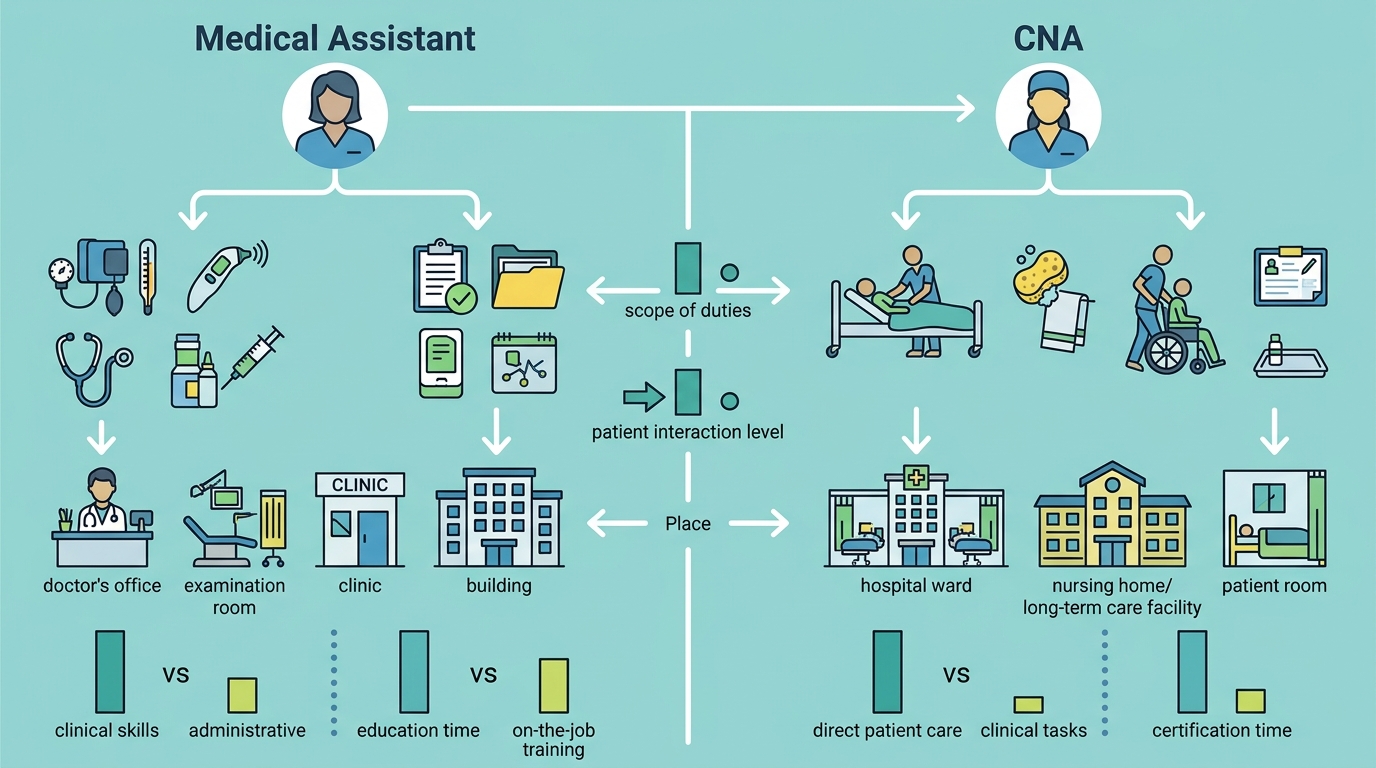
Medical assistants work mostly in outpatient settings, splitting the day between clinical tasks like measuring vital signs and giving injections where state law allows, and administrative ones like scheduling appointments (U.S. Bureau of Labor Statistics). Certified nursing assistants work mainly at the bedside in nursing homes, hospitals and home care, bathing, repositioning and transferring patients and checking vitals.
The practical difference is training length and physical load: medical assisting programs typically take about one or two years including a practicum (U.S. Bureau of Labor Statistics), while CNA entry runs through a shorter state-approved program plus a state competency exam — and nursing assistants have one of the highest rates of injuries and illnesses of all occupations (U.S. Bureau of Labor Statistics).
Side-by-Side Comparison
These two jobs sit close together on a résumé and far apart in daily reality. Use the table to see where the differences actually fall.
| Dimension | Medical Assistant | Certified Nursing Assistant (CNA) |
|---|---|---|
| Median pay | Paid as an hourly wage in most clinics; the U.S. Bureau of Labor Statistics publishes a median annual wage for medical assistants (May 2025) in its Occupational Outlook Handbook — check that page and CareerOneStop for your state before you commit | Paid as an hourly wage, often with shift differentials for nights and weekends; the U.S. Bureau of Labor Statistics publishes separate median annual wages for nursing assistants and for orderlies (May 2025) — check both, plus your state figure on CareerOneStop |
| Typical schedule | Most work full time on the clinic's opening hours; because many outpatient offices are not open overnight, fixed weekday shifts are common | Most work full time and some part time, and may need to work nights, weekends and holidays because facilities run 24 hours (U.S. Bureau of Labor Statistics) |
| Education required | Postsecondary nondegree certificate or diploma is the typical entry-level education (U.S. Bureau of Labor Statistics); O*NET places the occupation in Job Zone Three, Medium Preparation Needed | A state-approved nursing assistant education program, which is shorter than most medical assisting programs and set by state rules |
| Credential and exam | Most states do not require certification, but employers may prefer or require it; the CMA (AAMA) Certification Exam from the American Association of Medical Assistants is one route | Pass your state's competency exam after the approved program, then be placed on the state registry; the title is CNA in some states and differs in others (U.S. Bureau of Labor Statistics) |
| Physical demands | On your feet between exam rooms, steadying patients onto exam tables, handling needles and lab specimens | Heavy and repeated lifting, turning, repositioning and transferring patients; much of the shift on your feet; one of the highest rates of injuries and illnesses of all occupations (U.S. Bureau of Labor Statistics) |
| Job growth projection | The U.S. Bureau of Labor Statistics publishes a 2025–35 employment projection for medical assistants in the Occupational Outlook Handbook | The U.S. Bureau of Labor Statistics publishes a 2025–35 projection for nursing assistants and orderlies as a combined occupational group |
| Typical work setting | Outpatient: physicians' offices, group practices, specialty clinics and outpatient care centers | Inpatient and residential: nursing and residential care facilities, hospitals, and home health visits |
| Mix of work | Clinical plus administrative — interviewing patients, recording medical history, measuring vital signs, giving injections or medications as permitted by state law, scheduling appointments, collecting lab specimens (U.S. Bureau of Labor Statistics) | Almost entirely hands-on personal care — cleaning and bathing patients, helping with toileting and dressing, turning and transferring, measuring vital signs, serving meals (U.S. Bureau of Labor Statistics) |
A Day in Each Role
A medical assistant's shift is paced by the appointment book. You room the first patient, confirm why they came, take a blood pressure with a cuff and a digital thermometer reading, and type the history straight into the electronic health record while the provider finishes a note next door. Between patients you draw a blood specimen, label and spin it in the centrifuge for courier pickup, run instruments through the autoclave, and restock the exam room. Later you give an injection if your state permits medical assistants to do so, call a patient back with instructions, and book a follow-up in the practice management system. The rhythm is stop-start: clinical task, clerical task, clinical task.
A CNA's shift is paced by the care plan and the call light. You start with rounds — helping residents out of bed with a gait belt, assisting with toileting and dressing, bathing someone who cannot do it alone. You record vitals on a handheld or at a point-of-care terminal, pass breakfast trays and chart how much each person ate and drank, then reposition bed-bound patients on a schedule to prevent pressure injuries, sometimes using a mechanical lift with a second staff member. The afternoon brings transfers to wheelchairs, walks down the hallway, linen changes and a report to the nurse about anything that looked different. The physical load is constant, and so is the personal contact.
Choose Medical Assistant If...
- You want a mostly weekday, clinic-hours schedule rather than the nights, weekends and holidays common in 24-hour nursing facilities.
- You like switching between clinical and desk work — drawing a specimen in one room, scheduling appointments and updating the electronic health record in the next.
- You are willing to spend about one or two years in a program that includes a practicum, rather than entering through a shorter state-approved course.
- You want the option of a national credential such as the CMA (AAMA) Certification Exam, even though most states do not require medical assistants to be certified.
- You prefer an outpatient setting — physicians' offices and specialty clinics — where you see the same patients at intervals rather than through a whole hospital stay.
Choose CNA If...
- You want to start earning in patient care quickly, through a state-approved program and a state competency exam rather than a one- to two-year medical assisting program.
- You are comfortable with the physical side — lifting, turning, transferring and bathing patients — in a job with one of the highest rates of injuries and illnesses of all occupations (U.S. Bureau of Labor Statistics).
- Night, weekend and holiday shifts suit you, either because of shift differentials or because they fit around school or family.
- You want sustained contact with the same residents or patients across a shift, not six-minute room turnovers between appointments.
- You are considering nursing later and want bedside experience, a state registry listing and a clear view of what LPN or RN work involves before you enrol.
Getting Started in Either Path
Both paths start with a program your state or an accreditor recognises. Confirm the specifics with your state's health or nurse aide registry office and with CareerOneStop before you pay for anything.
| Starting point | Medical Assistant | Certified Nursing Assistant |
|---|---|---|
| Typical entry credential | Postsecondary certificate or diploma in medical assisting (the typical entry-level education, U.S. Bureau of Labor Statistics); for the CMA (AAMA) Certification Exam you must be a student or graduate of a CAAHEP- or ABHES-accredited medical assisting program, and recent graduates must sit the exam within 12 months of graduation | Completion of a state-approved nursing assistant education program plus a pass on the state competency exam, followed by placement on the state nurse aide registry |
| Typical time to entry | About 1 to 2 years, including a practicum or internship (U.S. Bureau of Labor Statistics) | Weeks to a few months, depending on the hour requirements your state sets, plus scheduling and sitting the competency exam |
| First job title | Medical Assistant or Clinical Medical Assistant in a physicians' office or outpatient clinic | Certified Nursing Assistant in a nursing or residential care facility, or Nursing Assistant or Orderly in a hospital — the official title varies by state |
Two practical notes. If you aim at the CMA (AAMA) Certification Exam, check the program's CAAHEP or ABHES accreditation before enrolling, because eligibility depends on it, and note that candidates may not exceed six exam attempts in any 12-month period. If you are going the CNA route, confirm that the program is on your state's approved list — approval and the exam are state-run, so a course accepted in one state is not automatically accepted in another.
Frequently asked questions
Which one pays more, medical assistant or CNA?
The U.S. Bureau of Labor Statistics publishes separate May 2025 median annual wages for medical assistants and for nursing assistants and orderlies, and the gap between them differs by state and by setting. Both are usually paid hourly, but CNA work in 24-hour facilities more often carries night, weekend and holiday differentials, while medical assistant pay tends to track clinic hours. Look up both occupations in the Occupational Outlook Handbook and then check your own metro area on CareerOneStop, because local rates vary more than national medians suggest.
Which job is harder on your body?
CNA work is the more physically demanding of the two: nursing assistants and orderlies spend much of their time on their feet and have one of the highest rates of injuries and illnesses of all occupations (U.S. Bureau of Labor Statistics), mostly from lifting, turning and transferring patients. Medical assistants are also on their feet, but the lifting is lighter and the day is broken up by charting in the electronic health record and scheduling appointments. If repeated patient transfers worry you, medical assisting is the safer bet for your back.
Can I move from CNA to medical assistant, or the other way?
Yes, and CNA is the faster first step because entry runs through a state-approved program and a state competency exam rather than the one- to two-year program typical for medical assistants (U.S. Bureau of Labor Statistics). Working as a CNA while you complete a CAAHEP- or ABHES-accredited medical assisting program is a common sequence. Going the other direction, a medical assistant moving into CNA work still has to complete their state's approved nurse aide program and pass the competency exam, since the registry requirement is set by the state.
Which gives better advancement?
CNA experience is the more direct on-ramp to nursing, because bedside hours and a state registry listing count toward admission and comfort in LPN and RN programs. Medical assistants more often advance sideways or upward inside outpatient practice — lead medical assistant, clinical supervisor, or administrative and billing roles — and a credential such as the CMA (AAMA) Certification Exam supports that, even though most states do not require certification (U.S. Bureau of Labor Statistics). Decide which ceiling you are aiming at: hospital nursing, or clinic operations.
Sources
- U.S. Bureau of Labor Statistics — Occupational Outlook Handbook: Medical Assistants (2025-05)
- U.S. Bureau of Labor Statistics — Occupational Outlook Handbook: Nursing Assistants and Orderlies (2025-05)

Written by
Priya turns job-market numbers into something readable, chasing the story behind a wage chart or an unemployment figure. She's most interested in what statistics miss about an actual day at work.