 Hire Compass HQ
How to Prepare for a Warehouse Job Interview
From the phone screen to the walk-through of the floor, here is what hiring teams ask about, what to bring, and how to talk about lifting and safety.
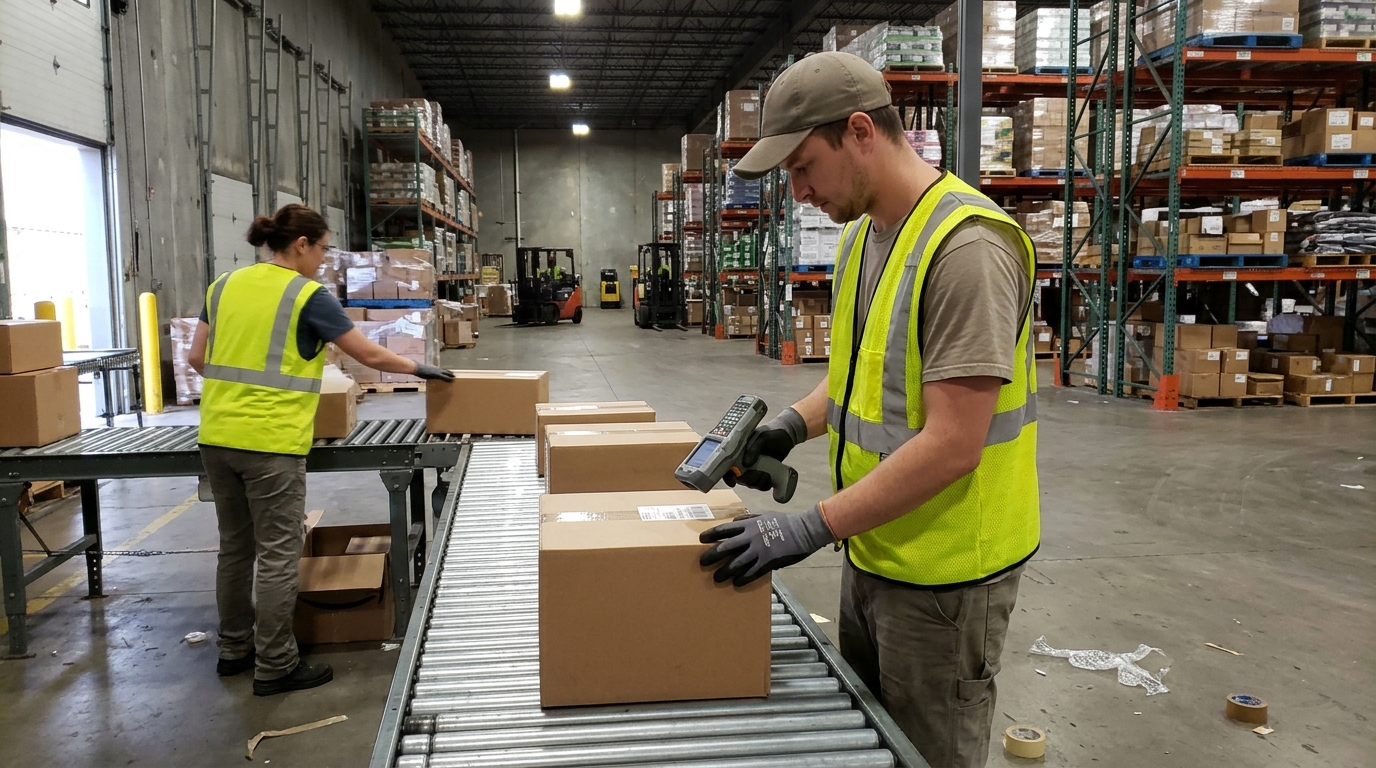
Warehouse interviews are short and practical. They test three things: whether you can do the physical work shift after shift, whether you follow instructions and safety rules exactly, and whether your availability matches the shift being filled. For warehouse and material-moving roles, expect roughly one to three stages — a 10 to 20 minute phone screen with an in-house or staffing-agency recruiter, a 20 to 45 minute on-site conversation with the warehouse supervisor or hiring manager, and sometimes a short walk through the floor — though this varies by employer and by whether you are hired direct or through an agency.
Formal education is rarely the barrier: the U.S. Bureau of Labor Statistics (2025) lists no formal educational credential as the typical entry-level requirement for hand laborers and material movers, and says most learn through short-term on-the-job training of a month or less. The interview is where you prove reliability, accuracy and safety awareness instead.
Step-by-Step Interview Preparation Plan
- Build a one-page job sheet from the posting. Write down the shift pattern and start time, the stated lift weight and frequency, the area (inbound receiving, outbound loading, pick-pack, returns), the temperature zone (ambient, chilled, freezer, outdoor yard) and every tool named — pallet jack, walkie rider, RF scanner, cherry picker, forklift, shrink wrapper. The Bureau of Labor Statistics (2025) notes these roles sit in stockrooms, warehouses, manufacturing plants and other settings, and that most are full time though part-time work is common, so pin down which one you are interviewing for.
- Find out what the site actually moves. Look up the employer's recent news, the product categories it ships, its main named competitors in that sector, and whether the building is a distribution center, a cross-dock or a fulfillment site. Write three sentences you can say out loud: what the site ships, where it ships to, and when its peak season falls.
- Map your experience onto the real tasks. O*NET (2026) lists tasks including moving freight and stock to and from storage areas, loading docks, delivery vehicles and containers; reading work orders or taking oral instructions to determine assignments; installing bracing, padding or strapping to stop loads shifting; and maintaining storage areas so inventory is protected. Write one short story for each that you have genuinely done, even from a non-warehouse job.
- Draft four STAR answers in writing, then say them aloud. O*NET (2026) rates being exact or accurate as extremely important in this occupation, so accuracy stories carry weight.
Sample answer: "Tell me about a time you caught a mistake before it left the dock."
Situation: I was loading outbound pallets on second shift, around 40 pallets a night. Task: scan every pallet label against the trailer's load list before it went on. Action: two labels scanned to the same stop code, so I stopped the load, pulled both pallets back to the staging lane and had the shipping clerk reprint from the work order. Result: the trailer left 12 minutes late but the customer got the right freight, and my supervisor had us scan-verify in pairs on high-volume stops after that.
- Prepare your equipment and licence answers precisely. If forklifts are mentioned, know that OSHA's powered industrial truck standard, 29 CFR 1910.178, requires employers to give operators formal instruction, practical training and a workplace evaluation of their performance, and that a course certificate alone does not establish qualification (summary of OSHA 29 CFR 1910.178, 2026); performance must be re-evaluated at least every three years. Say what you were evaluated on, where and when, rather than "I'm certified." Some roles need a state-issued licence — the Bureau of Labor Statistics (2025) gives the example of refuse and recyclable material collectors driving trucks above a certain capacity needing a commercial driver's license, obtained by passing written, skill and vision tests. CareerOneStop's licensed occupations tool is the source BLS points to for state licensing board requirements, and those differ by state.
- Rehearse the physical and availability questions, and confirm the format. Expect: "Walk me through the heaviest, most repetitive work you've done and how long you did it for." And: "Are you available for mandatory overtime at the end of the shift, and weekends during peak?" Answer with shift lengths and seasons you have actually worked. The Bureau of Labor Statistics (2025) lists physical stamina, physical strength, hand-eye coordination, listening skills, attention to detail and customer-service skills as the qualities that matter, so give an example rather than the adjective. Then ask the recruiter or agency coordinator who runs each stage, which gate to use, and whether the visit includes a floor walk.
Day-Before and Day-Of Checklist
- Closed-toe boots, ideally steel-toe, worn rather than carried — O*NET (2026) reports workers in this occupation wear protective equipment such as safety shoes, glasses, gloves, hearing protection or hard hats every day, and a floor walk usually requires them.
- Layered clothing matched to the zone: O*NET (2026) reports daily exposure to very hot or cold temperatures and to all weather conditions outdoors, so add a jacket for a yard, dock or freezer role.
- Your printed one-page job sheet with the shift, zone, lift requirement and equipment list, with three written questions on the back.
- Copies of any forklift training and evaluation records, commercial driver's license, or safety course certificates, in a plain folder.
- A written employment history with employer names, addresses, start and end months, and supervisor phone numbers — on-site application forms usually ask for all of it.
- Government-issued photo ID, plus anything else the recruiter specifically asked you to bring.
- A pen that works and a small notebook; shift options and start dates are often given verbally.
- Screenshots of the visitor entrance and parking instructions, since truck gates and visitor doors are frequently different; plan to arrive 10 to 15 minutes early.
- Hair tied back, no loose jewelry or dangling lanyards, so you can step onto the floor without being turned away.
- The name and job title of the person meeting you, written down, so you can ask for them at reception.
- The night before, check travel time against the actual interview hour — if it is set at 6 a.m. to match first shift, do a practice drive at that time, not at midday.
Questions to Ask Your Interviewer
- Which area would I start in — receiving, put-away, picking, packing or outbound loading — and how often do people move between them?
- What does the productivity target look like here, and is it measured in units, cases or pallets per hour?
- How is pick or scan accuracy tracked, and what happens when someone's accuracy slips below the standard?
- What scanning or warehouse management system do you use on the floor, and how long does it usually take a new hire to get comfortable with it?
- Who gives me my assignments each shift — a printed work order, a verbal huddle, or tasks pushed to the scanner?
- The Bureau of Labor Statistics (2025) says new hand laborers and material movers often shadow an experienced worker during short-term on-the-job training — would I be paired with someone, and for how long?
- Safety rules learned on the job are largely standardized through OSHA (U.S. Bureau of Labor Statistics, 2025) — who runs the site's safety briefings, and how often?
- If I want to run a forklift, how does the site handle the practical training and workplace evaluation OSHA's powered industrial truck standard requires, and are re-evaluations on the three-year cycle or more often?
- What protective equipment does the site provide versus what I buy myself, and which areas have dust, fumes or other contaminant exposure? O*NET (2026) reports daily exposure to contaminants in this occupation.
- How do you want loads secured — what are your standards for bracing, padding or strapping so freight doesn't shift in the trailer?
Frequently asked questions
How early should I arrive for a warehouse interview?
Aim for 10 to 15 minutes before the scheduled time, and confirm which entrance to use. Many sites have a separate truck gate and visitor door, and security sign-in can take several minutes. If the interview is set to match a shift start, such as 6 a.m. or 2 p.m., check traffic at that exact hour the day before rather than at midday.
What should I wear?
Clean work-appropriate clothes and closed-toe boots, ideally steel-toe. Skip the suit. O*NET (2026) reports workers in this occupation wear safety shoes, glasses, gloves, hearing protection or hard hats every day, and if the supervisor offers a walk through the floor you need footwear that lets you take it. Add a layer if the site includes a freezer, dock or outdoor yard.
Will there be a physical test or lifting demonstration?
It varies by employer. Some sites run a short walk-through only; others include a lift or carry demonstration, or schedule a physical assessment after an offer. Ask the recruiter when scheduling exactly what the visit includes so you dress for it, and be ready to describe the heaviest repetitive work you have done and how many hours you did it for.
Do I need a resume or a diploma?
Bring a one-page resume if you have one, but the application form matters more — most ask for employer names, dates and supervisor contacts, so bring that list written out. The Bureau of Labor Statistics (2025) lists no formal educational credential as typical entry-level education for hand laborers and material movers, though O*NET (2026) notes many jobs in this preparation zone ask for a high school diploma or GED.
Sources
- U.S. Bureau of Labor Statistics — Hand Laborers and Material Movers : Occupational Outlook Handbook (2025)
- O*NET OnLine / National Center for O*NET Development — 53-7062.00 - Laborers and Freight, Stock, and Material Movers, Hand - O*NET OnLine (2026)

Written by
Mireille thinks about work the way some people think about weather: always shifting, worth tracking closely. She edits pieces on hiring trends and the small negotiations that shape a career, and has little patience for advice that assumes everyone wants the same thing from a job.