 Hire Compass HQ
Behavioral Interview Questions and How to Answer Them
Behavioral questions ask for evidence from your past work, so the structure of the story you tell matters as much as the story you pick.
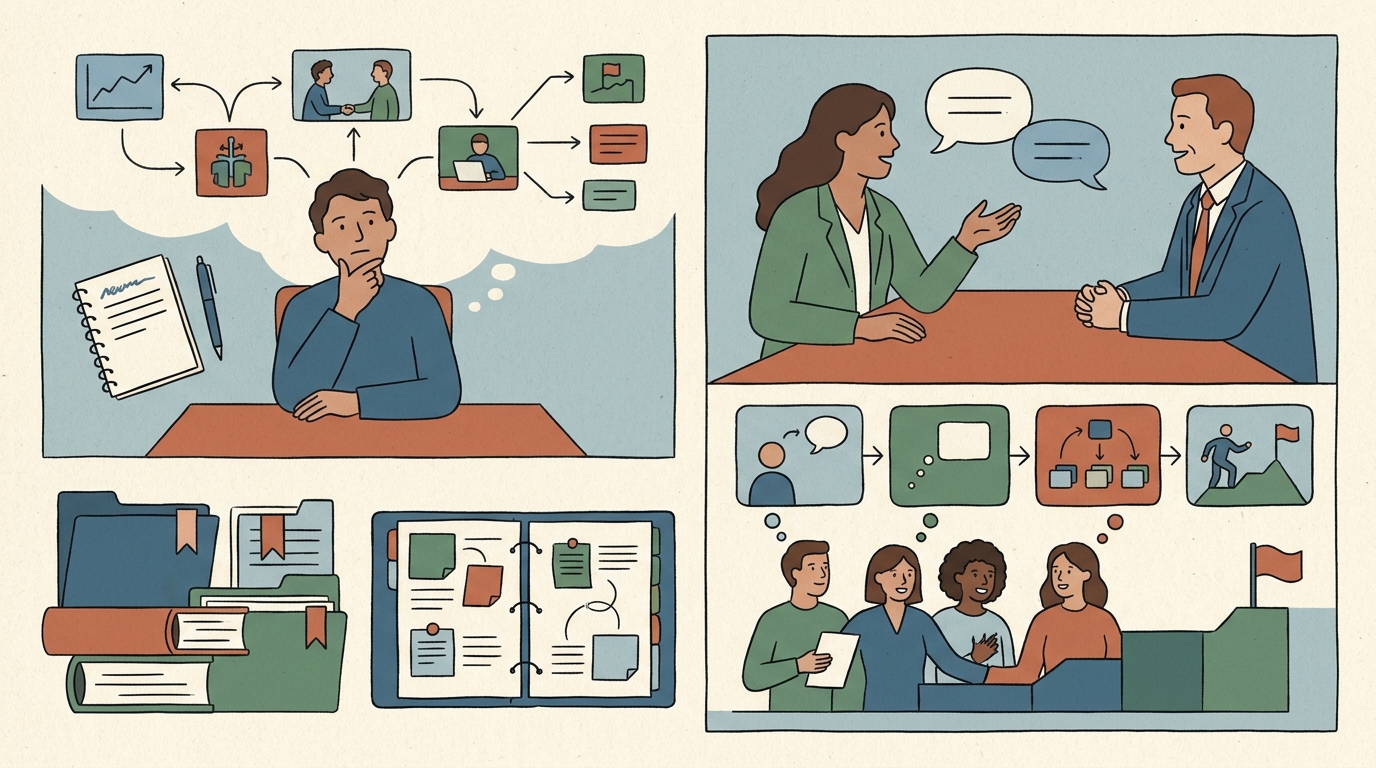
Behavioral interview questions ask you to describe something you have actually done — a conflict you handled, a deadline you missed, a process you fixed — rather than what you would do in theory. Interviewers use them because past behavior is easier to probe than a hypothetical, and because a well-run panel can score several candidates against the same prompts.
The fix is not charisma. It is having six to eight real stories ready, each with a clear situation, your specific task, the actions you personally took, and a result you can put a number or an outcome against.
What to Expect From a Behavioral Interview
Behavioral questions rarely sit in a round of their own. In most US hiring processes they appear across two to four stages, though this varies widely by employer, sector and country — a small business may do one conversation, while large employers, government agencies and regulated industries often run structured panels with scored rubrics.
Typical stages:
- Recruiter or HR screen, 20–30 minutes, usually by phone. One or two light behavioral prompts, mostly about why you are leaving and how you handle workload.
- Hiring manager interview, 45–60 minutes. This is where the bulk of behavioral questions land, aimed at how you work day to day on their team.
- Panel or peer round, 45–90 minutes, run by future teammates or a cross-functional lead. Expect repeated prompts on conflict, feedback and ownership, each interviewer digging into a different competency.
- Senior leader or skip-level conversation at some employers, often shorter and focused on judgment calls.
What makes behavioral rounds distinct: the interviewer is not listening for the right answer. They are listening for whether you can name what you specifically did versus what the team did, and whether your result is checkable. Expect follow-up probes — "what would you do differently?", "how did the other person react?" — so pick stories you remember in detail rather than ones that sound impressive.
Common Behavioral Interview Questions and Sample Answers
Tell me about a time you had to work with a difficult coworker.
On a two-person support rotation, a colleague kept reassigning Zendesk tickets to my queue near the end of his shift, which pushed my first-response time past our four-hour target. My task was to fix the backlog without escalating it into a complaint. I pulled the queue report, showed him the reassignment pattern in a ten-minute conversation, and proposed we split the end-of-shift tickets by topic instead of by whoever was online. He agreed. Over the next month my first-response average came back under three hours and the handoff stopped being a weekly argument.
Describe a situation where you missed a deadline. What happened?
I owned the monthly close checklist for a three-person finance team. One month the bank feed in QuickBooks failed to sync and I found out two days before close, which left me reconciling 400 transactions by hand. My task was to still deliver usable numbers. I told my manager the same morning, agreed to deliver the P&L on time and the fully reconciled balance sheet 48 hours late, and worked through the backlog in priority order. The close landed two days late. I added a weekly sync check to the calendar and we have not missed the date since.
Give me an example of a time you had to learn a new system quickly.
My team migrated from shared spreadsheets to Jira with two weeks' notice, and I was the one scheduling the work. I set myself a target of running our first sprint planning in the new tool without falling back to the old sheet. I spent two evenings rebuilding our board, recreated the three report views people actually used, and wrote a one-page cheat sheet for the six-person team. We planned the first sprint in Jira on schedule. Three of my teammates used the cheat sheet in their first week and we stopped maintaining the spreadsheet entirely.
Tell me about a time you disagreed with your manager.
My manager wanted to cut a quality check from our shipping process to clear a backlog during peak season. My task was to raise the risk without stalling the plan. I pulled the previous quarter's return data, which showed that mis-picks accounted for roughly a third of our returns, and proposed we keep the check but only on multi-item orders. She agreed to trial it for two weeks. Throughput improved enough to clear the backlog and returns did not climb. I learned to bring a narrower alternative rather than just objecting.
Walk me through a time you handled an angry customer.
A customer called after a replacement part arrived damaged for the second time. My task was to keep the account and get them a working part. I stopped reading the script, confirmed the order history in Salesforce while they talked, and told them plainly what had gone wrong on our side. I arranged an overnight replacement, had it inspected before it shipped, and called them the day it was due to confirm it arrived intact. They kept the account and later renewed. I logged the packaging fault so the warehouse could see the pattern.
Tell me about a mistake you made at work.
I sent a client report with a pivot table filtered to the wrong date range, so the figures understated their spend by about a fifth. My task was to correct it before they acted on it. I spotted it the next morning, emailed the client within an hour with the corrected file and a plain explanation, and told my manager before the client could. The client used the revised numbers for their quarterly review with no further issue. I now have a second person check the filter range on anything that leaves the team.
Describe a time you had to prioritize competing demands.
Two stakeholders needed work in the same week: a compliance report with a fixed regulatory date and a sales dashboard someone wanted for a pitch. My task was to deliver both or be honest about which would slip. I wrote out the hours each needed, confirmed the compliance date was immovable, and asked the sales lead which three of the eight dashboard charts he actually needed for the pitch. I built those three. Compliance filed on time and the pitch went out with the charts that mattered. The remaining five shipped the following week.
Give me an example of influencing someone you had no authority over.
Our duplicate customer records were breaking the mailing list, and the fix sat with a team I did not report into. My task was to get it prioritized. I spent an afternoon pulling a count of duplicates by source and found most came from one web form. I took that to their team lead with a specific, small ask: change one field on one form. He scheduled it for the next sprint. Duplicate creation dropped sharply within a month and I stopped spending Fridays cleaning the list by hand.
Tell me about a time you received critical feedback.
In a review, my manager said my written updates were too long and people had stopped reading them. My task was to make them usable. I asked her to mark up my last two updates so I could see exactly what she cut, then rewrote my weekly note to a fixed shape: status in one line, blockers, decisions needed. I kept it under 150 words. Within a month two people outside my team started replying to it, which had never happened before. I still use that format.
How to Answer the Hardest Question You'll Face
The hardest behavioral question is almost always some version of "Tell me about a time you failed." Candidates either pick a fake failure — working too hard, caring too much — or they pick a real one and then narrate the blame. Both read badly. The answer that works names a genuine miss, owns your share of it, and shows the correction holding over time.
Sample answer: "Tell me about a time you failed."
I ran the rollout of a new scheduling system for a 40-person site. I built the training around a single two-hour session the week before go-live, because I assumed the tool was simple enough. It was not. In the first week, about a quarter of shifts were entered wrong, supervisors went back to the paper schedule, and I spent five days fixing records by hand instead of supporting the change.
The failure was mine specifically — I tested the system with the two supervisors who were already comfortable with software and treated that as proof it was intuitive. I never watched a hesitant user try it.
What I did after: I ran 15-minute floor sessions with each shift, sat next to the three people struggling most, and rewrote the quick-reference card based on the errors I was actually seeing. Entry errors dropped to near zero by week three and the paper schedule came down for good.
Since then I test any rollout with the least confident user first, not the most.
Frequently asked questions
What do I do if I genuinely have no example for the question asked?
Say so, then offer the closest real thing. "I haven't managed a direct report, but I've led a three-person project team through a migration — can I use that?" Interviewers almost always accept an adjacent example. Inventing one is worse, because the follow-up probes about what the other person said will expose it within two questions.
When should I bring up pay in a process that is mostly behavioral rounds?
Usually at the recruiter screen, when they ask for your expectations, and again at offer. Pay structures differ — base only, base plus bonus, hourly with shift differentials — so ask which applies before naming a number. Some states and cities require a range in the posting or on request; check your state's rules and look up current rates for the role and metro before the screen.
How many stories should I actually prepare?
Six to eight is usually enough for a two to four round process. Pick examples that can flex across themes — one strong conflict story often doubles as a communication or influence story. Write each one as four short lines and rehearse the action step out loud, since that is the part candidates compress and interviewers probe.
What if the interviewer cuts me off mid-answer?
That is usually a signal you spent too long on the setup. Stop, give the result in one sentence, and offer to go back into detail. If a panel is running several candidates against the same prompts, they are managing time, not dismissing you. Keep the remaining answers to roughly 90 seconds with the situation in two lines.
How soon should I follow up after a behavioral panel?
Within 24 hours, by email to the recruiter or whoever scheduled you, unless they asked you not to. Reference one specific thing from the conversation — a problem the team described, a tool they mentioned switching to — rather than restating your interest. If you fumbled a question, a two-sentence cleaner version of the answer is fair to include.

Written by
Yuki covers the broader shifts in how people work: shrinking industries, growing ones, the policies that quietly decide who gets steady income. She tends to start stories with a worker's own account before zooming out.