 Hire Compass HQ
Bank Teller Interview Questions and How to Answer Them
From cash-drawer balancing to angry-customer scenarios, here is what branch hiring managers probe for and how to answer without sounding rehearsed.
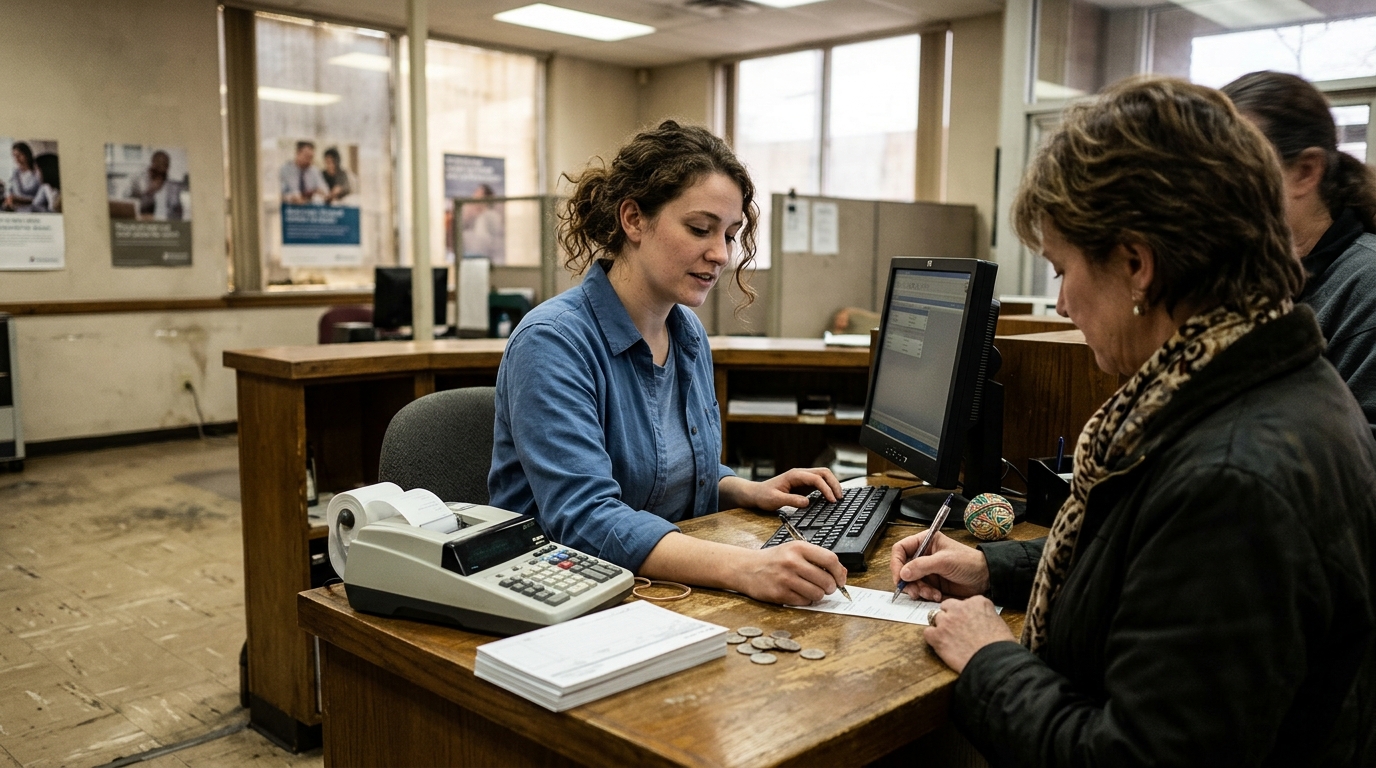
A bank teller interview is built around three things: accuracy with cash, calm at the window, and integrity when money goes missing. Tellers process routine transactions such as cashing checks and depositing money at a bank or credit union (U.S. Bureau of Labor Statistics, 2025), so expect scenario questions about verifying identity, balancing a drawer and referring a customer — not abstract questions about your strengths.
This guide covers who runs each round, nine questions phrased the way a branch manager asks them, sample answers you can adapt, and a script for the hardest one.
What to Expect From a Bank Teller Interview
Teller hiring usually runs two to three rounds. Single-interview hiring is common at small community banks and credit unions; large retail banks sometimes add a fourth stage.
A recruiter screen of roughly 15 to 30 minutes covers availability for Saturday and evening shifts, cash-handling history, and whether you can pass a background check — tellers typically need a high school diploma and may need to pass one (U.S. Bureau of Labor Statistics, 2025). The branch interview, usually 30 to 60 minutes with the branch manager or assistant manager, is where the scenario and behavioral questions land, often with the lobby open so they can see how you handle noise and interruptions. A head teller or senior teller frequently joins a second visit or a small panel; head tellers set schedules, help other tellers, handle difficult account problems and access the vault (U.S. Bureau of Labor Statistics, 2025), and that is the person who will train you. Some employers add a short math, cash-counting or customer-service simulation — that varies by bank, by credit union and by state.
What makes it distinct is that it tests the qualities the role is defined by: communication, customer service, attention to detail, integrity, interpersonal skills and math (U.S. Bureau of Labor Statistics, 2025). Teller employment is projected to decline 13 percent from 2025 to 2035, with about 26,800 openings a year, mostly from people leaving the occupation (U.S. Bureau of Labor Statistics, 2025), so concrete answers about drawers, checks and referrals separate you quickly.
Common Bank Teller Interview Questions and Sample Answers
"Walk me through how you would open and close your window on a normal day."
I count my cash drawer at the start of the shift and again at the end so the amounts balance (U.S. Bureau of Labor Statistics, 2025). At open, I verify strap and coin totals against the teller system figure, note any variance immediately, and check my stamps and counterfeit pen. During the day I watch my drawer limit and buy or sell cash with the head teller before I go over. At close I recount, reconcile against my transaction journal, and report any difference the same day.
"A customer hands you a check made out to them and asks for cash. What do you do before you count it out?"
Two checks first: I verify the customer's identity and make sure the account has enough money to cover the transaction (U.S. Bureau of Labor Statistics, 2025). That means a government photo ID matched to the signature on file, the endorsement signed in front of me, and the written amount agreeing with the numeric amount. I look for alterations and run it under the counterfeit detector. If it is a non-customer check or above my authority limit, I take it to the head teller rather than guess.
"Tell me about a time you dealt with an angry customer."
Situation: at a retail service counter, a customer had been charged twice for one order and had waited 20 minutes. Task: I was alone on the desk with six people behind her. Action: I moved her to the side counter so she was not performing in front of the line, repeated her problem back in her own words, pulled both transaction records, and told her exactly what I could do and by when. Result: the duplicate charge was reversed that afternoon, she stayed a regular, and my supervisor adopted the approach as the counter script.
"Your drawer is short at the end of the day. Walk me through what happens next."
I recount the drawer strap by strap, then compare my totals against my transaction journal to find the break — usually a miskeyed amount, a transposed figure or cash handed out twice. If it is still short, I report it to the head teller or branch manager immediately and complete the bank's cash-outage form. I never cover a shortage from my own pocket and never wait to see if it resolves itself. The record has to match reality, and someone senior needs to know the same day.
"How would you keep a customer's information confidential at an open teller window?"
I keep a clear desk, so no statements, signature cards or cash tickets sit face-up where the next customer can read them. I lower my voice for balances and never read an account number aloud. I confirm identity before discussing anything, including with someone who says they are a spouse. Under GLBA expectations, customer financial information stays inside the bank's systems — nothing leaves on paper or on my phone, screens lock when I step away, and anything printed in error goes to the shred bin.
"We expect tellers to refer products. How would you bring up a CD or a loan with someone who just came in to deposit a check?"
I listen for the cue rather than pitch. If someone deposits a large sum and mentions it is sitting idle, that is a natural moment to say the bank has certificates of deposit and ask whether they would like to speak with a banker. Tellers recommend products such as CDs or loans and refer interested customers to the right personnel (U.S. Bureau of Labor Statistics, 2025), so my job is a relevant question and a warm handoff, not a hard close. I would track referrals and ask which ones converted.
"Tell me about a time your attention to detail caught something others missed."
Situation: closing a register at a pharmacy, my till balanced but the coupon tape did not match the discount report. Task: I had 15 minutes before close and could have logged it as a minor variance. Action: I re-ran the day's discounted transactions, found a scanner applying a store coupon twice on multi-item rings, documented three example receipts and emailed the shift lead with times and register numbers. Result: the setting was corrected the next morning, and the same error turned up at two other registers.
"Why a teller job, and where do you want to be in three years?"
I want a role where accuracy is the job rather than a side task, and where I see the same customers weekly. Experienced tellers advance to head teller or supervisory roles, or move into occupations such as loan officer or sales (U.S. Bureau of Labor Statistics, 2025). My aim is to balance consistently, learn the core system and compliance rules well enough to train new tellers, then move toward head teller or personal banker.
"A long-standing customer asks you to post a deposit with yesterday's date so a payment clears. What do you say?"
I say no, warmly and without hesitation, and explain why: the deposit is recorded for the day it is received, and changing it would misstate the bank's records. Then I look for a legitimate option — same-day availability on part of the deposit, a transfer from another account, or a banker who can discuss overdraft protection. If the customer pushes, I bring in the head teller rather than negotiate alone, and I note the request.
How to Answer the Hardest Question You'll Face
The hardest question is not about your own mistake — it is about someone else's: "What would you do if you suspected a coworker was taking cash from their drawer?" Integrity is the trait being tested in cash questions, and banks would rather hire someone who reports a problem than someone who keeps quiet (Articuler, undated). Say "I'd talk to them first" and you have described concealment.
Scripted answer
I would report it, and I would be careful about how. I would not confront the person: if I am wrong I have accused a colleague, and if I am right I have given them warning. I would not discuss it with the other tellers either.
What I would do is write down exactly what I observed and when — a drawer that balanced only after a late adjustment on three separate days, or cash moved between drawers without a buy-sell ticket. Facts and times, not impressions.
Then I would take it to the branch manager the same day, or use the bank's ethics line if the manager were the person involved. After that it is not my investigation. I would keep my own drawer counted at the start and end of every shift, keep my transaction journal clean, and say nothing further to anyone outside the process.
I would rather have an uncomfortable conversation with a manager than be the person who noticed and said nothing.
Frequently asked questions
When should I bring up pay in a teller interview?
Let the recruiter or branch manager raise it, usually at the screen or the offer. Branch pay is typically hourly, sometimes with a shift differential or referral incentive, and it varies by bank, credit union and state. The median annual wage for tellers was $43,030 in May 2025, with the lowest 10 percent under $34,360 (U.S. Bureau of Labor Statistics, 2025); check current BLS figures and local postings before naming a range.
What do I say if I don't know the answer to a banking question?
Say what you would do to find out, and name the person. For example: "I haven't used that system, but I'd check the procedure manual and ask the head teller before processing it." That is correct behavior at the window anyway — training happens on the job, usually led by a head teller or experienced teller (U.S. Bureau of Labor Statistics, 2025). Guessing about a hold policy is worse than admitting a gap.
Is it worth mentioning a teller certificate if I don't have bank experience?
Yes, if you genuinely completed one. The American Bankers Association offers a voluntary Bank Teller Certificate covering communication, banking ethics, teller basics and workplace conduct in about 13 hours, and the Independent Community Bankers of America offers a Teller Specialist Certificate online (Indeed, undated). Name the modules you finished. The ABA's Certified Bank Teller exam, 75 multiple-choice questions, generally needs about six months of teller experience first (Best Accredited Colleges, undated).
What should I ask the branch manager at the end?
Ask what the first 30 days of training look like and what the path from teller to personal banker or branch roles has looked like for people there (Articuler, undated). Two more: how many tellers are on the line at peak hours, and whether referrals to bankers are tracked individually or by branch. Those tell you about workload and how your performance will be judged.
How should I follow up after a branch interview?
Email the branch manager who interviewed you within 24 hours — two short paragraphs referencing one specific thing from the visit, such as the Saturday coverage question or the drawer-balancing scenario. If a head teller sat in, thank them too. One polite check-in after a week is fine. Do not drop by the branch; it pulls staff off the line and reads as pressure.
Sources
- U.S. Bureau of Labor Statistics — Tellers : Occupational Outlook Handbook (2025)
- Indeed — Learn About Being a Bank Teller

Written by
Desmond writes about the mechanics of job hunting — resumes, interviews, the strange rituals of being evaluated by strangers. He's drawn to the gap between how hiring is supposed to work and how it actually happens.