 Hire Compass HQ
How to Apply for Warehouse Jobs: A Step-by-Step Guide
Warehouse hiring moves fast, but only if your ID, references and forklift certification record are ready before you open the first application form.
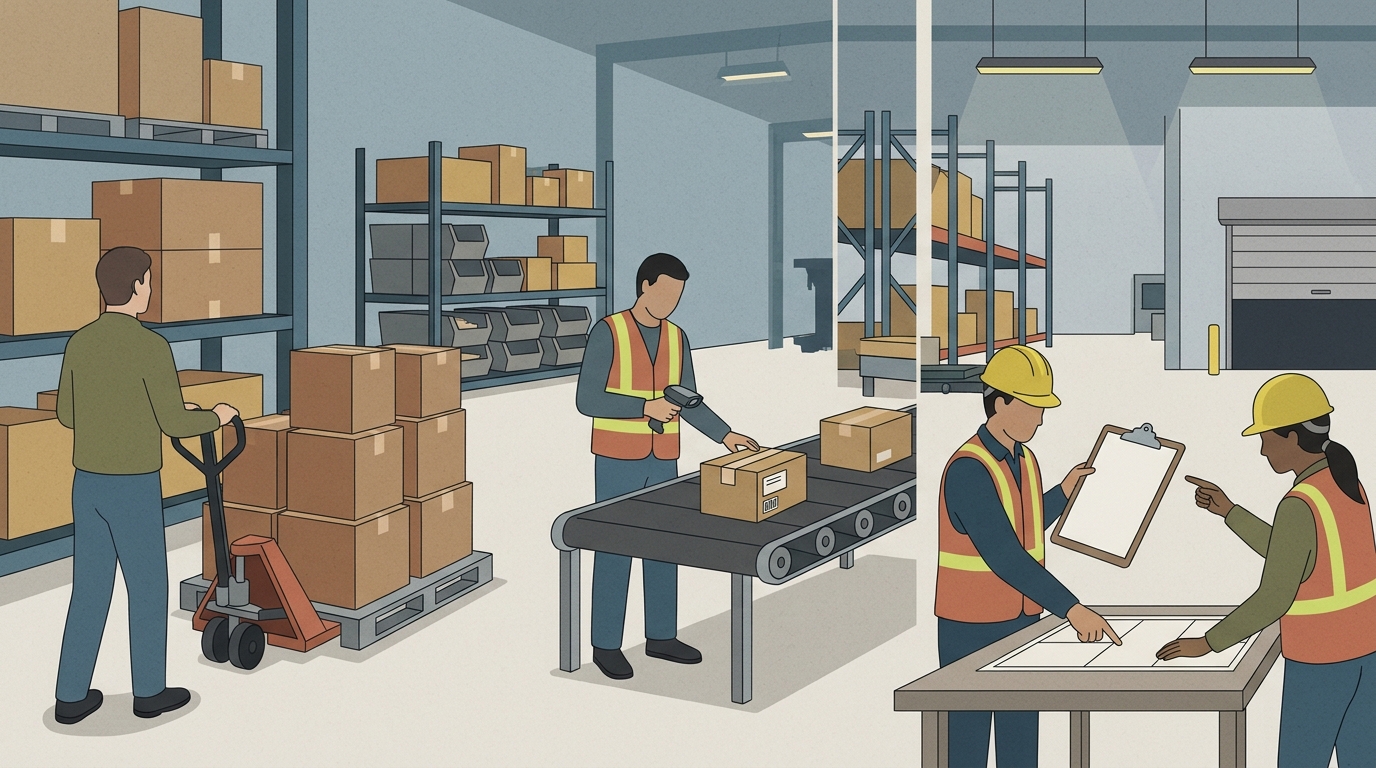
Applying for warehouse work is less about a polished resume than about being ready to move quickly: most employers screen for availability, physical capability, equipment experience and a clean background check, often within days of your application. The U.S. Bureau of Labor Statistics projects about 904,200 openings each year for hand laborers and material movers over the decade, with 4% growth from 2025 to 2035 (U.S. Bureau of Labor Statistics, 2025), so openings are frequent and competition is usually about who responds first and clears screening.
CareerOneStop lists the typical entry-level education for laborers and freight, stock, and material movers as no formal educational credential, and typical experience as no work experience (CareerOneStop, U.S. Department of Labor), so the barrier is paperwork and screening rather than schooling.
What Employers Expect From Applicants
Formal credentials are rarely the gate. CareerOneStop lists no formal educational credential and no prior work experience as typical requirements for laborers and freight, stock, and material movers (CareerOneStop, U.S. Department of Labor). What employers do expect is documentation they can process quickly.
At application stage you usually need only a short resume or an online form with your work history, dates, and the shifts you can work. Employers screen hard on availability — nights, weekends, four-tens, peak-season overtime — so answer those questions precisely rather than writing "flexible."
If you operate a forklift, bring your certification record. OSHA's powered industrial truck standard permits only trained and competent operators to run a forklift, and the employer must certify that each operator has been trained and evaluated under 29 CFR 1910.178(l)(6) (Occupational Safety and Health Administration). The record must show the operator's name, the training date, the evaluation date, and who performed the training or evaluation (Occupational Safety and Health Administration). Certification does not transfer automatically — your new employer must evaluate you before you operate a truck other than for training, and performance must be re-evaluated at least once every three years (29 CFR 1910.178(l)).
References, government photo ID, and consent forms for screening come after a conditional offer, not with the application. Specific document requirements vary by employer and by state.
Application Checklist
Prepare these before you start filling in forms, because high-volume warehouse applications often ask for all of it in one sitting:
- A one-page resume listing your last three jobs with month-and-year dates, plus a line at the top stating the shifts and start date you can commit to.
- Government-issued photo ID and your onboarding identity documents kept together in one folder for the day of orientation.
- A scanned or photographed copy of your forklift operator certification record showing your name, training date, evaluation date, and the trainer or evaluator's name (Occupational Safety and Health Administration).
- A written list of equipment you have operated: sit-down counterbalance forklift, stand-up reach truck, order picker, electric pallet jack, walkie rider.
- A list of systems you have used: RF scanner gun, warehouse management system, pick-to-light, cycle counting, bill of lading and packing-slip reconciliation.
- Three references with current mobile numbers and job titles — ideally two former supervisors — each asked in advance whether they are willing to take a call.
- Your lifting and standing capability stated plainly against the posting's requirement, since ONET identifies physical/manual labor, including manually unloading and moving freight and stock, as a key activity for this occupation (ONET OnLine).
- Any safety training certificates you hold, such as OSHA 10-Hour General Industry.
- A phone number that accepts text messages, with voicemail set up, and an email address you check daily.
- Steel-toe boots and a hi-vis vest ready, in case you are invited to a same-day walk-through.
- Prepared answers to screening questions: earliest start date, shift preference, reliable transport for overnight starts, and willingness to consent to a background check and drug screen.
Sample resume bullet
Unloaded and scanned an average of 18 inbound pallets per shift at Harlow Freight Services in Toledo, OH, maintaining a six-month record with no mis-routed receipts.
Typical Hiring Timeline
Ranges vary widely by employer, facility size and season — a third-party logistics site staffing for peak moves faster than a small family distributor.
- Application and automated screening — same day to 5 days. High-volume employers screen on availability and basic eligibility questions first; some career sites invite you straight to a scheduling page within hours.
- Phone or text screen — 1 to 7 days after applying. Short call confirming shift, transport, equipment experience and start date. Many warehouse employers now do this entirely over SMS.
- On-site interview, facility tour or group hiring event — 2 days to 2 weeks. Expect questions about lifting, standing hours and freezer or dock conditions, and a walk through the pick modules and dock doors.
- Conditional offer — same day to 5 days after the interview. Often made on the spot at hiring events, contingent on screening.
- Background check and drug test — 2 days to 2 weeks. Warehouse checks typically cover identity verification, national criminal database and county criminal records searches, plus a pre-employment drug test; forklift and supervisory roles often add motor vehicle records and employment verification (iprospectcheck). County-level searches are usually the slowest part.
- Orientation and equipment training — 3 days to 2 weeks after clearance. If you will run a powered industrial truck, your employer must train and evaluate you before you operate it other than for training purposes (29 CFR 1910.178(l)).
Where and How to Apply
| Channel | Typical response time | Best use case | Watch for |
|---|---|---|---|
| Employer career site or on-site hiring event | Hours to a few days; events often give same-day conditional offers | Large distribution centers and fulfillment sites hiring continuously for multiple shifts | Apply to a specific facility and shift, not a regional posting, so your application routes to the right hiring team |
| Staffing or temp agency | Days; placement can follow a single interview | Getting into a site quickly, trying different facilities, or building warehouse history with no prior experience | Most agencies run a background check before placing you, and drug tests are common for warehouse roles (bchex.com); confirm whether the role is temp-to-hire and who holds your forklift evaluation record |
| General and logistics job boards | Days to weeks; many listings are agency-posted | Comparing shifts, locations and equipment requirements across employers in one search | Search several of the titles ONET lists for this occupation — Material Handler, Loader, Receiver, Receiving Associate, Shipping and Receiving Materials Handler (ONET OnLine) |
| Referral from a current associate | Often the fastest; internal referrals can skip the queue | Facilities with referral programmes, or when you already know someone on the dock or in a pick module | Ask your contact for the exact requisition number and shift code before you apply |
| Walk-in at the dock office or local hiring board | Same day to a week | Smaller independent warehouses and cold-storage sites that post locally rather than online | Bring ID, your certification record and reference list on paper; go during the shift change listed on the posting |
Frequently asked questions
Do I need a forklift certification before I apply?
Not usually to apply, but it helps. OSHA permits only trained and competent operators to run a powered industrial truck, and the employer must certify that each operator was trained and evaluated under 29 CFR 1910.178(l)(6) (Occupational Safety and Health Administration). Certification is employer-specific, so a new employer will evaluate you before you operate. Bring your existing record — it should name you, the training date, the evaluation date and the evaluator.
What does a warehouse background check actually cover?
Typical warehouse pre-employment checks include identity verification, national criminal database searches, county criminal records checks and a pre-employment drug test (iprospectcheck). For forklift operator and supervisory roles, employers often add motor vehicle records and employment verification. What an employer may consider, and how far back, varies by state and by company policy. Check the posting and the consent form you are asked to sign.
What kind of drug test should I expect, and when?
Warehouse employers most commonly use a urine drug test as the standard pre-employment screen (The Future Warehouse), usually after a conditional offer rather than before the interview. A failed pre-employment drug test is cited as a factor likely to disqualify a warehouse candidate at the background-check stage (iprospectcheck). Staffing agencies often screen too, since drug tests are common for warehouse placements (bchex.com). Rules vary by state and employer.
Can I get hired with no warehouse experience at all?
It is a common entry point. CareerOneStop lists the typical entry-level education for laborers and freight, stock, and material movers as no formal educational credential and typical experience as no work experience (CareerOneStop, U.S. Department of Labor). Emphasise reliability, shift availability and physical capability — O*NET describes the core activity as manually unloading and moving freight, stock and other materials (O*NET OnLine). No employer can guarantee a hire.
Sources
- U.S. Bureau of Labor Statistics — Hand Laborers and Material Movers : Occupational Outlook Handbook (2025)
- CareerOneStop (U.S. Department of Labor) — Occupation Profile for Laborers and Freight, Stock, and Material Movers, Hand

Written by
Yuki covers the broader shifts in how people work: shrinking industries, growing ones, the policies that quietly decide who gets steady income. She tends to start stories with a worker's own account before zooming out.