 Hire Compass HQ
Medical Assistant Salary Explained: Entry-Level to Senior Pay
Where the national median sits, how the published percentile ladder maps onto years on the job, and which settings and credentials move you up it.
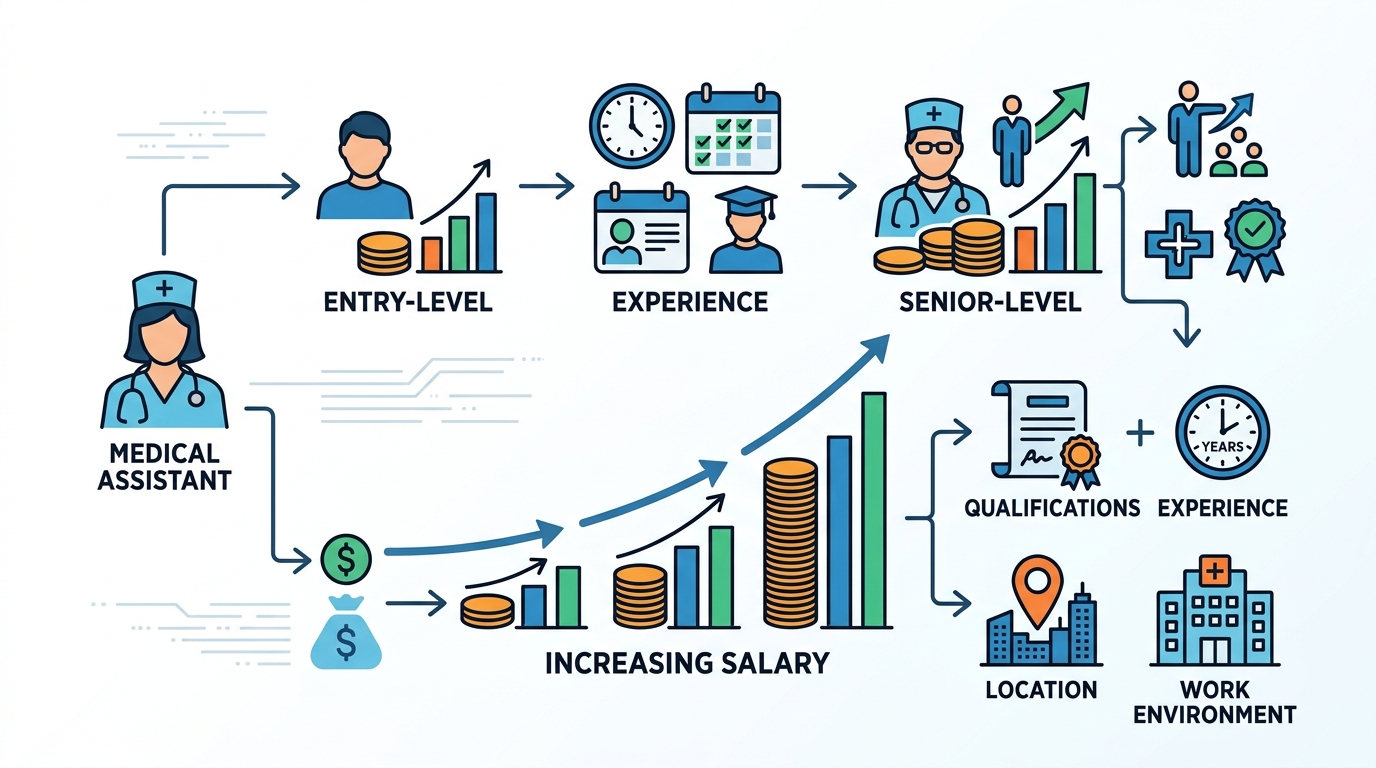
Medical assistants earned a national median annual wage of $42,000 in the U.S. Bureau of Labor Statistics May 2023 Occupational Employment and Wage Statistics release, with the bottom 10 percent under $33,500 a year and the top 10 percent above $56,480. That spread is driven mainly by experience, state and the type of practice employing you.
BLS republishes a median annual and a median hourly wage for this occupation in its 2025 occupational profile, so treat the figures below as the shape of the pay ladder and check the current BLS page for the newest number before you negotiate.
What This Job Pays Right Now
The national median annual wage for medical assistants was $42,000 in the U.S. Bureau of Labor Statistics May 2023 Occupational Employment and Wage Statistics release. Most medical assistant jobs are paid by the hour rather than salaried, and BLS publishes the matching national median hourly wage in its 2025 occupational profile for the occupation — open that page for the current hourly figure before you talk pay with an employer.
The rest of the May 2023 release gives you the full ladder: $33,500 at the 10th percentile, $36,780 at the 25th, $42,000 at the median, $47,220 at the 75th and $56,480 at the 90th (U.S. Bureau of Labor Statistics, May 2023 OEWS). Those five numbers are the most useful thing on this page. Your state, your credential and the setting you land in mostly decide which rung you stand on.
For the direction of travel, BLS publishes an updated median annual and hourly wage in its 2025 occupational profile, along with the bottom-10-percent and top-10-percent annual figures, and the U.S. Department of Labor's ONET OnLine carries a 2024 median snapshot for the same occupation. Put the 2025 BLS median next to the 2024 ONET snapshot and the May 2023 figure of $42,000; the percentage change between those published numbers is the only honest read on whether pay has risen or fallen, and it takes a minute to work out.
One caution on job ads. A posted hourly rate is not comparable to a posted annual salary until you know the scheduled hours. Part-time work at a median hourly rate still lands you near the bottom decile of $33,500 a year rather than the $42,000 median (U.S. Bureau of Labor Statistics, May 2023 OEWS).
Pay by Experience Level
BLS reports wages by percentile rather than by years of experience, so the table maps the published May 2023 OEWS percentile figures onto the bands they usually correspond to. Every figure in the cells is a reported BLS number; the experience labels are the interpretation.
| Experience band | Low (annual) | Median (annual) | High (annual) |
|---|---|---|---|
| Entry-level, 0-2 years | $33,500 | $36,780 | $42,000 |
| Mid-career, 3-9 years | $36,780 | $42,000 | $47,220 |
| Senior or lead, 10+ years | $42,000 | $47,220 | $56,480 |
All figures: U.S. Bureau of Labor Statistics, May 2023 OEWS.
Read across one row and you see the effect of location and setting at a fixed level of experience: an entry-level assistant sits anywhere between $33,500 and $42,000 a year depending on which state and which practice type hires them. Read down the median column and you see the effect of time served, from $36,780 to $42,000 to $47,220.
The move from the 75th percentile of $47,220 to the 90th of $56,480 is not usually a reward for seniority alone. It typically involves a title change to lead medical assistant, clinical coordinator or office supervisor, or a move into a higher-wage state. Stay in the same role, practice and market and the 75th percentile is realistically where the ladder stops.
In your first two years, the fastest route up is not the annual raise. It is finishing an accredited program and sitting a certification exam, both covered below.
Pay by State or Metro Area
Geography is the single biggest reason two medical assistants with identical credentials earn different money. BLS publishes an annual mean wage for this occupation for every state and for hundreds of metro areas in the May 2023 OEWS state and metropolitan tables, and names the top-paying state by annual mean wage in that same release. Use the national median of $42,000 a year (U.S. Bureau of Labor Statistics, May 2023 OEWS) as your benchmark and look each state up directly — the tables are free and updated annually.
| State to check | What to expect against the $42,000 national median |
|---|---|
| Alaska | High-wage, high-cost market; its May 2023 annual mean generally sits above $42,000 |
| California | Large employer base and a statewide wage floor; generally above $42,000 |
| Washington | Hospital and clinic systems around Seattle; generally above $42,000 |
| Massachusetts | Dense academic medical sector; generally above $42,000 |
| Minnesota | Large integrated health systems; typically near or above $42,000 |
| Texas | Very large employment, wide metro-to-rural spread; often near $42,000 |
| Florida | High employment, large outpatient sector; often at or below $42,000 |
| Alabama | Lower statewide wage floor; typically below $42,000 |
| Mississippi | Among the lower-paying state markets; typically below $42,000 |
Two pieces of context. Whichever state tops the May 2023 BLS list by annual mean wage, much of that premium is absorbed by housing: a figure near the 90th percentile of $56,480 goes less far in Anchorage or the San Francisco Bay Area than the number suggests. At the other end, a lower-paying state such as Mississippi is not automatically the worse deal — $36,780 in a low-rent market can leave more at month's end than $47,220 in a coastal metro. Within a single state, the metro-versus-rural gap can be as wide as the gap between states.
Pay by Employer Type or Industry
BLS publishes a separate median annual wage for medical assistants in each main employing industry in its 2025 occupational profile, and an annual mean wage by industry in the May 2023 OEWS release. Check each against the $42,000 national median (U.S. Bureau of Labor Statistics, May 2023 OEWS).
| Employer type | Benchmark | Why this setting pays what it does |
|---|---|---|
| Hospitals (state, local and private) | $42,000 national median (BLS, May 2023 OEWS) | Standardised pay grades, evening and weekend differentials and, in some states, collective bargaining push the top of the band up |
| Outpatient care centers | $42,000 national median (BLS, May 2023 OEWS) | Urgent care and surgical centers run extended hours and need staff for unsocial shifts, usually reflected in the rate |
| Offices of physicians | $42,000 national median (BLS, May 2023 OEWS) | The largest employer of medical assistants; weekday hours and smaller payrolls leave less room for differentials |
| Offices of other health practitioners | $42,000 national median (BLS, May 2023 OEWS) | Chiropractic, podiatry and optometry practices are often small businesses where the rate tracks local market pay |
The practical difference is less about the median than the top of the range. A large hospital system usually has a published pay grade with steps, so a senior assistant can climb from $42,000 toward the 75th percentile of $47,220 or the 90th of $56,480 without changing employer. A two-physician office often has no grade structure, so increases come from asking.
Benefits sit outside the wage figure entirely. Employer-paid health coverage, retirement matching and paid tuition for a certification exam can be worth more than a small difference in base rate, so price them before comparing two offers.
What Actually Moves Your Pay
Each factor below is quantified against the published ladder: $33,500 at the 10th percentile, $36,780 at the 25th, $42,000 at the median, $47,220 at the 75th and $56,480 at the 90th (U.S. Bureau of Labor Statistics, May 2023 OEWS).
- Certification. BLS notes in its 2025 profile that most states do not require medical assistants to be certified but employers often prefer or require it, and that some states do require graduation from an accredited program, licensure or other prerequisites. Employers that require a credential generally hire at or above the $42,000 median rather than at the $36,780 25th percentile.
- An accredited postsecondary program. The typical entry-level education for this occupation is a postsecondary non-degree award (U.S. Bureau of Labor Statistics, 2025). Starting without one usually means starting nearer the 10th percentile of $33,500 than the 25th percentile of $36,780.
- Shift differentials. Evening, overnight and weekend differentials are set as a percentage of base pay by employer policy, and in hospital settings they are what commonly carries an assistant from the $42,000 median toward the 75th percentile of $47,220. Ask for the differential percentage in writing before you accept.
- Specialty and setting. BLS publishes a different median for outpatient care centers, hospitals, offices of physicians and offices of other health practitioners (2025). The whole published spread across settings sits inside the $33,500 to $56,480 ladder, so switching setting is worth real money but will not take you past the reported top decile on its own.
- A lead or coordinator title. The step from the $42,000 median to the $56,480 90th percentile usually comes with a supervisory title — lead medical assistant, clinical coordinator, office manager — rather than from extra years in the same job.
- Employer size and pay structure. Large systems run step scales with scheduled increases; small private offices usually do not. In a graded system you can see the move from the $36,780 25th percentile to the $42,000 median written into the scale before you accept the job.
- Union representation. Where medical assistants are covered by a collective agreement, typically in hospital systems in certain states, the rate and each step increase are in the contract. Ask to see the wage schedule and line it up against the $42,000 median and the $47,220 75th percentile.
- Hours actually scheduled. Part-time work at a median hourly rate still produces a bottom-decile annual figure near $33,500 rather than the full-time median of $42,000, so confirm the weekly hours before comparing offers.
Frequently asked questions
What is the median pay for a medical assistant?
The national median annual wage was $42,000 in the U.S. Bureau of Labor Statistics May 2023 OEWS data. BLS publishes an updated median annual wage and a median hourly wage in its 2025 occupational profile, so check that page for the current figures.
What should I expect to earn in my first medical assistant job?
Most first jobs land between the 10th and 25th percentile — under $33,500 and $36,780 a year respectively (U.S. Bureau of Labor Statistics, May 2023 OEWS). Where you fall in that band depends mainly on your state and whether you completed an accredited program, the typical entry-level credential for this occupation (U.S. Bureau of Labor Statistics, 2025).
How much more do experienced medical assistants make?
The 75th percentile was $47,220 a year and the 90th percentile $56,480, against a median of $42,000 (U.S. Bureau of Labor Statistics, May 2023 OEWS). The $56,480 figure usually belongs to lead or coordinator roles and higher-wage states rather than to staff assistants.
Does certification increase medical assistant pay?
BLS notes in its 2025 profile that most states do not require certification but employers often prefer or require it, while some states require an accredited program, licensure or other prerequisites. In practice, credentialed candidates tend to be hired at or above the $42,000 median rather than near the $36,780 25th percentile (U.S. Bureau of Labor Statistics, May 2023 OEWS).
Which pays more, a hospital or a physician's office?
BLS publishes separate medians for hospitals, outpatient care centers, offices of physicians and offices of other health practitioners in its 2025 profile; compare each against the $42,000 national median (U.S. Bureau of Labor Statistics, May 2023 OEWS). Hospitals usually run graded scales with shift differentials, giving a clearer route from $42,000 toward the $47,220 75th percentile without changing employer.
Sources
- U.S. Bureau of Labor Statistics — Medical Assistants : Occupational Outlook Handbook (2025)
- O*NET OnLine (U.S. Department of Labor) — 31-9092.00 - Medical Assistants (2024)

Written by
Desmond writes about the mechanics of job hunting — resumes, interviews, the strange rituals of being evaluated by strangers. He's drawn to the gap between how hiring is supposed to work and how it actually happens.